The birth of the book in China










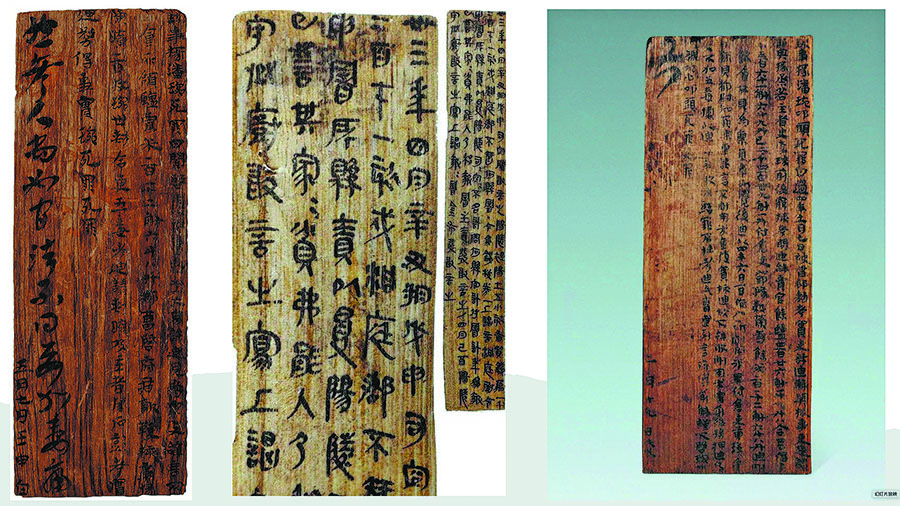
In some of the chapters of the Shi Jing in the collection of Anhui University in Hefei, which are written on 48.5-centimeter-long bamboo strips and were produced during the Warring States Period, the distance between adjacent characters in the vertical manuscripts is fairly wide, which is not conducive to reading.
Scholars speculate that these strips were used in an educational environment. Teachers would place them on the ground or hang them on a wall, so that all of the students could see them in class.
Xu explains that the use of paper gradually replaced bamboo strips and wooden tablets, lowering the cost of reading, adding that the spread of reading may have resulted not only from increasing literacy, but also from the increased demand for standardized texts due to stricter selection procedures being implemented in the entrance exams for officials.
"The whole way of learning and reading changed, and ever since, books have been made for reading, rather than for being displayed or recited," Xu says.
He says that over the past 30 years, the global academic circle of humanities has placed increasing emphasis on the importance of the carriers of reading and writing — the ways ancient people read and wrote; how knowledge was transcribed, copied and circulated; and how reading and writing became a social practice that accelerated the development of civilizations — rather than learning about the past simply by reading ancient documents.
The development of archaeology and the numerous subsequent discoveries have played an important role in this process.
"Archaeology is the foundation of a lot of our work today, so that we not only study new things, but also rethink traditional things that we thought we knew," Kern says.
"We have to take the materials we find seriously in their own right, and for what they are, not for what we want them to be. We should let them speak, and help us ask new questions about tradition, instead of going with our traditional presumptions into the texts. The nature of scholarship is to doubt things, to ask questions, not to prove things."