Shenzhou 19 mission a journey of progress










At precisely 4:27 am Beijing time on Oct 30, China's Shenzhou 19 spacecraft soared into the night sky aboard a Long March 2F rocket. With an efficient autonomous rapid docking system, Shenzhou 19 docked just 6.5 hours later with the Tianhe core module of China's Tiangong space station, settling in at forward port. As Shenzhou 19 docked smoothly, it's hard not to feel a growing sense of pride in the country's space program.
The launches and successful space missions have now become symbols of excellence, and increased people's confidence in China's prowess in the field of science and technology.
This confidence didn't emerge overnight. I still vividly remember standing on the sandy shores of Wenchang in 2021 with my colleagues, hearing the roar of Tianhe's launch, seeing the sky light up, and joining the thousands of voices cheering as the core module ascended. The memories stretch back further to 2003, watching the launch of Shenzhou 5 with bated breath in my dorm at Beihang University, anxious for Yang Liwei's safety. More than 20 years later, China's space achievements have become examples of space exploration.
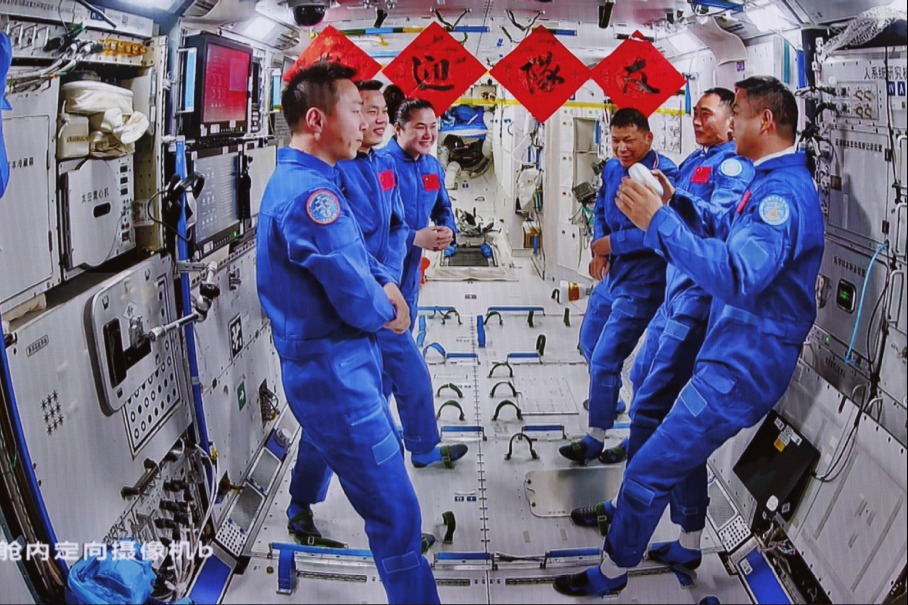
Shenzhou 19 represents the 33rd mission of China's manned space program and the fourth manned mission during the space station's development phase. The new crew comprises both familiar and new faces: Cai Xuzhe, previously on Shenzhou 14, returns as mission commander, while two young astronauts, Song Lingdong and Wang Haoze, both born in the 1990s, make their first journey into space. Incidentally, Wang is only the third female Chinese astronaut, and also a pioneering spaceflight engineer.
China's first female astronaut, Liu Yang, and the first woman to fly twice, Wang Yaping, have left a legacy of inspiration for young women. In the course of my work, I've met students in rural areas, and have heard many girls, inspired by the female astronauts, say that they too want to fly into space. Hopefully, Wang Haoze's flight will inspire a new generation of young women who perhaps believe space is indeed within reach.
Wang Haoze's journey is unique as she joins this mission as an aerospace engineer responsible for the critical upkeep and operation of the spacecraft's equipment. Unlike her bespectacled colleague Gui Haichao, a payload specialist, Wang Haoze manages the technical systems, and is in charge of maintenance and repairs. Before joining the astronaut team, she was a rocket engineer, earning the affectionate nickname "the first Chinese rocket engineer to fly on a (real) rocket".
Life aboard the Tiangong space station is not easy. The Shenzhou 19 team will undertake 86 science and technology experiments, covering everything from trying to grow plants in space to conducting genetics studies. Perhaps most intriguing is the "space farm": Cai may pick up his lettuce-growing project from two years ago, while Song plans to cultivate sweet potatoes, giving the mission a gardening touch.
The mission will also test how fruit flies — a common model in genetic research due to their short lifespan and high genetic similarity to humans — react to microgravity and low magnetic environments. About 75 percent of human disease genes exist in fruit flies, making them ideal for studying the biological impacts of space travel. For instance, how will humans fare on the moon or Mars, where gravity and magnetic forces differ dramatically from Earth's?
In an exciting sneak peek into the future, Shenzhou 19's crew will expose lunar soil bricks to the harsh elements of space. These soil bricks, replicas created from samples returned by the Chang'e 5 and 6 lunar missions, will face space radiation and extreme temperature fluctuations. The ultimate goal? To someday build structures on the moon from locally sourced materials. A "village" built on the moon from lunar soil is an astonishing concept that could soon become reality.
China's preparations for manned lunar exploration are underway. The fourth group of astronaut trainees began their rigorous training in August, with the group including specialists from the Hong Kong and Macao special administrative regions. To make their in-orbit lives more comfortable in the future, the team has even planned Cantonese-style space meals — a touch of home miles above Earth.
Walking on the moon, however, is not simply a matter of visiting the space station. Due to the moon's lower gravity, astronauts must undergo special training for lunar mobility. With just one-sixth of Earth's gravity, even a light step could propel them meters above the lunar surface. China's manned lunar lander, Lanyue (which means "Embracing the Moon"), will play a crucial role in the success of the mission. Redesigned from the Chang'e 5 model, it will support the more challenging tasks of the manned spacecraft's soft landing and lifting off.
On the lunar surface, a distant 380,000 kilometers from Earth, there's no robust launch support system like the one at the Jiuquan Satellite Launch Center in Northwest China, or the on-site backing of tens of thousands of engineers and designers. Lunar astronauts, relying solely on the support of the Lanyue lunar lander, will have to ignite fuel for liftoff from the lunar surface, a challenge which is very difficult to meet.
Of course, all space missions come with risk. Even as we celebrate Shenzhou 19's success, we're reminded of the challenges. Earlier this year, two US astronauts were stranded on the International Space Station due to the malfunctioning of a spacecraft. Every mission includes countless steps, each with potential risks, as shown in the history of manned spaceflight, including dramatic rescues like Apollo 13's safe return.
China's manned space program has a "one launch, one backup" policy, with a backup rocket and spacecraft ready in case of any emergency. Since Shenzhou 12 mission, a second rocket has been kept on standby, ready to launch for a rescue mission if needed.
As Shenzhou 19 embarked on a six-month journey of exploration, let's wish its crew success and safety. With each space mission, China takes another step closer to fulfilling its ambitious goals in space, inspiring us all to look upward — and forward.
The author is vice-president of Aerospace Knowledge Magazine.
The views don't necessarily reflect those of China Daily.
If you have a specific expertise, or would like to share your thought about our stories, then send us your writings at opinion@chinadaily.com.cn, and comment@chinadaily.com.cn.