



UN envoy: AI not privilege of few people
China's ambassador urges equitable access to bridge North-South divide









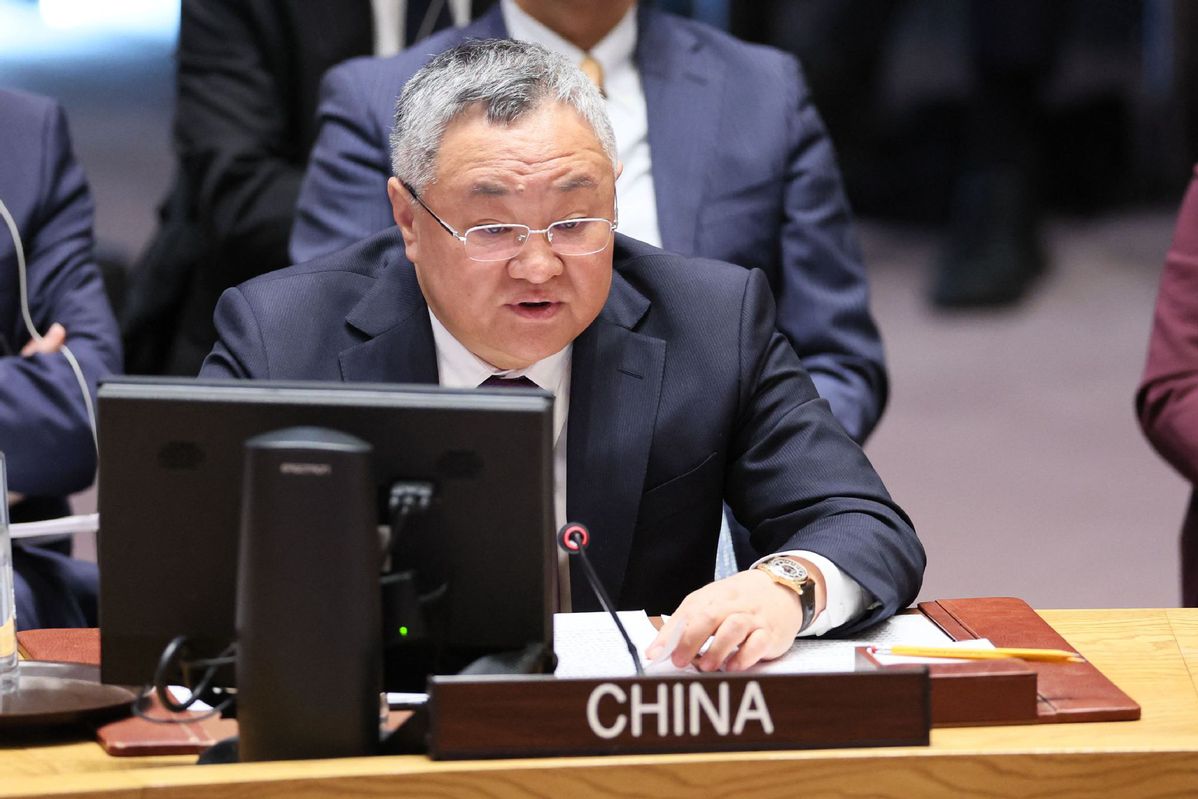
China's ambassador to the United Nations said on Thursday that artificial intelligence technology is not a pie to be divided among a small group of people, nor should its global governance be determined by just a small number of countries.
Fu Cong, China's permanent representative to the UN, told a Security Council briefing on AI that China "firmly opposes discriminatory barriers based on ideological differences".
Such measures undermine the right of all countries, developing countries in particular, to use emerging technologies on an equal footing, Fu said.
"China firmly opposes the practice of imposing on others the rules formulated by a small number of countries or creating small circles targeting certain countries.
"Only by learning from each other, implementing joint governance for good and for all, seeking the greatest common denominator, and expanding cooperation, can we embark on the right path", he said.
The AI divide between the North and the South is widening, he said. "It is important to uphold cooperation, enhance the representation and voice of developing countries, and implement the Global Digital Compact, so that AI technology could benefit the developing countries."
The Global Digital Compact is a framework proposed at the UN to ensure a responsible digital technology use and benefit of all.
Fu said it is imperative to abide by the purposes and principles of the UN Charter, observe the basic norms governing international relations, and ensure that AI technology does not become a tool for waging wars and pursuing hegemony.
Relevant laws, rules and regulations must be in place, he said, adding education and training targeting practitioners must be strengthened.
"Prevention on both the human front and the technological front must go hand in hand to prevent systemic risks brought by hacker attacks or data fraud, among others, and reduce the proliferation risk of AI's military use," he said.
Initiatives introduced
China has recently introduced a series of laws, regulations and initiatives within its domestic framework and the UN framework to address AI governance.
In 2017, China issued the development plan for the new generation of AI, indicating the need to address the double-edged attributes of AI, Fu said. In 2021, China released the code of ethics for the new generation of AI, integrating ethics into the entire life cycle of AI. Last year, the Chinese government issued the world's first legislative document on generative AI.
China proposed Global AI Governance Initiative last year, illustrating its position on AI.
In June, the UN General Assembly adopted a resolution proposed by China and co-sponsored by more than 140 countries on strengthening international cooperation in the capacity-building of AI. Then China proposed the action plan on AI capacity-building for good and for all, and promoted the establishment of the Group of Friends for International Cooperation on AI Capacity-Building at the United Nations.
US Secretary of State Antony Blinken chaired Thursday's meeting, as the United States holds the rotating presidency of the Security Council this month.
Blinken said the US agreed to make the benefits of AI more accessible, in part by closing the digital divide that still exists around the world. That is something the US highlighted in a resolution drafted by China and adopted by the UN in June, he added.
UN Secretary-General Antonio Guterres told the meeting that rapid developments in AI are outpacing humanity's ability to govern it, raising important questions about accountability, equality, safety and human oversight in decision-making.
"The fate of humanity must never be left to the 'black box' of an algorithm," he said, emphasizing the importance of human control over decisions involving the use of force.
"No country should design, develop, deploy or use military applications of AI in armed conflict that violate international humanitarian and human rights laws. That includes relying on AI to select or engage targets autonomously," Guterres said.










