Weather the storm









Latin American countries are expected to come under tremendous pressure from the new US administration to distance themselves from China
Editor's note: The world has undergone many changes and shocks in recent years. Enhanced dialogue between scholars from China and overseas is needed to build mutual understanding on many problems the world faces. For this purpose, the China Watch Institute of China Daily and the National Institute for Global Strategy, Chinese Academy of Social Sciences, jointly present this special column: The Global Strategic Dialogue, in which experts from China and abroad will offer insightful views, analysis and fresh perspectives on long-term strategic issues of global importance.
Since the early 2000s, China's presence has become a key variable in Latin America's economic performance. Due to Chinese demand, the balance of payments crisis in the region has been significantly decreased. In general, South American countries have a surplus with China, enabling economic stability in an area historically marked by successive recessions resulting from imbalances in external accounts.
Latin American countries have joined the Belt and Road Initiative in large numbers. Even Brazil, which has not formally joined the BRI, has many synergies with the initiative's projects. The long-standing infrastructure deficit in the region has been mitigated with several investments made jointly with China in hydroelectric plants, clean energy, ports, highways and telecommunications. In this regard, it is important to note that the Chinese investment pattern has forced rich countries and multilateral institutions to prioritize investments in expanding production capacity, something that was abandoned at the height of neoliberalism in the 1980s and 1990s. At that time, it was believed that the World Bank and regional development banks should only support institutional reform in countries so that the free market could allocate the investments necessary for economic growth. But this did not happen.
In 2021, pressured by the new pattern created by China, US President Joe Biden announced at the G7 summit the creation of the Build Back Better World (B3W) initiative that would supposedly provide an alternative to the BRI for infrastructure development in low- and middle-income countries. After difficulties implementing the Biden administration's domestic plan, the B3W was re-branded as the Partnership for Global Infrastructure and Investment. The initiative sought to bridge the $40 trillion infrastructure-investment gap needed by developing countries by 2035.Neither of these initiatives has materialized.
Another aspect of the relationship between China and Latin America concerns structuring industrial production chains in the region and investments in the agricultural, service and financial sectors. Companies such as COFCO, BYD, GWM, Chery, Huawei, Didi, Bank of China and Alibaba are increasingly present in the local market, helping to improve the economic competitiveness of the countries. In this regard, it is also worth considering the expansion of the use of the renminbi in bilateral transactions and the formation of international reserves.
Unfortunately, the relationship between China and Latin America is viewed with suspicion by the United States. The persistent Cold War mentality in Washington colors every partnership established with China as an existential threat to the security of the US. A bridge in Panama, a space observatory in Argentina, a transmission line in Brazil, or a port in Peru are seen as military assets, not as opportunities to stimulate local development.
In this regard, it is essential to note the first announcements made by president-elect Donald Trump. Containing China appears to be the number one priority of the new government. Trump has already promised to increase tariffs on products imported from China. He has warned that he will impose additional taxes on imports from Mexico and Canada to curb illegal immigration. He is also pressuring Mexico to curb the operations of Chinese enterprises in the country and trying to block local production of electric vehicles by Chinese companies. Another threat concerns the use of alternative currencies to the dollar in international trade with other countries. In this regard, he promised to impose 100 percent tariffs on products exported by the BRICS countries if the group organizes an alternative system to the US dollar or SWIFT.
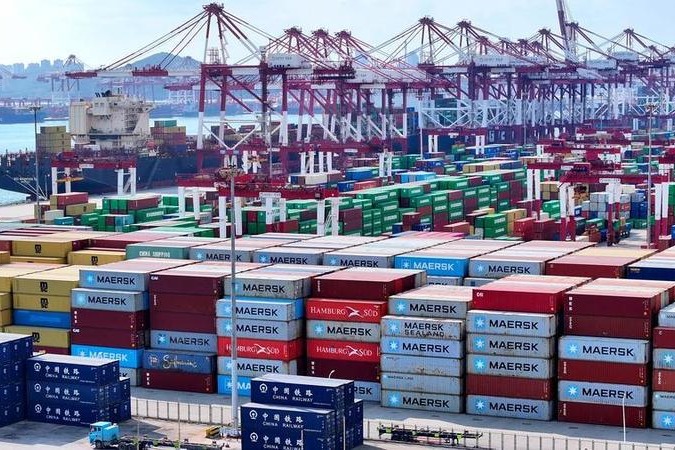
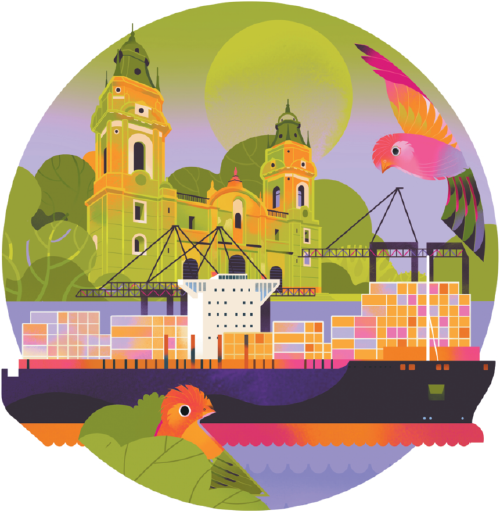
One specific point deserves attention: the imposition of surcharges on imported goods that pass through the new Port of Chancay in Peru, developed by Cosco Shipping Ports Chancay Peru S.A. and inaugurated via video by Peruvian President Dina Boluarte and Chinese President Xi Jinping on Nov 14.Washington sees this deepwater port as a threat. Because of this, Mauricio Claver-Carone, former president of Inter-American Development Bank and now adviser to the Trump transition team, said that the new government should impose 60 percent tariffs on goods that pass through the Peruvian port.
It is interesting to note that the new Trump administration promises to use tariffs to solve all of the country's real or imagined problems, like a charlatan in old movies who sells a panacea that promises to cure all kinds of diseases. However, it is also worth remembering that all medicines have side effects and that the damage can affect the US population, whether due to the increase in inflation, the drop in productivity, or even the creating of new jobs.
In conclusion, Latin America's geographical position, "so far from God and so close to the US", as an old Mexican saying goes, places it at the center of global geopolitical and economic disputes. The leaders of Latin American countries will be under tremendous pressure to distance themselves from partnerships with China. The administrations of Biden and Trump have already made many threats. However, Latin America has learned that third parties cannot define its interests. We can see this perception when Brazil incorporated Huawei into its 5G infrastructure, when the Peruvian government resisted pressure against the construction of Chancay, or when Argentina maintained its renminbi swap agreement to stabilize its international reserves. The Latin American region needs peace and stability to maintain its development path and refuses to relive the worst moments of the Cold War. Therefore, it must pursue its own objectives and understand that China is an essential partner, just like the US.
The author is a professor of international political economy at Sao Paulo State University in Brazil. The author contributed this article to China Watch, a think tank powered by China Daily.The views do not necessarily reflect those of China Daily.
Contact the editor at editor@chinawatch.cn.