Trump's tariff policy sword with double edge









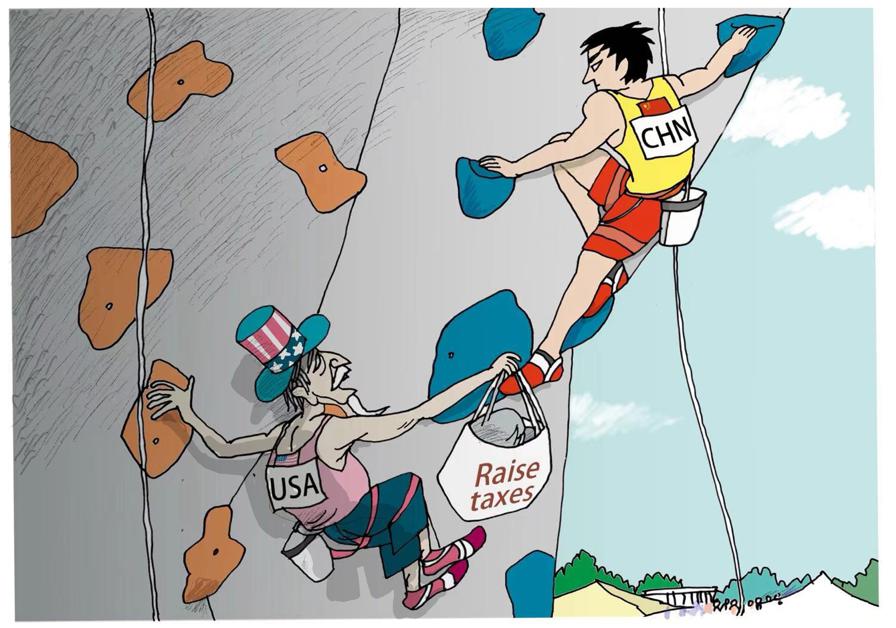
With Donald Trump set to be sworn in as the US president for a second time and given the partisan nature of US politics, many observers have been asking what the new Trump administration's China trade policy will be like.
The US' trade relations with China have always been shaped by the administration's perception of the Sino-US relationship. It was during Trump's previous tenure that the US began to view China as a rival that has both the will and ability to challenge American interests on a global scale, and characterize Sino-US relations as one of strategic competition.
Hence, the long-term trend of the US' economic and trade policies will be to serve Washington's needs of strategic competition against Beijing.
In this context, irrespective of whether Trump, like some of his close aids, is obsessed with anti-China ideology, the incoming US administration's perception of bilateral relations will not change.
A second factor that will shape the US administration's China policy is Trump's sense of history and accountability to voters. While Trump may tend to honor the promises he made during the presidential campaign, as a US president nearing his 80s he may be eager to leave behind a "good" political legacy.
Intensifying the trade war against China on the pretext of reducing the huge trade imbalance between China and the US might serve him well in this regard — the huge trade deficit in the US is what prompted Trump to launch the trade war in 2018 in the first place. Yet the US' trade deficit against China further increased in recent years because of high economic interdependence. In 2023, China's surplus in goods trade was $608 billion, the second-highest in history. To a mercantile businessman-turned politician, such a huge trade deficit is a thorn in the flesh.
As a matter of fact, during his election campaign Trump promised to impose up to 60 percent tariffs on all imports from China after taking office. If he does impose punitive tariffs on Chinese goods, it might help Trump "honor his words" but will in fact deal a blow to the US consumers by exacerbating US inflation.
Given that the Republican Party also won the majority seats in both the Senate and the House of Representatives in November, it won't be a surprise to see Trump use his influence in the Republican Party and Congress to push forward the legislative piece, which is similar to the US Tariff Act of 1930, so as to leave behind his legacy in the field of trade.
A third factor is that US domestic laws provide the needed support or ammunition for the Trump administration to impose new, more drastic trade measures against other countries. In addition to antidumping and countervailing measures that can be easily used against imports from other countries, the Trump administration may also use measures under Section 301 to address so-called unfair trade practices, Section 232 to address self-perceived national security threats and Section 201 to cater to global safeguard needs.
Moreover, it can use the Foreign Investment Risk Review Modernization Act of 2018 to screen foreign investment in the US, and the Export Control Reform Act of 2018 to prevent the export of targeted technology to certain countries. It can also use the CHIPS and Science Act of 2022, Bipartisan Infrastructure Investment and Jobs Act and Inflation Reduction Act to build barriers to deny targeted countries access to advanced technologies and products.
As such, the incoming Trump administration may adopt an even more treacherous trade policy.
However, even US economists have debunked tariff hike justifications as exaggerated, unsubstantiated, and logically flawed. In reality, the tariffs did not succeed in stimulating US manufacturing and, instead, resulted in a net loss of jobs. Relying too heavily on tariffs could lead to elevated living costs and heightened inflationary pressures, ultimately jeopardizing the overall health of the US economy.
The US president-elect should think twice.
The author is the dean of the School of International Law at the China University of Political Science and Law.
The views don't necessarily reflect those of China Daily.
If you have a specific expertise, or would like to share your thought about our stories, then send us your writings at opinion@chinadaily.com.cn, and comment@chinadaily.com.cn.