


Brain-computer interface gains traction in nation










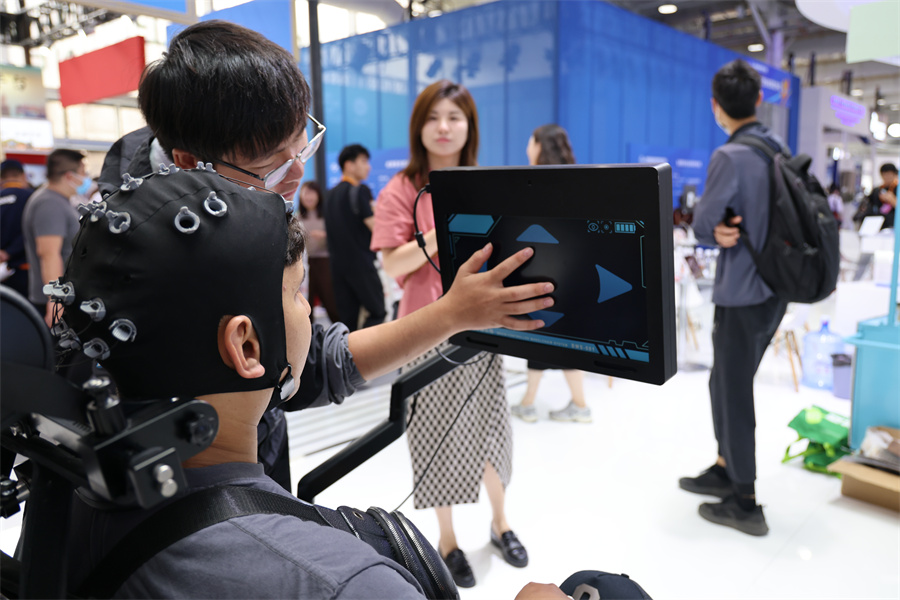
With coordinated national and regional strategies, coupled with intensified efforts for innovation, China is positioning itself as a key player in the field of brain-computer interface (BCI) technology.
The National Medical Products Administration recently announced the drafting of a new industry standard for BCI-enabled medical devices in an effort to ensure the reliability and safety of such devices by setting clear guidelines for data collection, algorithm training and AI applications.
According to the announcement, it will focus on the quality requirements for electroencephalogram datasets, whose accuracy and reliability usually directly impact the performance of AI algorithms. The move is expected to advance the integration of BCI technology and AI within the medical field.
The NMPA's announcement follows recent ambitious BCI development moves by major cities such as Beijing and Shanghai.
At the beginning of this year, Beijing unveiled an action plan for accelerating BCI innovation (2025-30). It aims to cultivate three to five globally influential BCI tech leaders and over 100 specialized small and medium-sized enterprises by 2030. Key focus areas include advanced BCI chips, encoding-decoding algorithms and minimally invasive implantation technologies.
Expanding the application scenarios of BCIs will also be a key focus, including in fields such as healthcare, industrial safety, education, sports and smart lifestyles, the action plan said.
Shanghai responded later with its BCI future industry development plan (2025-30), which aims to achieve high-quality BCI performance by 2030, with BCI products fully implemented in clinical applications.
Yang Yi, executive deputy director of the BCI research center at the China National Clinical Research Center for Neurological Diseases, said the introduction of BCI policies by multiple regions is an inevitable trend, which is also the result of years of accumulated practical experience. With the growing number of policies, the once theoretical BCI technology is expected to transition into practical application at an accelerated pace, Yang said.
At the national level, the early months of last year already signaled a clear emphasis on the cutting-edge sector.
In January 2024, seven government departments, including the Ministry of Industry and Information Technology, designated BCIs as one of the 10 flagship innovative products for "future industries" and specialized policy documents will be developed to address specific needs in the field.
The move was followed in July by the MIIT, which plans to establish a BCI standardization technical committee that will focus on optimizing and refining the standardization roadmap for the high-tech sector.
"Recent years have witnessed a growing level of policy support for the BCI sector. From national to regional policies, there has been a clear evolution in the policy landscape," said Zhou Mingzi, executive director at Frost & Sullivan Greater China.
"National policies generally emphasize macro-level technological breakthroughs and industry-wide strategic planning, whereas local policies are more focused, prioritizing the practical application of specific technologies and the expansion of use cases," Zhou said, adding that this shift marks a transition in the development of BCI technology from the "exploration" phase to the "implementation" stage.
The push for BCI development aligns with projections of rapid market growth. According to market consultancy Precedence Statistics, the global BCI market was valued at $2.35 billion in 2023, and is expected to reach $10.89 billion by 2033, with a compound annual growth rate of 16.55 percent from 2023 to 2033.
As a technology that connects human brain activity with computers and other devices, BCI has been predominantly applied in the healthcare sector in its initial stages, mostly focusing on providing innovative assistance for individuals with motor impairments.
For example, Shanghai-based BCI tech firm NeuroXess recently reported it had accomplished the world's first real-time Chinese language decoding with invasive BCI technology, with the patient achieving a 71 percent decoding accuracy rate for 142 commonly used Chinese syllables just five days after surgery, the company said.
"BCI technology offers a wide range of application scenarios, and whether from the standpoint of scientific exploration or the enhancement of public welfare, healthcare remains the most crucial sector," Yang said.
However, the scope of BCI applications has gradually broadened to include areas such as education, smart homes, virtual reality and gaming. According to a report by China Asset Management, approximately 43 percent of BCIs globally are now utilized for nonmedical purposes.





