



Remarks over Taiwan question spark concerns
Statement by US, Japan slammed for interfering in China's internal affairs









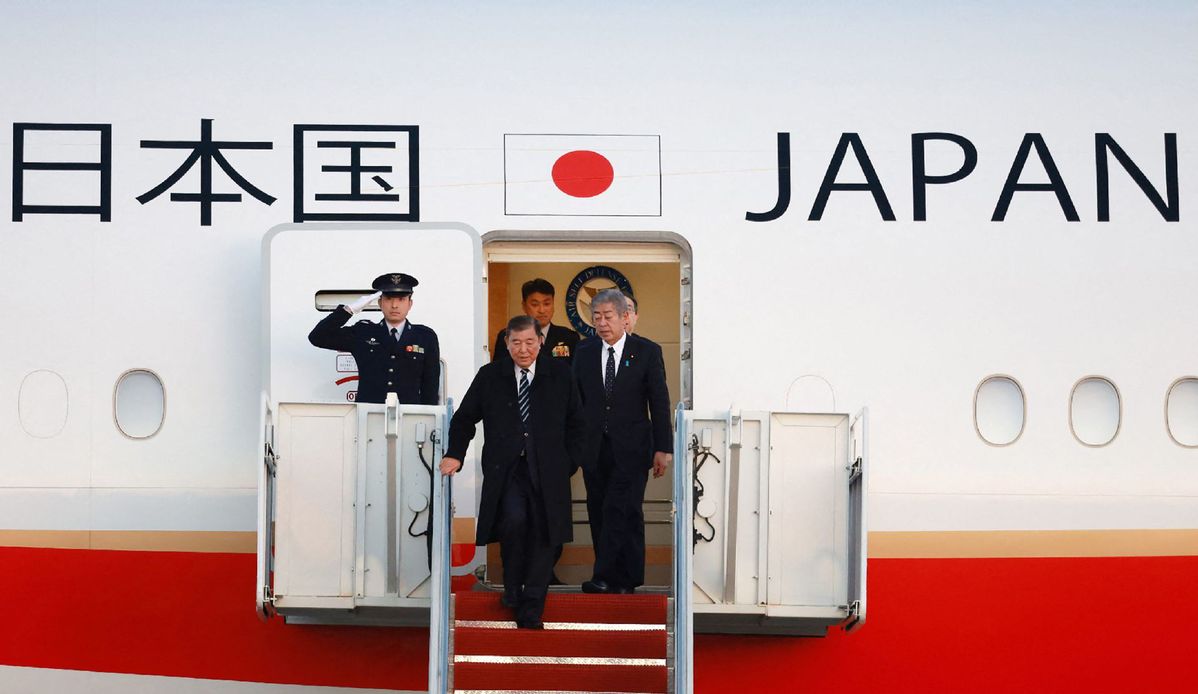
Experts urged Japan to adhere to the one-China principle if it genuinely seeks to maintain the status quo in the Taiwan Strait, rather than interfering in China's internal affairs.
Their remarks came in the context of a joint statement issued by the United States and Japan after Japanese Prime Minister Shigeru Ishiba's meeting with US President Donald Trump at the White House on Friday, which touched on the Taiwan question.
The statement emphasized the two leaders' support for a "peaceful resolution of cross-Strait issues" and their opposition to any attempts to "unilaterally change the status quo by force or coercion." It also voiced backing for Taiwan's "meaningful participation in international organizations".
Takakage Fujita, secretary-general of the Association for Inheriting and Propagating the Murayama Statement, a Japanese civil group, said that in the Japan-China joint communique, the Japanese government explicitly recognized the Government of the People's Republic of China as the sole legal government of China. It also reaffirmed that the People's Republic of China considers Taiwan an inseparable part of its territory.
However, Fujita noted that in recent years, the US has repeatedly provoked China through actions such as record-breaking arms sales to the Taiwan region, visits by high-ranking US officials to the region, and frequent passages of US warships through the Taiwan Strait.
"These actions have raised Chinese concerns about the erosion of the long-standing US one-China policy. Without such provocations, the so-called Taiwan contingency would not have arisen," Fujita said.
He further argued that it is the US government, rather than China, that is attempting to change the status quo across the Taiwan Strait. Fujita also warned the Japanese government against preparing for war by portraying China as a threat.
"China is Japan's largest trading partner. Strengthening Japan-China friendship is one of Japan's most important security measures. Ultimately, the key to peace, stability, and development in Asia lies in the friendship and peaceful coexistence between Japan and China," he said.
Zhu Fenglian, spokeswoman for the Taiwan Affairs Office of the State Council, said at a regular news conference on Wednesday that the Taiwan question is purely China's internal affair and brooks no external interference.
"The so-called US-Japan joint leaders' statement makes unwarranted remarks on the Taiwan question and crudely interferes in China's internal affairs. We firmly oppose this," Zhu said, urging the US to adhere to the one-China principle and the three China-US joint communiques, and to stop sending any wrong signals to "Taiwan independence" separatist forces.
As a country with historical culpability on the Taiwan question, Japan should draw lessons from history, speak and act with caution, abide by the spirit of the four China-Japan political documents, and handle Taiwan-related matters prudently, Zhu said.
She also warned the Democratic Progressive Party administration that any attempt to rely on external forces to split the country is doomed to fail.
Core interests
Highlighting that the Taiwan question is "at the core of China's core interests", Chinese Foreign Ministry spokesman Guo Jiakun told a news conference on Monday that China has lodged serious protests with the US and Japan.
"The Taiwan region's participation in the activities of international organizations must and can only be handled in line with the one-China principle. Taiwan has no basis, reason or right to join international organizations that only sovereign countries join," said Guo.
On the so-called Taiwan contingency, Shigeaki Koga, a policy analyst and a former official at Japan's Ministry of Economy, Trade and Industry, argued that Japan has the power to either trigger or prevent such a scenario.
"Diplomacy would have to be structured on the premise of avoiding war. This means Japan holds considerable influence, and rather than simply following the US, it should consider restraining it," Koga said.
However, he noted that the Japanese government regards the Japan-US alliance as the cornerstone of its national security. In the event of a "Taiwan contingency", refusing to support the US could anger Washington and even risk destabilizing the alliance.
"To maintain the alliance, Japan may feel compelled to deploy its Self-Defense Forces and fight alongside the US, even at significant cost, in the name of protecting its own security," said Koga. "What was originally meant to safeguard Japanese citizens now seems to require Japanese sacrifices to sustain itself. This paradox must be fully recognized, and it is crucial for Japanese citizens to understand that we have the power to prevent such a crisis."
Gui Yongtao, associate dean at the School of International Studies at Peking University, said the joint communique signed by Japan and China in 1972 when they normalized diplomatic relations makes China's national interests absolutely clear: that Japan should adhere to the one-China principle. He emphasized that Japan has upheld the principles outlined in the communique for decades.
Additionally, he pointed out that while the Treaty of Peace and Friendship between China and Japan does not directly address the Taiwan question, it underscores a key principle twice: noninterference in each other's internal affairs.
"The Taiwan question is China's internal affair; it is primarily a political issue, not a security issue. Therefore, any irresponsible comment or move related to the Taiwan question by any country is an interference in China's internal affairs," said Gui.
jiangxueqing@chinadaily.com.cn










