



Winter games ignite passion for sports









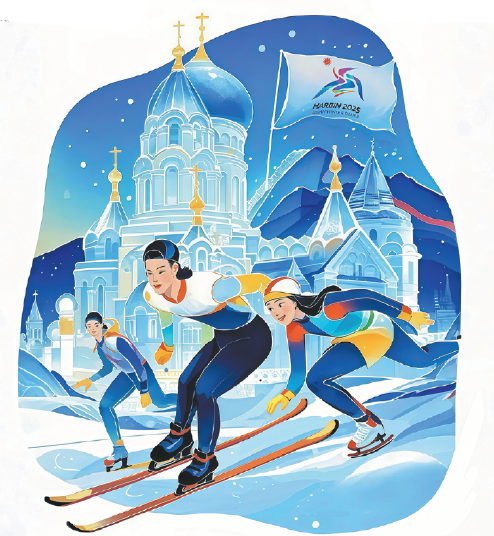
The 9th Asian Winter Games from Feb 7 to 14 in Harbin, Heilongjiang province, is a milestone in the development of winter sports in China and a defining moment in its journey to become a global sports powerhouse. The Harbin Asian Winter Games, from venue construction to event management, and technological innovation to cultural integration, not only showcases China's multifaceted achievements in sports, on and off the field, but also lays a strong foundation for popularizing winter sports.
For example, the Asian Winter Games curling venue is equipped with two independent sound systems: a centralized amplification system and a distributed amplification system, which together have eliminated echoes in the arena.
At the Yabuli Sports Training Base, a 3D digital twin system, using virtual reality, has recreated the competition venues, equipment rooms and device information, enhancing management efficiency. And the "5G+BeiDou" wide-area seamless integrated positioning technology, which combines BeiDou satellite capabilities with 5G communication networks, offers an innovative solution to the problems affecting the flight of drones in zones with weak indoor satellite signals.
Also, China's independently developed lap counting and video replay equipment for short track speed skating meticulously records every detail of the competition, substantially improving the efficiency of the judges. These innovations not only enhance the quality of the competition but also set new benchmarks for sustainable operations in winter sports facilities.
During the opening ceremony, the powerful, sonorous ice-harvesting chant (song performed during ice harvesting in Northeast China, particularly in Harbin) showcased Harbin's rich culture, symbolized by the concept of "first ice" — the first block of ice cut from the Songhua River, signaling the beginning of the New Year and conveying good wishes for the future.
The region's intangible cultural heritages, including paper-cutting, handkerchief dancing, and ice lanterns — cultural symbols rooted in the region's black soil — offer Chinese wisdom and warmth to Asia through vibrant, living traditions. The harmonious fusion of tradition and modernity reflects China's confidence in its approach to winter sports.
A record number (more than 1,200) of athletes from 34 Asian countries and regions have participated in the Harbin winter games, with athletes from Cambodia and Saudi Arabia making their debut, and Thailand and Lebanon sending their largest-ever delegations. In fact, countries with limited or no snow, such as the United Arab Emirates, Vietnam, Indonesia and Thailand, have also sent their teams to the Asian Winter Games.
Saudi Arabia, scheduled to host the 10th Asian Winter Games in 2029, is using this opportunity to gain valuable knowledge about hosting winter sports tournaments. In this context, the China-Saudi Arabia partnership to develop the NEOM special economic zone has expedited the construction of the Trojena Sports City for the 2029 Asian Winter Games, which will mark the event's entry into the Middle East. This open approach marks China's transition from a participant to a leader in the winter sports in Asia.
As Chinese athletes win medals at the Asian Winter Games, their successes catalyze broader public interest in winter sports, highlighting the symbiotic relationship between elite competition and mass participation. The challenge is in sustaining this momentum.
How do we transform competitive enthusiasm into long-term public engagement? How do we democratize advanced technologies used at the winter sports venues for wider community benefit? Addressing these questions is crucial not only for the sustainable growth of winter sports but also for advancing China's aspirations as a sports powerhouse.
The advancement of competitive winter sports and the increasing public participation form a virtuous cycle. Rather than being mutually exclusive, professional and amateur athletes create a complementary ecosystem through resource sharing, technological exchanges and coordinated policy initiatives.
The extraordinary performances of professional athletes on the competitive stage can spark widespread interest in winter sports. When spectators witness high-level skills at regional and international competitions and gain insight into athletes' training regime via social media, this tangible inspiration translates into motivation for ordinary individuals to try winter sports. Professional competitions promote not only excellent performances but also create "promotional windows "for mass participation in winter sports.
Cutting-edge technologies, when appropriately used, can significantly enhance the public's experience of watching or participating in winter sports. For instance, the environmentally friendly materials and technologies used at the Asian Winter Games are expected to play a crucial role in promoting sustainable urban development in the region.
Strategic policy design creates vital links between professional systems and public needs, and facilitates the periodical opening of professional venues to the public while inspiring retired athletes to serve as coaches and trainers.
The key to bringing winter sports from competitive arenas to communities lies in developing a sustainable participation ecosystem.
As winter sports develop, the grand narrative of "winning glory for the nation" widens the scope for mass participation in winter sports to "improve individual health and fitness", advancing China's quest to become a sports powerhouse. To achieve this transformation, however, the government should optimize resource allocation and cultivate talents.
The significance of the Asian Winter Games in Harbin extends far beyond medal tallies; it showcases China's unique approach to the coordinated development of competitive sports and public health. From state-of-the-art venues to community ice rinks, from professional athletes to amateur athletes, all are promoting winter sports and contributing to China's efforts to build a healthy and active society.
The ultimate aim of this comprehensive strategy is to transform the ambitious vision of "300 million people participating in winter sports" into a lived reality.
The author is an associate professor at the College of Marine Culture and Law, Jimei University.
The views don't necessarily reflect those of China Daily.
If you have a specific expertise, or would like to share your thought about our stories, then send us your writings at opinion@chinadaily.com.cn, and comment@chinadaily.com.cn.





