



Indigo: Reviving traditional dyeing for sustainable fashion









You may ask yourself every day, what am I going to wear? Nowadays, environmental protection has become the new fashion. Even if they are ordinary jeans, you should check the carbon labels when buying them.
As a university student concerned with environmental protection, I explored the environmental pollution and energy consumption of the jeans production process from cotton planting and dyeing. I love the blue color of jeans, so I am attracted to eco-friendly craft indigo dyeing. I hope that by focusing on traditional crafts, I can call more people to pay attention to environmental protection and thus bring new business opportunities for eco-friendly craft indigo dyeing from the perspective of the customization economy.
Xunzi, an ancient Chinese philosopher, said that Indigo blue is extracted from the indigo plant but is bluer than the plant it comes from. Chinese people began to collect indigo 3,000 years ago and applied blue dyeing technology to life.
Many regions with developed handcrafts, such as Cangnan in Zhejiang, Nantong in Jiangsu, Tianmen in Hubei, “Biancheng” in Hunan, traditional Hakka areas, Southwest ethnic areas, still retain the traditional craftsmanship and production applications of blue dyeing. There is also a blue-printed cloth museum in Nantong Jiangsu. In the southwest ethnic area, Yao ethnic people love to wear blue indigo clothes named “Lan Dian Yao”.
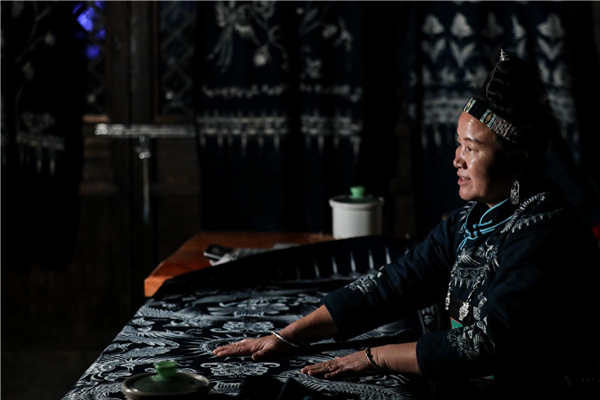
Moreover, the flower zodiac clothes of the Zhuang, the bright cloth of the Buyi, and the batik of the Miao people are all masterpieces of the blue dyeing process. There is a village of Miao in Longlin Guangxi, known as the indigo village, where every family has an indigo pool. There is a fixed process for producing indigo. Every year, during September and October, people cut the leaves and put them into the indigo pool. The indigo leaves are soaked in water for three days, and when the blue color is precipitated, the lime is put into the indigo pool, and the blue color precipitated is collected by the lime at that time. In terms of the blue color, blue with purple is the best. The villagers grow and harvest indigo, make indigo, sell the paste, dye the cloth, and support their families through the production of traditional handicrafts.
From the perspective of the world, the process of indigo and blue dyeing in the third century A.D. spread from China to Japan. Today, Kojima in Japan creates a denim clothing culture and builds a jeans museum from a slow and fashionable perspective. Some brands of commercial hand-woven fabrics and plant-dyed blue dyes customize high-quality jeans for customers. Some merchants even produce only 20 pairs of jeans a year, which exceeds the demand. In the United States, the birthplace of jeans, dye suppliers, and clothing manufacturers have also continued to carry out research and development and practical exploration of indigo cultivation and blue dyeing. Some brands pay attention to corporate social responsibility and constantly increase the proportion of plant dyeing in products.
Universities in China, India, and Australia have also jointly explored and practiced the traditional blue mining process. Many designers, craftsmen, and inheritors who love handmade blue dyeing have also established their brands and studios. They come from Japan, the United States, Indonesia, Thailand, Australia, and Africa. Although they are niche, they still gained relatively good benefits by using the Internet for communication and publicity and customized blue dyeing works.
Whether it is the production of clothing and clothing under the background of carbon peaking and carbon neutrality or people's expectations for slow fashion, I believe that through further scientific research, indigo dyeing handicrafts can make traditional Chinese villages more distinctive and allow villagers to realize the value of themselves, their handicrafts and their villages in rural revitalization.
Ding Weiyi is a student at the Communication University of China.
The views don't necessarily reflect those of China Daily.
If you have a specific expertise, or would like to share your thought about our stories, then send us your writings at opinion@chinadaily.com.cn, and comment@chinadaily.com.cn.





