



LA port braces for disruptions amid new fees, tariffs









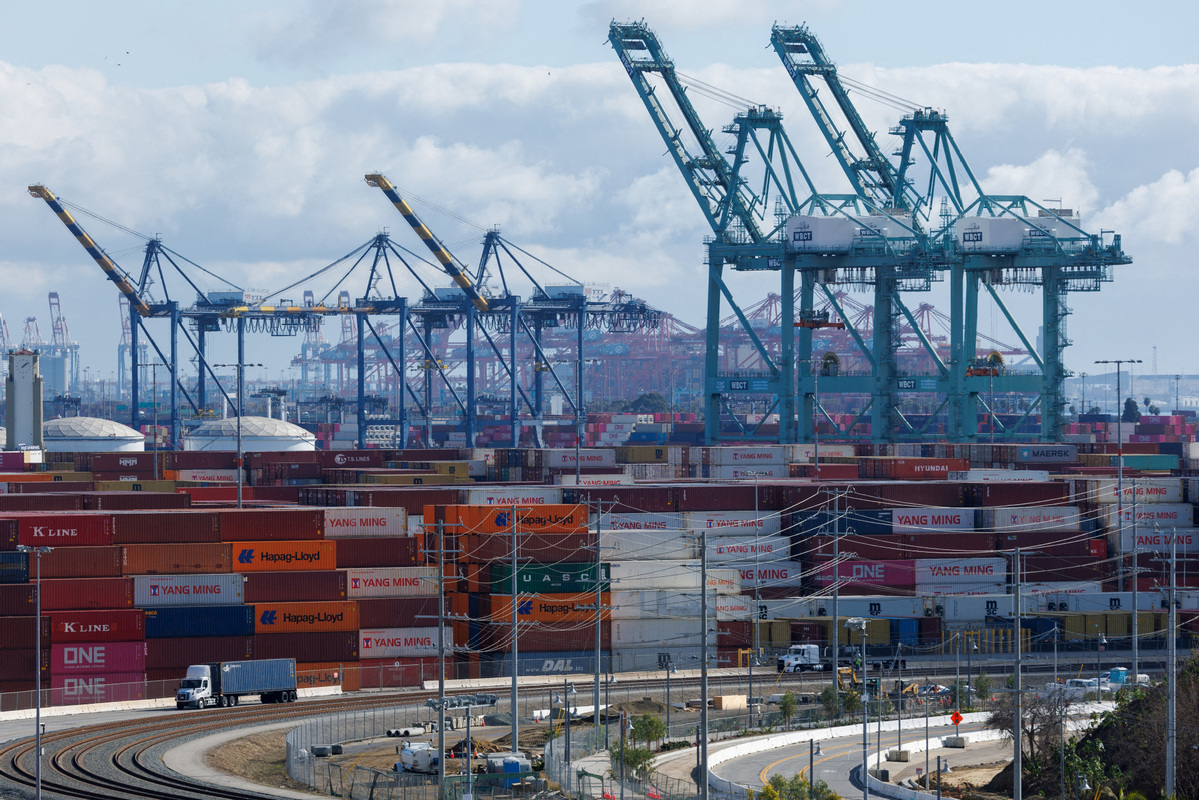
The executive director of the Port of Los Angeles has expressed concern that imposing fees on Chinese shipping companies and vessels in that enter US ports — on the heels of new tariffs — could have economic repercussions.
A proposal announced Friday by the US Office of the Trade Representative would require the vessels to pay millions of dollars in new fees each time they dock at a US port, a cost that is likely to be passed down to American importers and exporters through higher freight rates.
Gene Seroka, executive director of the Port of Los Angeles, noted that the new fees and tariffs could create significant disruptions for businesses and workers who rely on international trade.
"We are hearing concerns from retailers, manufacturers, exporters, shippers, and consumers alike," he told China Daily. "Right now, there is a lot of confusion and uncertainty.
"While there is merit in fair, rules-based trade and strategic tariffs on specific items, widespread tariffs and counter-tariffs will adversely impact the American economy," he said.
US President Donald Trump, through an executive order, issued an additional 10 percent tariff on all imports from China, which took effect on Feb 4.
"Tariffs have been front of mind across the supply chain industry and for American consumers alike. Importers have been front-loading as a hedge against tariffs for months," Seroka said. "January was our busiest start to the year ever in part due to tariff front-loading. Longer term, however, we will likely see cargo volume begin to decline."
Seroka stressed the importance of engaging policymakers to ensure stability in trade relations.
"Our plan is to knock on every door in Washington, building relationships and emphasizing the value of the work that goes on in and around the nation's busiest container port each day," he added. "This port complex is tied to nearly a million jobs in the LA region and 2.7 million jobs in the US. We don't want to see any of those jobs disappear because of tariffs."
The Port of Los Angeles recorded the busiest January in its 117-year history, processing 924,245 20-foot equivalent units (TEUs) — an 8 percent increase over last year.
"This January milestone adds to a great run of strong volume, with the last seven months averaging more than 927,000 container units," Seroka said at a recent media briefing. "A strong economy, along with importers bringing in cargo as a hedge against tariffs and ahead of Lunar New Year, were key factors."
"We've had about seven consecutive months of peak season volume, much of that in anticipation of what tariffs could mean, and could I leverage my price down before they hit," Seroka said in an interview with CNBC.
The effects of the tariffs are particularly being felt in the transpacific trade, where the majority of cargo arrives from Asia, with China being a key partner. Seroka said that the tariffs would impact a wide range of consumer goods.
"Coming from China — furniture, toys, electronics, household appliances — the gamut," Seroka said.
Seroka also said that companies are having to adjust.
"The impact of tariffs on negotiations between procurement executives and manufacturers in Asia is ongoing. Many companies are facing pressure to offer discounts or relocate production," he noted.
"If I'm getting pushback to lower prices, whether I'm a parts supplier or selling directly to the American public, do I have to take a little hit myself? This is a key discussion happening across the industry today," Seroka said.
The increased demand for imports has led to lower warehouse vacancies and full trains to the Midwest. Some analysts suggest that this anticipation of tariffs is contributing to inflationary pressures, reflected in rising consumer prices.
While the new tariffs create short-term disruptions, Ye Chun, president of the China General Chamber of Commerce Los Angeles, said that the underlying economic principles of global trade will ultimately drive tariffs back to a reasonable level.
"The current tariff dispute between China and the US should be seen as a temporary issue," Ye told China Daily, noting the determining factor in the trend of globalization and deglobalization is the economic laws governing industrial supply chains.
He emphasized that post-industrial economies like the US face high manufacturing costs and inefficiencies, making large-scale domestic production difficult to sustain.
"Developed countries like the US are not suited for large-scale reindustrialization. The economic principles of international division of labor will eventually restore trade relations," Ye said.
Ye also noted that the Trump administration's tariffs initially disrupted US-China trade, causing supply chain shifts and raising import costs. However, he predicted that over time, economic pressures will push trade relations back to normal.
"As product prices rise and domestic reindustrialization efforts face challenges, trade will eventually return to a more balanced trajectory, aligning with the economic logic of international cooperation," he said.
Chinese businesses have been adapting since the initial wave of tariffs under the Trump administration, implementing strategies such as tax management, exchange rate adjustments, cost transfers and productivity improvements.
"I believe that after a brief period of difficulty, tariffs may actually become an external factor that stimulates further growth in China's manufacturing sector," Ye added.
Xie Jianhua, president of the US-China E-commerce Trade Association, emphasized the structural complementarity between China, home to seven of the world's top 10 ports, and the US, the largest consumer market.
"Decoupling and breaking links do not align with market rules," Xie told China Daily, citing the projected $690 billion bilateral trade volume in 2024.
Xie also stressed the need for US-China collaboration in emerging industries like green shipping and smart logistics.
China holds 62 percent of global electric ship-battery patents, and the US excels in marine electronic systems.
"Only cooperation can accelerate the industry's low-carbon transition," he said.
renali@chinadailyusa.com










