Xinjiang has an ancient chapter in China's history









Xinjiang was known as Xiyu, or the Western Regions, in ancient China. Following its unification during the reign of Emperor Qianlong (1735-96) of the Qing Dynasty (1644-1911), the Western Regions were renamed Xinjiang, meaning "newly stabilized region". In the 10th year of Emperor Guangxu's reign (1884), Xinjiang was officially turned into a province and named "Xinjiang province" to signify its "return to the homeland".

Even before the Qin Dynasty (before 221 BC), the Western Regions had close ties with the Central Plains. Many archaeological discoveries have shown that Xinjiang bore the imprint of Chinese civilization from its earliest days, with ancient trade routes between the Western Regions and the Central Plains facilitating the exchange of cereals, jade, silk, painted pottery and other goods.
The county governance system originated during the Spring and Autumn and Warring States periods.
After unifying China in 221 BC, the first Chinese emperor, Qin Shi Huang, implemented a system of counties and prefectures nationwide. This move significantly bolstered the central government's authority in guiding local administrations. The Western Han Dynasty (206 BC-AD 24) later advanced and further solidified this system.
In 60 BC, the Han court established the Western Regions Frontier Command, adopting the "ruling according to local customs" governance policy. While the status of the states in the Western Regions was maintained, their leaders and officials were granted permission to use the seals and ribbons of the central government. This means their status was akin to vassal states of the Central Plains. During the Tang Dynasty (618-907), the county governance system had become more widespread in the Western Regions.
In the Yuan Dynasty (1271-1368), the system of administrative provinces was adopted for the first time in the Western Regions, which was a breakthrough in the central government's governance in the region.
From the Han Dynasty (206 BC-220 AD) to the Qing Dynasty, the central government continuously refined its administrative system in Xinjiang, gradually implementing the county system. This progress paved the way for Xinjiang to harmonize its administrative structure with that of the inland regions.
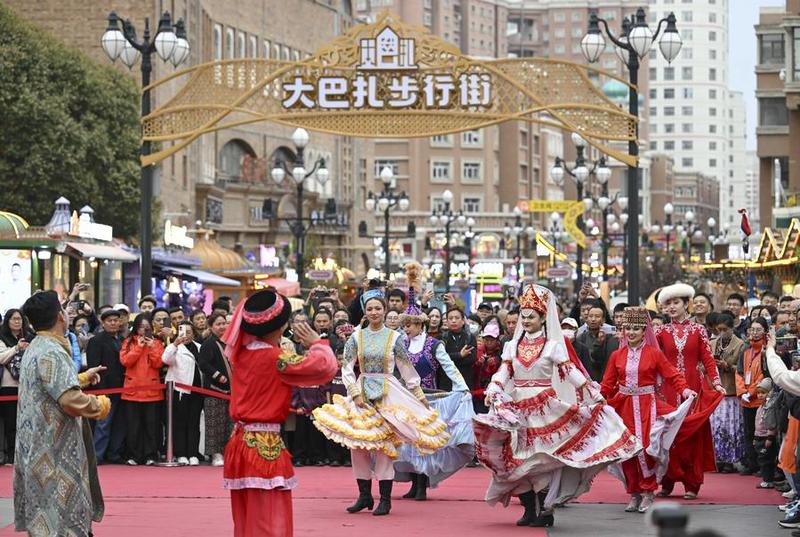
The concept of a unified multi-ethnic country started taking root among the members of all ethnic groups in Xinjiang in ancient times, with the region becoming a place where multiple ethnic groups, diverse cultures and different religions thrived.
Throughout history, the people of all ethnic groups in Xinjiang have welcomed national unity. Their local leaders' loyalty to the emperors reflected their political allegiance to the central government, facilitating the effective governance of the Western Regions by successive dynasties.
Moreover, the ancient Silk Road positioned Xinjiang at the forefront of cultural and commercial exchanges between Eastern and Western civilizations, promoting economic prosperity and intermingling of cultures, religions and technologies.
History shows Xinjiang's fate has always been part of the Chinese nation, and the region's development reflects the evolution of a unified multi-ethnic country and the growth of the Chinese nation. People of all ethnic groups in Xinjiang have contributed to the unity of the nation, and helped write China's glorious history.
The development of Xinjiang is a microcosm of the broader development of China as a unified multi-ethnic country.
The author is a professor of the School of History at Xinjiang University and a deputy to the 14th National People's Congress. The views don't necessarily reflect those of China Daily.
If you have a specific expertise, or would like to share your thought about our stories, then send us your writings at opinion@chinadaily.com.cn, and comment@chinadaily.com.cn.