US 'reciprocal tariff' is an old habit that dies hard









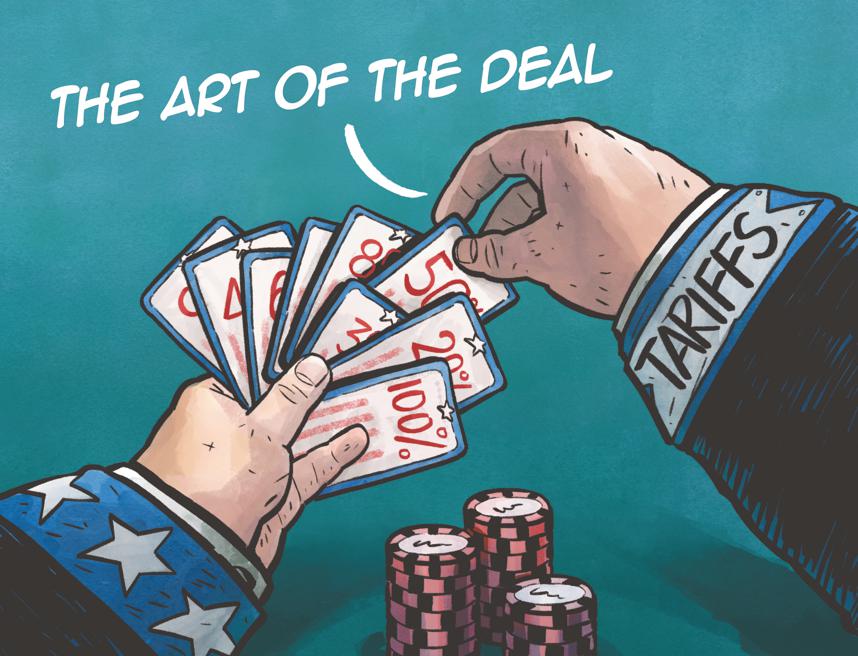
Once again, the US Administration imposed sweeping tariffs on the world — even targeting some poor penguins. Many around the world were stunned, with some US allies protesting, "This is no way to treat friends."
Yet America's habit of imposing tariffs is nothing new. Over a century ago, the United States had its own "Tariff Man," who not only levied tariffs but also pursued policies that have parallels with those seen today.
A tariff-obsessed president
William McKinley, the 25th President of the United States, is a controversial figure in American history. During his presidency, the US experienced "The Gilded Age," an era marked by rapid industrial growth as well as significant social inequalities. He campaigned with the slogan "Prosperity at Home, Prestige Abroad" and declared himself "Tariff Man".
As a congressman, he was a staunch advocate of tariff. The McKinley Tariff Act of 1890, named after him, raised average US tariffs from 38 percent to 49.5 percent. Later, as president, he signed the Dingley Tariff Act in 1897, pushing rates to 52 percent under the guise of "protecting American workers and products".
Industrial capitalists adored him. Under tariffs, foreign goods became uncompetitive, allowing some US industrial giants to monopolize domestic markets. Protected by a 70 percent tariff, American tinplate production expanded rapidly, capturing over 60 percent of the domestic market by 1895.
But workers and farmers despised him. Tariffs inflated living costs, pushing US consumer prices 35 percent higher than Europe's. Retaliatory tariffs crushed agricultural exports, slashing farmers' incomes. Between 1897 and 1904, the labor movement saw a stunning 17,000 strikes involving four million workers.
The old playbook
For quite a long time, McKinley was a forgotten president, until the current US administration began to hype up his presidency for its own purposes.
Today's US administration openly shows admiration for McKinley. It restored the name "Mount McKinley" to "dutifully recognize his historic legacy of protecting America's interests and generating enormous wealth for all Americans."
The administration's slogan — "The Golden Age of America" — reminds people of "The Gilded Age." After announcing "reciprocal tariffs," the administration even claimed high tariffs "could have prevented the Great Depression".
The mimicry extends beyond tariffs. McKinley launched the Spanish-American War, seized colonies like Cuba and the Philippines, threatened Hawaii with tariffs, and pushed for a Latin American canal. The new administration, meanwhile, vows to "not rule out military force to take Greenland," threatens an annexation of Canada, and demands control of the Panama Canal.
In McKinley's time, the US government was relatively small, with federal spending accounting for less than three percent of GDP. His administration relied on the alliance with industrial capitalists. Today's administration, through the Department of Government Efficiency (DOGE), plans to slash US$2 trillion in federal spending while aiming to build alliances with tech capitalists, mirroring McKinley's approach.
Learning the right lesson
Clearly, the US is replaying its 19th-century playbook, hoping to solve modern crises with outdated strategies. But the world — and America itself — has changed. Repeating past errors won't secure the future. It only leads to more problems.
If history is any guide, tariffs are never the foundation of prosperity, but threats to prosperity. What McKinley's 19th-century "boom" actually relied on was technology, capital, and labor growth — not tariffs.
History also offers a stark lesson: the Smoot-Hawley Tariff Act of 1930 slapped tariffs on more than 2,000 products, raising average rates to 60 percent. The result? US trade plummeted 67 percent, and global trade collapsed by 66 percent in just four years.
The damage of the Smoot-Hawley Tariff Act of 1930 was so severe that 50 years later, Ronald Reagan provided a cautionary tale: "There are those in the Congress, just as there were back in the 1930s, who want to go for the quick political advantage, who risk America's prosperity for the sake of a short-term appeal to some special interest group".
He succinctly pointed out the logic and impact of tariffs: They might seem appealing initially, but they ultimately lead to economic devastation.
The new administration believes that tariffs that "nurtured" 19th-century industry can also bring about 21st-century manufacturing "reshoring." But we should remember one thing: tariffs in the 1890s were aimed at bolstering the rising industries and companies in the US, not attracting manufacturing from other countries or creating new industrial chains from zero.
US today
Today, US manufacturing is in a totally different position compared to 100 years ago. It is hollowed out: skilled workers are scarce, infrastructure is crumbling, and supply chains are broken. Decades of financialization have overvalued the dollar, making US production costs uncompetitive.
Without cost advantages or reliable infrastructure, tariffs for "reshoring" would only yield two outcomes: slow,expensive production and no market — domestic or global.
US Commerce Secretary Luttnick claimed "An army of millions will build iPhones in the US". If the US attempts to do so, it can surely be achieved. But if the costs of producing an iPhone were to double or rise even higher as a result, who would be willing to buy it? And while consumers might skip an iPhone, they can't skip expensive food or other daily essentials made in the US, as the tariffs choke off cheap imports.
The world has moved on since McKinley's time. In the 19th century, America could thrive as an isolated industrial power. Today's global economy is interconnected. By dismantling the global trading system which was built by the Americans but deemed "unfair" by some Americans, the US risks global isolation, losing moral authority, and ultimately, dollar hegemony.
As International Chamber of Commerce Secretary General John Denton noted, "only 13 percent of global trade issues from the US". The world would suffer without America, but America alone is not in a position to disrupt the global trade order and threaten the whole world.
If the US truly seeks a "Golden Age," it must choose wisely: cling to the outdated history and repeat past failures, or confront its own flaws, solve real problems, and stop blaming others.
The author is a commentator on international affairs. The views are the author's own and do not necessarily reflect those of their affiliation or China Daily.
If you have a specific expertise, or would like to share your thought about our stories, then send us your writings at opinion@chinadaily.com.cn, and comment@chinadaily.com.cn.