



Countries benefiting from collaborative research









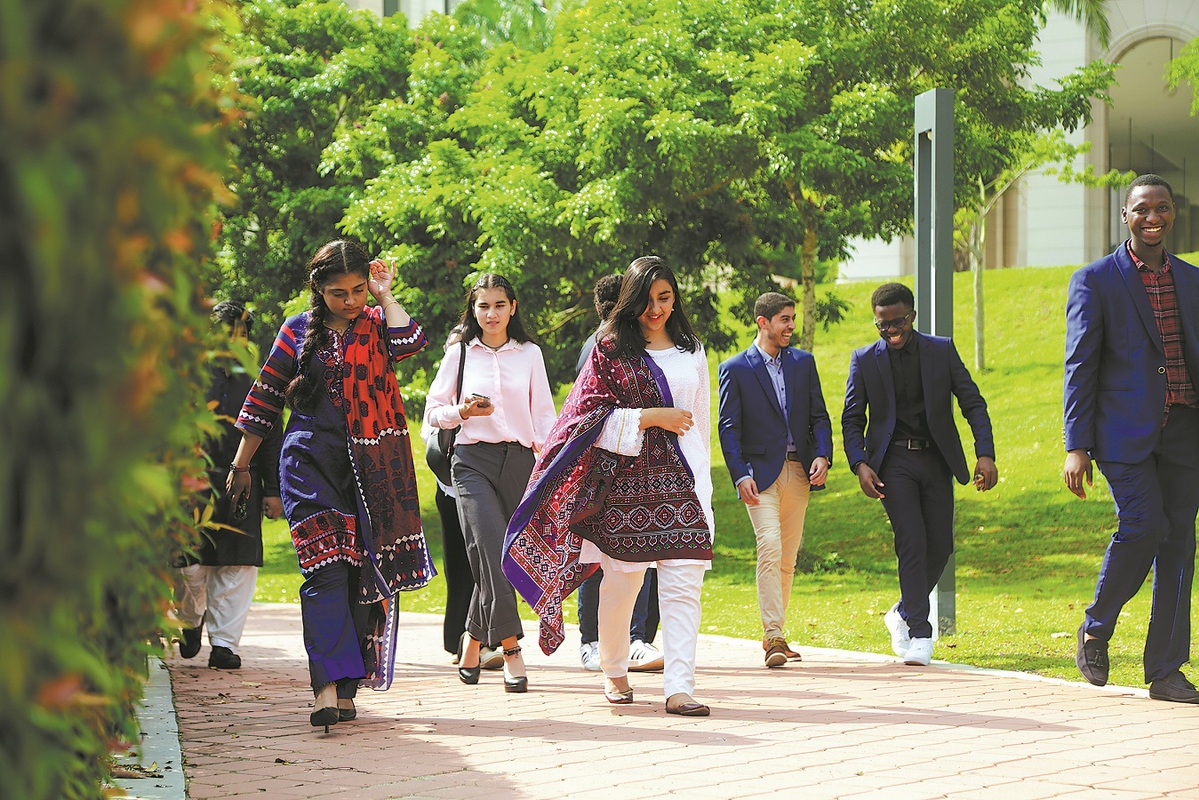
Growing China-Malaysia exchanges have opened up fresh avenues for collaborative research, cultivating young professionals who are not only steeped in Chinese culture, but are also savvy about Southeast Asia's development.
"There's a notable uptick in education and research cooperation between the two countries," said Wang Ruifang, president of Xiamen University Malaysia, or XMUM. An increasing number of Malaysian students and scholars are pursuing studies and research in China, and more Chinese university representatives have visited Malaysia to seek partnerships, he said.
XMUM is the first overseas campus established by a Chinese education institution that is included in the Double First-Class Initiative — a government program with selected universities to enhance the country's higher education capabilities.
Ong Wee Jun, a Malaysian professor and assistant dean of the university's School of Energy and Chemical Engineering, has firsthand experience with the research exchanges. As a foreign expert, he has been deeply involved in a clean energy project funded by the National Natural Science Foundation of China.
The project has gained global recognition, with findings published this year in Advanced Functional Materials, one of the Nature-indexed journals, the professor said.
After completing a four-year program in new energy science and engineering at Ong's school, Malaysian graduate Loong Mun Wah joined the Malaysian branch of technology giant Huawei as a technical service engineer last year. He believes he was recruited by Huawei, which is based in Shenzhen, Guangdong province, due to his understanding of both China and Malaysia.
Han Lei, a professor at XMUM's China-ASEAN College of Marine Sciences, has also been active in cross-border research. Established in 2016, the college marks China's first foray into expanding its marine education abroad to nurture marine talent for Southeast Asia.
He had worked with experts from Universiti Malaysia Terengganu and a local marine research institute on a four-year project investigating the phenomenon of upwelling — a process in which deep, cold water rises to the surface of the sea — along the east coast of the Malay Peninsula.
Han said the project employed a numerical model tailored for Malaysia's east coast — a tool previously unavailable in the country — and provided scientific references for assessing local fishery resources and strengthening marine ecosystem conservation.
XMUM now has more than 9,000 students from 48 countries and regions, including nearly 5,000 Malaysian students and some 2,500 from China. Indonesia is the next largest source of students, contributing over 600.
University President Wang said perfect timing contributed to the creation of the campus, as China's economy was taking off and bilateral relations were deepening. The Malaysian government saw the need for such an institution to cultivate talent familiar with China. Its founding also coincided with the launch of China's global connectivity push — the Belt and Road Initiative — in 2013, creating demand for the country to enrich its talent pool with a deep understanding of the BRI participants, including Malaysia and other Southeast Asian nations.
Wang said the most sought-after program among local students is international business, which could prepare them for future business dealings with China. Traditional Chinese Medicine is also a very popular major, with more than 400 students having enrolled in the course, a figure exceeding that of its counterpart at the main campus in China.
Besides the growing interest among young Malaysians in understanding China, the Southeast Asian nation is fast emerging as a favored option for Chinese students seeking education abroad, thanks to its stable social environment, its use of English as the medium of instruction and the competitive costs, Wang said.
According to Education Malaysia Global Services, China is the largest source of international students in Malaysia. Last year, more than 33,000 of non-local students in the country were from China — an almost 25 percent increase year-on-year.


- Miao communities celebrate Lantern Festival with fireworks
- Mainland vows safety for Taiwan compatriots amid Middle East tensions, criticizes DPP’s political manipulation
- Zhengding Folk Art Performance draws 30 troupes for Lantern Festival
- China advances in quantum technology, sets global records with new innovations: national political adviser
- Adrian Cheng: HK needs to build platforms for international and local talent exchange
- Mainland offers to resume cross-Strait dialogue if DPP acknowledges 1992 Consensus





