Flexible policies bode well for driverless vehicles









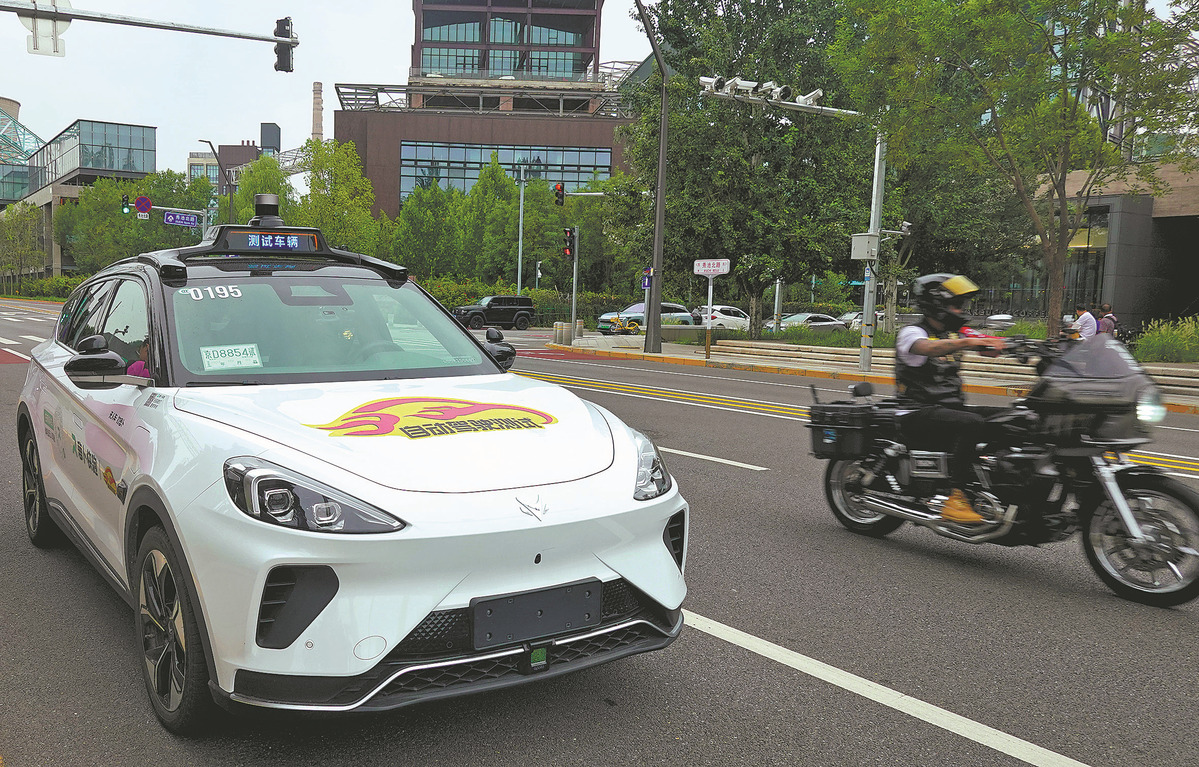
Last year, after I completed an interview in Yizhuang, a southern suburb of Beijing, I hailed a robotaxi by using a ride-hailing app on my mobile phone.
All I had to input was the pickup and drop-off points and the number of passengers.
A few minutes later, a self-driving taxi approached, with no driver or safety operator sitting in. The fully driverless vehicle ran smoothly with no shaking or sudden braking.
It could identify stop signs and traffic lights; the vehicle automatically slowed down and finally came to a halt.
As traffic lights changed from red to green, the taxi proceeded through the intersection. Whenever there was a traffic jam, the car automatically switched to the most convenient path.
I think a driverless vehicle is very convenient and safe and that there is no difference between it and cars with human drivers.
This was not the first time that I had experienced self-driving vehicles.
About four years ago, I took a robotaxi with a safety operator sitting behind the steering wheel to monitor the vehicle and take manual control in case of an emergency.
Driverless vehicles have developed very fast in recent years and become a reality in China, although their operations are still limited to some designated areas of Beijing; Shanghai; Chongqing; Wuhan, Hubei province; and Shenzhen and Guangzhou, Guangdong province.
According to a report by Pacific Securities, the market scale of robotaxis in China is expected to exceed 1.18 trillion yuan ($161.3 billion) in 2025 and 2.93 trillion yuan in 2030, making it one of the largest application scenarios for autonomous driving technology.
The nation has taken the lead in the research and development as well as application of autonomous driving technology around the world and it is the first country to allow fully driverless paid robotaxi operations.
Local government support is critical for promoting the commercial operation of self-driving vehicles.
Currently, over 50 cities nationwide have released autonomous driving pilot demonstration policies and stepped up efforts to expand the application scenarios of self-driving technology, laying a solid foundation for the future operation of driverless vehicles.
Beijing launched China's first pilot area for commercial autonomous driving vehicle services. Chinese tech giant Baidu and self-driving startup Pony.ai were the first enterprises granted permission to offer paid services.
In December 2024, the city approved new regulations for autonomous vehicles. The regulations, which took effect on April 1, encourage and support policies and measures for technological innovation and industrial development of autonomous vehicles.
Autonomous driving vehicles, particularly robotaxis, are poised to revolutionize transportation by significantly improving driving safety, said Robin Li, co-founder and CEO of Baidu at the World Governments Summit 2025 in Dubai, the United Arab Emirates, in February.
"We have proven that robotaxis are much safer than human drivers. As of today, they are at least 10 times safer," Li said. "If you look at our operational record, our insurance claims rate is only one-fourteenth that of regular taxis or a regular driver's car."
The Beijing-based company has invested heavily in developing self-driving technology. Apollo Go, its robotaxi service, is currently operational across 11 cities nationwide.
Continuous testing and operation on public roads, easing regulations as well as cost reductions in autonomous vehicle manufacturing will help accelerate the deployment and commercialization of self-driving cars, said Lyu Jinghong, an intelligent mobility analyst at research firm BloombergNEF.
According to the BloombergNEF's Electric Vehicle Outlook, China will operate the world's largest robotaxi fleet with about 12 million self-driving vehicles by 2040, followed by the United States with around 7 million such vehicles.
Meanwhile, experts emphasized that ensuring the safety and stability of robotaxis should be a top priority, and more efforts are required to enhance self-driving testing and application scenarios, continuously optimize algorithms, reduce manufacturing costs of driverless vehicle components, and strengthen the construction of intelligent transportation infrastructure.