


Clay dragon heads, glass beads help connect dots in history









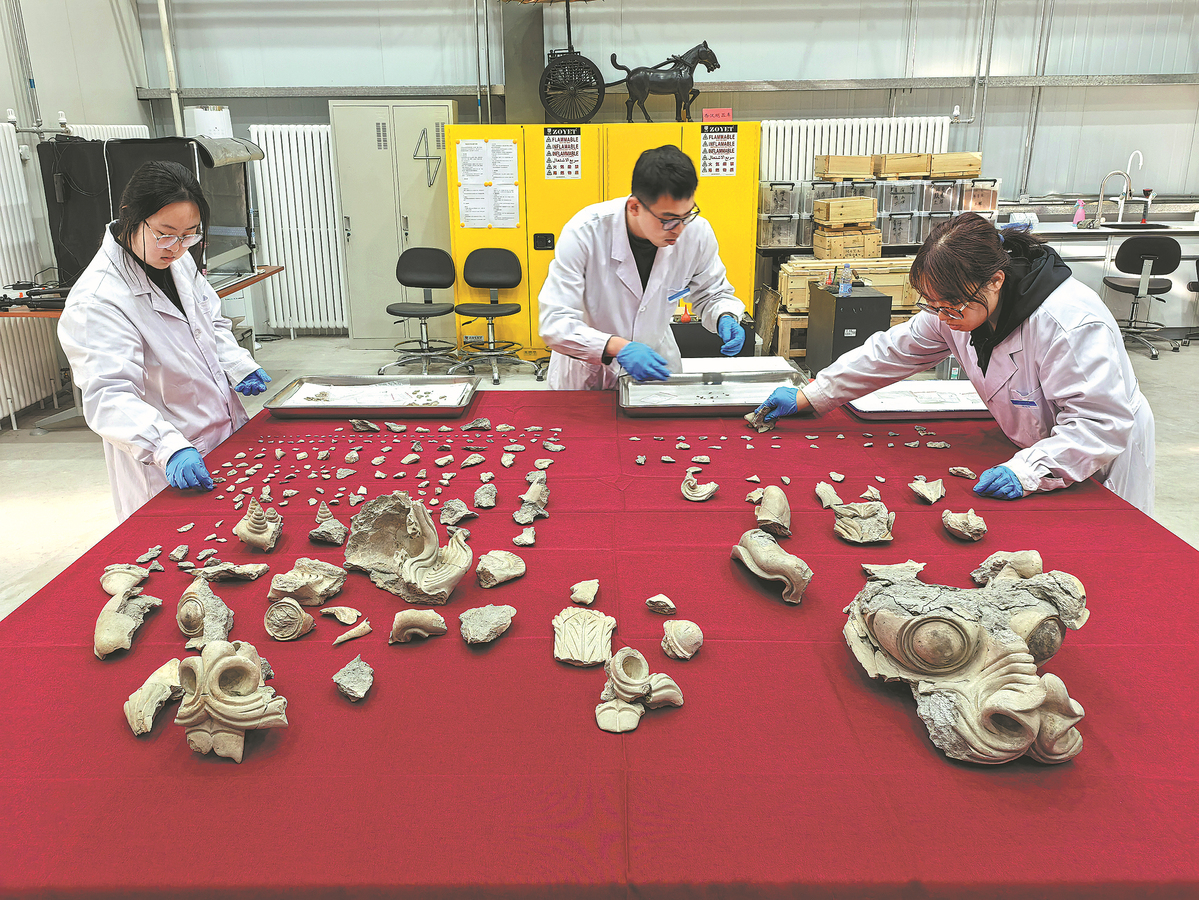
The Chinese Academy of Social Sciences announced on Tuesday that restoration has been completed of two precious pottery dragon heads unearthed from the Xiong'an New Area in Hebei province.
The restoration work was carried out by the academy's Key Laboratory of Archaeological Sciences and Cultural Heritage.
Pieces of the rare clay dragon heads, which are believed to have been used in Tang Dynasty (618-907) architecture, were found in October amid the ruins of an ancient city in Xiong'an.
Similar artifacts have been occasionally unearthed nationwide, but this was the first time pottery dragon heads were found in "relatively complete shape", according to CASS.
Computerized tomography, micro X-ray fluorescence spectroscopy, 3D laser scanning and virtual assembly techniques were used for detailed analysis of the Xiong'an pottery samples to ensure proper restoration of the dragon heads.
"These dragon heads add a new dimension to the image of dragons in ancient China," said Liu Yong, an assistant researcher at CASS, who led the restoration work. "They offer fresh archaeological evidence regarding the evolution of the dragon's image."
Liu added that the findings further emphasize the long historical and cultural lineage in Xiong'an, and bear testimony to the ancient and modern glory of the area.
On Tuesday, CASS announced six more project achievements of its Key Laboratory of Archaeological Sciences and Cultural Heritage, which was launched as a national-level research hub in November.
The lab, which has 18 subdivisions, focuses on various fields including radiocarbon dating, ancient DNA analysis, bioarchaeology, textile conservation, and ceramics and glass archaeology.
It also operates five interdisciplinary centers that cover key academic issues such as studies concerning the origins of Chinese civilization, regions related to the Belt and Road Initiative, and the shared community of the Chinese nation.
Liu Nian, an assistant researcher at the CASS lab, is leading a research on the spread of natron glass in China roughly between 1000 and 200 BC, focusing on beads unearthed at several sites in the Xinjiang Uygur autonomous region.
Cultural exchanges
The spread of the glass production technique from the Middle East to China was long considered a key indicator of East-West cultural exchanges. However, the specific routes remained vague in previous studies.
Natron glass is known to have first appeared in Egypt. Analysis of the samples found in Xinjiang suggested that they originated in the sea sands of the Levant region along the eastern shores of the Mediterranean, according to Liu Nian.
This means natron glass made its way to Xinjiang about four centuries before Han Dynasty (206 BC-AD 220) envoy Zhang Qian made his historic journey westward and launched the East-West communication network now known as the Silk Road.
Further comparative studies involving glass beads from the Warring States Period (475-221 BC) tombs in Gansu province have revealed that similar artifacts were introduced in the plains of Central China via the Hexi Corridor. China had started developing its own glass-making techniques by then.
"The evolution of glass-making reflects the dynamic nature of early technological interactions between Asia and Europe, as well as the inclusiveness and innovation of Chinese civilization," Liu Nian said.
She added that their research highlights Xinjiang's pivotal role in exchanges among various civilizations and deepens people's understanding of cultural communication before the Silk Road.
There is also solid evidence of the influence of Chinese civilization in wider regions.
At the Munchaktepa archaeological site in Uzbekistan, researchers from CASS set up a mobile lab for the better conservation of unearthed relics, including a Han Dynasty coin.
As Munchaktepa is believed to have been the capital of Dayuan, a state with the influence of Greek culture, the coin stands out as a crucial witness to East-West communication.
"The project not only provides evidence of cultural exchanges along the Silk Road, but also demonstrates our excavation technology and ideas of cultural heritage conservation to our counterparts," said Han Huarui, an assistant researcher at CASS who is a team member of the Munchaktepa project. "Every excavation abroad is, thus, a new start of cross-civilization dialogue."
Gao Xiang, president of CASS, noted that the establishment of the lab has been "a strategic pivot in the engine of innovation", and vowed to further enhance international archaeological cooperation.