Moody's downgrade reflects US debt woes









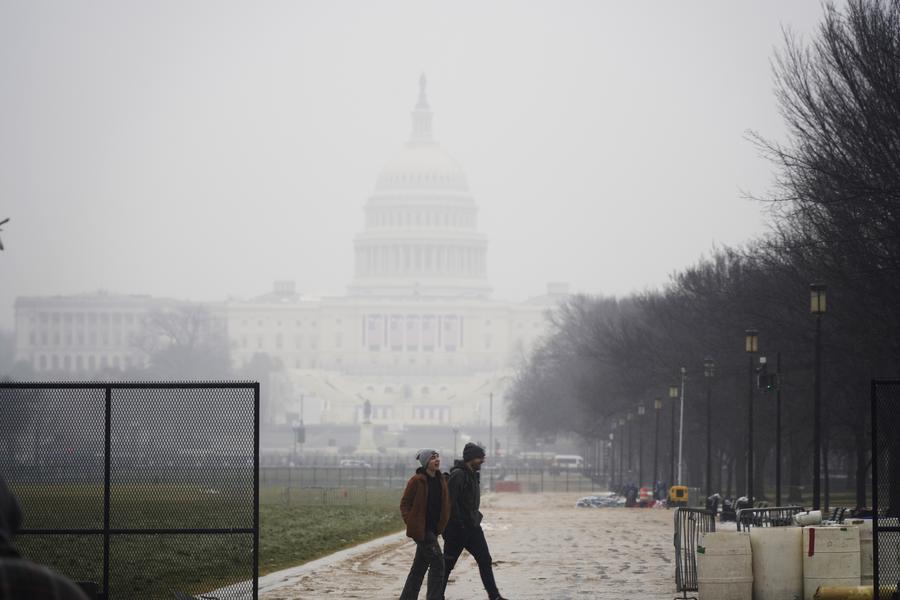
Moody's recent downgrade of the United States' sovereign credit rating from the top-notch Aaa to Aa1 — the first time in more than 100 years — over concerns about the nation's growing debt underscores an unsustainable debt-driven growth model, experts said, as they warned of economic pressure and the risk of a potential debt crisis.
The sovereign credit rating is a measure of a government's ability to repay its debts.
Moody's cited "the increase over more than a decade in government debt and interest payment ratios to levels that are significantly higher than similarly rated sovereigns", as the reason behind the downgrade in a statement.
The two other major credit rating agencies, Fitch Ratings and S&P, lowered their ratings for the US in 2023 and 2011, respectively.
"The underlying cause of the growing debt lies in high, rigid government spending, especially on military and defense," said Wang Zhen, a research professor of international politics at the Shanghai Academy of Social Sciences' Institute of International Relations.
US federal spending reached $6.8 trillion in the 2024 fiscal, with defense accounting for $860 billion, or 12.6 percent of the total, and the federal deficit hit $1.8 trillion, according to the Congressional Budget Office.
On May 22, the US House of Representatives passed a sweeping tax and spending bill, extending corporate and individual tax cuts passed in 2017. The Congressional Budget Office estimates that the bill would add $3.8 trillion to the deficit in the next decade, further straining fiscal sustainability.
"These expansionary measures, aimed at stimulating consumption and investment, increase borrowing needs at a time high-interest costs are already burdening the economy," Wang said.
"Relatively weak economic performance fails to rapidly increase revenue and instead requires more expansionary fiscal policies to stimulate the economy," Wang added. "On top of that, huge interest payments on debt add to the financial burden."
In 2024, the US government for the first time spent more than $1 trillion on interest payments for its national debt.
"The debt burden, exacerbated by post-2008 stimulus measures, reflects an unsustainable reliance on borrowing," said Chen Zheng, a lecturer on US politics at Beijing Foreign Studies University and a researcher at the Beijing-based think tank Taihe Institute.
"In fact, it has never truly recovered since the subprime mortgage crisis in 2008," Chen said.
Moody's had warned in 2023 that the US triple-A rating was at risk due to a wider fiscal deficit and higher interest payments.
"The US relies heavily on high levels of borrowing, often using short-term debt to pay off old debt — constantly spending future money to cover present needs.
"Every administration recognizes this driven-by-debt growth model as problematic but cannot break away," she said.
The US has more than $36 trillion in national debt — the amount of outstanding borrowing by the US federal government — which equals more than 120 percent of its annual economic output.
The US Federal Reserve's key interest rate, maintained at between 4.25 and 4.5 percent to combat inflation, has kept borrowing costs high.
"Moody's downgrade signals that the debt situation requires urgent action," Chen added. "Debt will remain a long-term issue until a systemic crisis eventually breaks out."
In another development, the US administration on Friday threatened to impose 50 percent tariffs on select imports from the European Union but on Sunday announced a delay until July 9. This marks the latest move in a series of tariff actions by Washington, which has already imposed a universal 10 percent tariff on its trade partners.
"The tariffs do little to reduce the US fiscal deficit," Wang from the Shanghai Academy of Social Sciences said. "The revenue from tariffs is not enough to offset the massive deficit. Instead, it will push up domestic prices, reduce consumer spending and ultimately hurt US economic growth."
Meanwhile, the US consumer sentiment fell in May for the fifth straight month, to the second-lowest level on record, as concerns grew over the fallout of the tariffs, the University of Michigan announced in mid-May.
"The chaos caused by the US administration's aggressive tariff measures further undermined confidence and dampened expectations for economic growth," Wang added.
shaoxinying@chinadaily.com.cn