



The era of chain connectivity: Strategic significance of the ASEAN-China-GCC trilateral mechanism









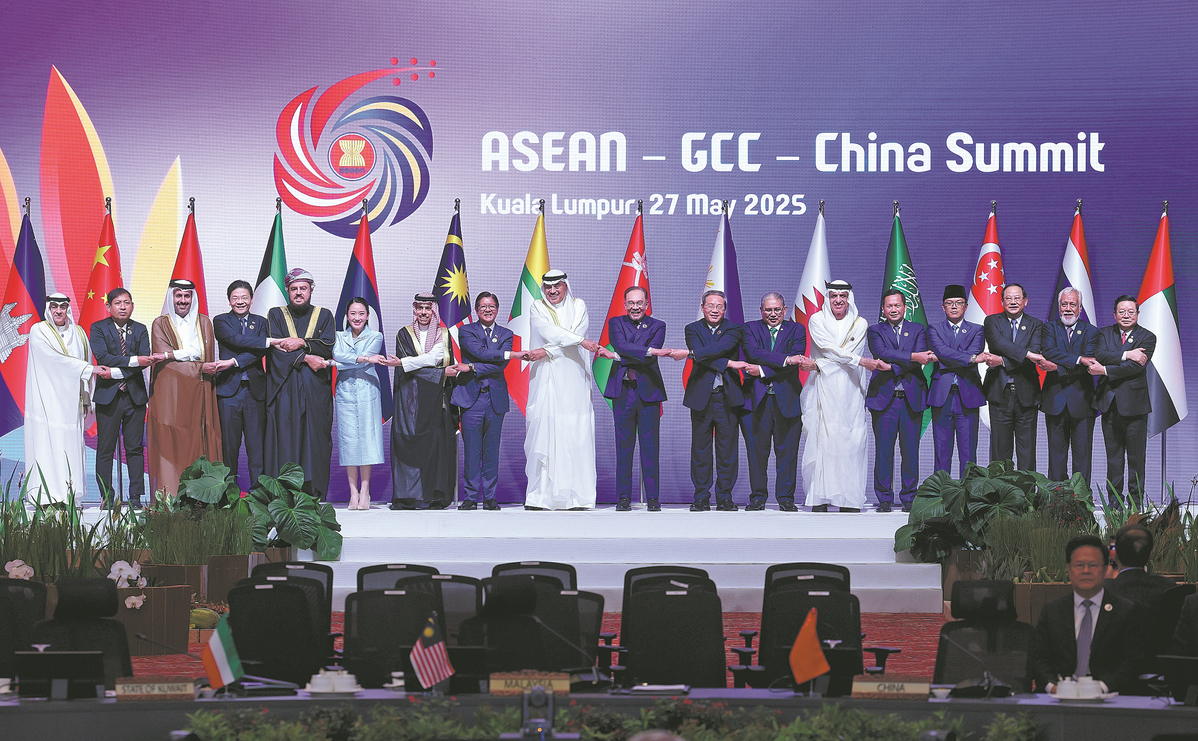
On May 27, 2025, the first ASEAN-China-Gulf Cooperation Council (GCC) Summit convened in Kuala Lumpur, Malaysia. In a joint statement, the three parties underscored economic complementarity and strategic coordination, pledging to align cross-regional development strategies, strengthen regional value chains, and promote the liberalization and facilitation of trade and investment. Within this evolving diplomatic context, the concept of chain connectivity has emerged as a key framework for understanding China's current approach to Belt and Road Initiative (BRI) cooperation.
Institutionalizing trilateral cooperation
The ASEAN-China-GCC summit built on three established bilateral frameworks: China–ASEAN, China–GCC and ASEAN–GCC. Institutional momentum has grown steadily, with the China–GCC Strategic Dialogue Action Plan (2023–2027) and the ASEAN–GCC Framework of Cooperation (2024–2028) laying the groundwork for trilateral coordination.
At the summit, Chinese Premier Li Qiang proposed positioning the trilateral mechanism as a model of cross-regional openness, cross-stage development cooperation and inter-civilization integration. He called for strategic alignment and macroeconomic coordination through a multi-sectoral approach. Malaysian Prime Minister Anwar Ibrahim characterized the initiative as a new chapter in ASEAN's external engagement, while Vietnamese Prime Minister Pham Minh Chinh and the Amir of the State of Kuwait, Mishal Al-Ahmad Al-Sabah stressed the urgency of supply chain integration and crisis resilience. This convergence of perspectives reflects a growing consensus on the mechanism's strategic trajectory.
Chain connectivity: Structural extension of the Belt and Road Initiative
While the early years of the BRI emphasized physical infrastructure (hard connectivity), regulatory alignment (soft connectivity), and cultural exchanges (people-to-people connectivity), the present phase calls for deeper structural linkages — specifically across value chains, supply chains, industrial chains and innovation chains. Chain connectivity does not replace prior modes of integration but extends them in response to shifting geopolitical conditions and the reconfiguration of global production.
The Beijing Initiative for the Connectivity of Industrial and Supply Chains, launched at the second China International Supply Chain Expo (CISCE), called for a system defined by stability, efficiency, inclusiveness and mutual benefit.
As Ren Hongbin, Chairman of the China Council for the Promotion of International Trade, emphasized, international economic cooperation is fundamentally shaped by division of labor and comparative advantage. These principles now underpin the evolving framework of chain connectivity.
In the ASEAN-China-GCC context, this agenda is moving from rhetorical vision to policy implementation. The Joint Statement issued at the summit outlines commitments to strengthening supply chain resilience, facilitating trade and investment, and safeguarding access to critical materials essential for energy transition. By incorporating these priorities into the structure of trilateral cooperation, China is shaping a new model of Belt and Road engagement that seeks to address global fragmentation through institutional and structural coordination.
The chain connectivity framework reflects a broader logic of co-construction, strategic alignment and rules-based cooperation. It brings together the development agendas of Southeast Asia, the Middle East and China not as a response to exclusion, but as a deliberate strategy to reinforce the foundations of global economic governance. Amid resurgent protectionism and growing uncertainty in the international trading system, this trilateral platform provides institutional support for policy coordination and capacity building, while enabling emerging economies to strengthen their autonomy over development pathways.
From strategic vision to institutional architecture
For chain connectivity to be realized, complementarity in industrial structure must be accompanied by systemic coordination in finance, logistics and innovation.
First, financial integration provides institutional scaffolding. During the summit, China's Cross-Border Interbank Payment System (CIPS) signed a memorandum of understanding with the Central Bank of the UAE to jointly explore interlinked payment systems.
This initiative aims to enable local currency settlement for businesses across the Middle East and North Africa. By late 2024, nearly 100 ASEAN-based banks had been integrated into the CIPS network, either directly or indirectly, helping to normalize the use of renminbi in regional transactions.
Second, logistics corridors are essential to maintaining continuity and scale. The Joint Statement emphasized the joint development of logistics corridors and digital platforms to support high-quality Belt and Road cooperation and enhance seamless regional connectivity. The "Silk Road Maritime" network, launched in 2018, has since expanded to connect with the China–Europe Railway Express and other multimodal systems. In 2024, the first maritime–rail corridor linking GCC countries was inaugurated, further opening China's southeastern transport gateway. That same year, the China–Laos Railway moved over 19 million tons of freight, with integrated operations reducing transit time between Southeast Asia and Europe.
Third, the trilateral mechanism is seeking long-term alignment in emerging industries. In the context of global climate change and green growth, cooperation is deepening in fields such as renewable energy, sustainable fuels and digital infrastructure. Ongoing dialogues around standard-setting and knowledge exchange suggest that chain connectivity is evolving into a platform for co-developing future industries across regions.
By grounding chain connectivity in concrete institutional arrangements, the ASEAN-China-GCC partnership provides a framework for fostering resilient globalization. Instead of retreating into fragmented regional spheres, it advances an integrated model of South–South cooperation based not on dependency, but on reciprocity and shared strategic interests. As existing global rules face growing contestation, the emergence of this trilateral mechanism reflects a broader shift—from passive adaptation to fragmentation toward the active construction of more inclusive and durable alternatives.
Shao Zhicheng is a Ph.D. candidate at the Institute of Area Studies, Peking University. Zhai Kun is a professor at the School of International Studies, Peking University. The views don't necessarily reflect those of China Daily.
If you have a specific expertise, or would like to share your thought about our stories, then send us your writings at opinion@chinadaily.com.cn, and comment@chinadaily.com.cn.





