



US trade deficit inevitable result of its policies









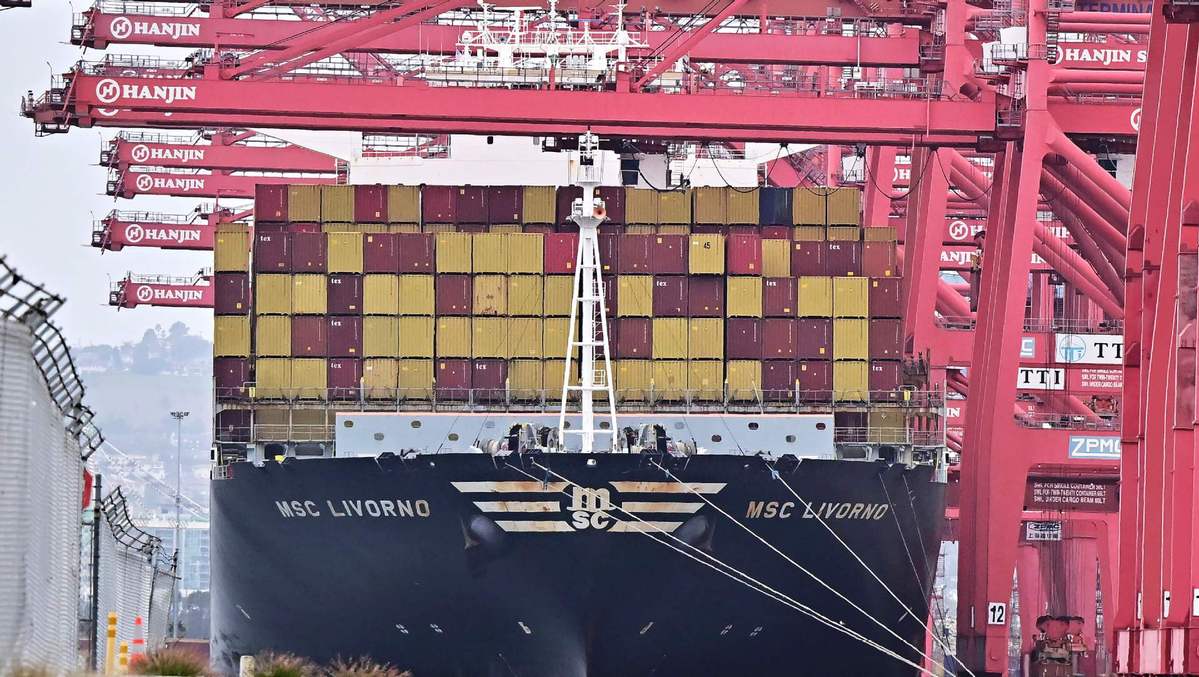
The Chinese delegation at the World Trade Organization initiated a special agenda item, criticizing the United States for its misleading narrative and the flawed logic of the so-called reciprocal tariffs, during the second annual meeting of the WTO Council for Trade in Services in Geneva on Friday.
The US maintains the world's largest surplus in trade in services. In 2024, the country had a trade surplus of nearly $300 billion in services such as finance and technology, but the White House selectively ignored it and excluded these high value-added industries from its tariff calculations.
In fact, in terms of goods trade alone, the US government has imposed export controls on high-tech products. The US' trade deficit is thus a result of its own policies, and also reflects its global economic status and the privilege of the US dollar as the world's primary trading currency. The US' exclusive coinage rights over the dollar enable it to obtain more cheap foreign goods by releasing liquidity.
So the US can obtain financing, at a much lower cost, which serves to promote its economic growth, and the dividends it reaps from around the world are transformed into the US' consumption and investment capacity.
That reinforces the US' ability to provide liquid assets on a large scale to the world, which means there is a steady flow of capital into the country, allowing US people to consume beyond the country's production capacity. So the US actually benefits tremendously from its goods trade deficit, which is a "privilege" exclusively owned by the country that can continually borrow without having to repay all of it. So using the "reciprocal tariffs" to resolve the US' "trade deficit" not only contradicts the facts but also violates the principles of economics and international trade rules.
That explains why the Chinese delegation's remarks during the WTO event prompted active echoing from the delegates of the European Union, Australia, Canada, Brazil and Pakistan. These countries called on all parties to uphold the spirit of consultation and cooperation, exercise restraint on trade restrictions, ensure the stability and predictability of regulatory policies, and jointly promote the healthy and stable development of global trade.
These economies see clearly the absurd logic of "reciprocal tariffs": that higher taxes should be levied to address the deficit. By that analogy, can economies with a deficit in their trade in services with the US also impose "reciprocal tariffs" on the country?
Raising tariff rates will not effectively increase the US' fiscal revenue or reduce its trade deficit. In fiscal year 2024, the total federal tax revenue was $4.92 trillion, of which personal income tax was $2.43 trillion. Senior Counselor to the President for Trade and Manufacturing Peter Navarro claimed that the US could collect an additional $600 billion in import taxes each year by implementing "reciprocal tariffs", which would be enough to support a significant reduction in personal income tax.
However, as tax rates continue to rise beyond an unrealistic level, economic activities, trade and investment will all be suppressed, which will lead to lower tax revenue, and will inevitably affect workers' income and employment, thereby dragging down the government's personal income tax revenue.
High tariffs cannot ease the US' fiscal crisis either. In fiscal year 2024, the federal deficit was as high as $1.83 trillion, while tariff revenue was only $86 billion. Even if it can really increase to $600 billion, as Navarro claimed, it can only meet the federal government's expenditure for about 4 weeks.
Behind the "reciprocal tariffs" is the US administration's intention to use tariffs to blackmail the world. The US should abide by WTO rules, resolve differences through multilateral cooperation rather than unilateral measures, and jointly maintain the stability of the global trade system with all parties.
China calls on all parties to resolve their respective concerns under the WTO framework, handle trade disputes through multilateral cooperation rather than unilateral means, accelerate the reform of the WTO, and consolidate an open, stable and predictable multilateral trading system.





