A small sample of lunar rocks is a big step in exploring the universe together









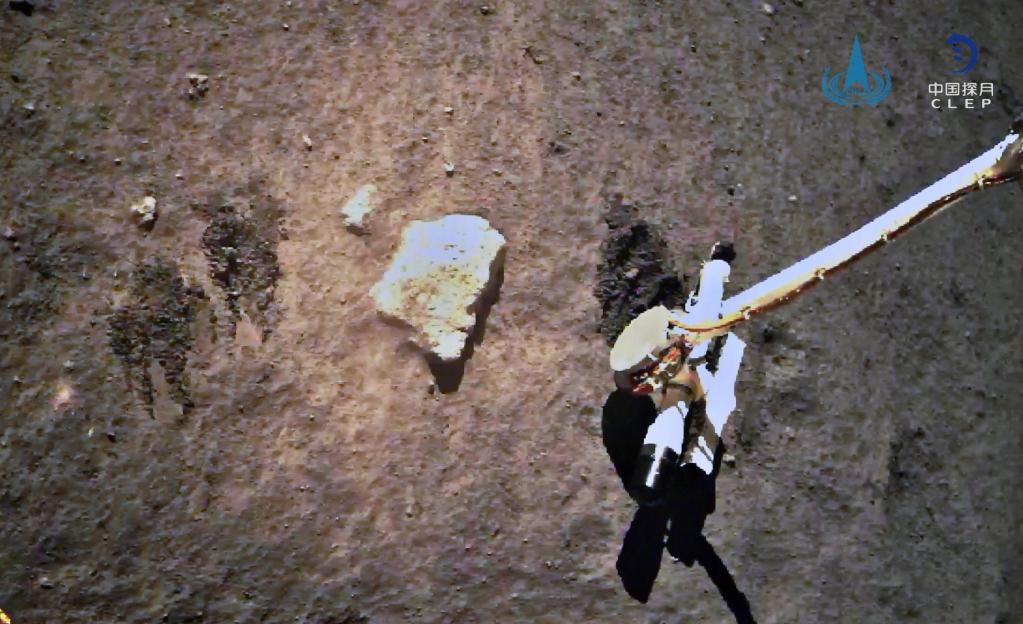
In April this year, the China National Space Administration (CNSA) opened up its latest batch of lunar rock samples to scientists from seven institutions in France, Germany, Japan, Pakistan, the UK and the US. The samples retrieved by the Chang'e-5 probe from the Moon's mysterious volcanic region will now serve as the foundation for an ambitious joint research project among the world's top institutions.
This has turned the heads of the global science community, as such a joint project covering three continents and six countries will be an important step in knowing more about the Moon. Moreover, it stands out as a much-needed reminder: cooperation in science is not only possible, it's essential.
Science cooperation across borders
The Moon may be 384,000 kilometers away, but that hasn't stopped it from becoming a focal point of international interest. Humanity has all along been inspired to explore the secrets of the Moon. Now we are better equipped than ever before with tools and technology for this enduring quest.
Many Western media outlets are reporting in amazement that China's list of institutions includes two from the United States despite the tariffs the latter has imposed on the world and especially China. Many also made reference to the Wolf Amendment, a legislation passed by the US. in 2011, which prohibits NASA from using federal funds to engage in direct, bilateral cooperation with the Chinese government and Chinese organizations without explicit congressional approval.
But just as CNSA chief Shan Zhongde put it, the samples are "a shared treasure for all humanity." By sharing this treasure, China, for its part, is demonstrating that it has no intention of monopolizing knowledge or putting up barriers. It is extending a hand, not drawing a line. No strings, no political litmus tests — just science for science's sake.
Science as a bridge, not a battlefield
As an immense scientific asset, these small lunar rocks bear another immeasurable value: how science connects us all.
Back in the 15th and 16th centuries, the yearning for scientific observation of the world drove fleets from many countries deep into the ocean, making it possible for humans to physically connect with each other. In the 20th century, the invention of the World Wide Web formed the basis of the existing information system and connected us online in real-time. Entering the 21st century, China, having benefited from all that, carries forward the spirit and opens its arms to the world, be it Artemisinin in the fight against Malaria or Deepseek as an open source AI model.
The dividends of the breakthroughs in science and technology have long been shared by all humankind. However, things have recently changed—this is no longer the case, at least for certain countries.
In today's world, some countries regard each other's growth as a threat, and resort to decoupling and other dividing moves to hold back others' technological advancement. Global industrial chains based on cutting-edge technologies are turned into a battleground for some to pursue supremacy.
This will not only hurt their international image and credibility, but will also, in the end, undercut their own development.
Yet such a deviation in values will not sway the rightful path of scientific sharing for the common good. Science should be a bridge, not a battleground. By transporting equipment from partner countries to the Moon and sharing lunar rock samples, China has demonstrated to the world that it is a country with an open mind, committed to advancing the well-being of all humanity through scientific and technological cooperation.
While the research will take months, if not years, to yield concrete results, the message is loud and clear: the future of space exploration should be collaborative, or it won't be sustainable.
The universe knows no borders, nor should our pursuit of science. This isn't just about samples or technology. It's about setting a tone for how humanity explores the universe together. And this one step to share lunar research represents a giant leap for mankind.
Going forward, as China and countries around the world turn their eyes to the back of the Moon, to the Mars and even beyond the solar system, much can be done in the joint exploration of the vast universe—together.
Yi Xin is a Beijing-based international affairs commentator. The views don't necessarily represent those of China Daily.
If you have a specific expertise, or would like to share your thought about our stories, then send us your writings at opinion@chinadaily.com.cn, and comment@chinadaily.com.cn.