



Strait threat casts pall over Asia's development









The possible closure of the Strait of Hormuz — a vital artery for global crude shipments — is casting a shadow over the growth outlook of Asia-Pacific for the year.
Analysts warn that some of the region's largest economies, heavily reliant on oil and gas from the Gulf, are vulnerable to supply disruptions that could trigger inflationary pressures.
As tensions in the Middle East escalate, Iran's parliament on Sunday voted to authorize the possible closure of the strategic waterway, pending approval by national security authorities.
The news sent jitters across the global oil market, with Brent crude climbing above $77 per barrel on Monday, its highest level since January.
South Korea's acting Finance Minister Lee Hyoung-il said on Sunday that his government must closely monitor international energy prices and supply-demand dynamics, Yonhap news agency reported.
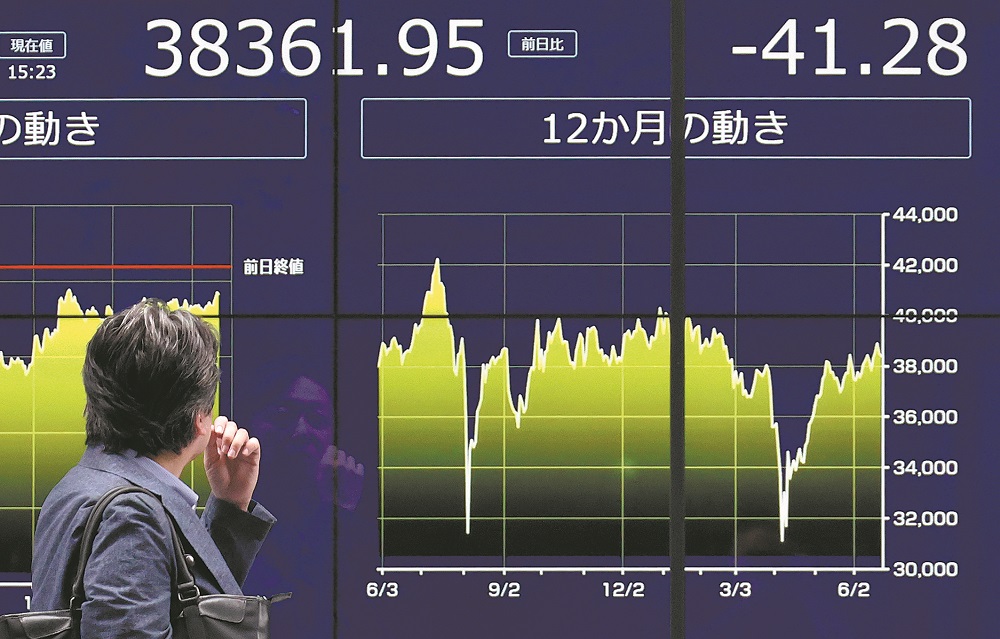
Some Asian bourses were not rosy: Japan's benchmark Nikkei 225 declined 0.13 percent, South Korea's Kospi shed 0.24 percent, and India's Nifty 50 dropped 0.56 percent.
"Higher global crude oil prices could lead to a pickup in inflation and thereby slow down the world GDP growth," said Michael Ricafort, chief economist at the Rizal Commercial Banking Corporation in Manila.
Alicia Garcia-Herrero, chief economist for Asia-Pacific at French investment bank Natixis, described the situation as a "big Asia problem".
Asia is "particularly vulnerable "because more than 80 percent of its oil and gas imports pass through the Strait of Hormuz, she said. The region's heavy reliance on Gulf energy supplies, coupled with limited alternative routes, makes it highly exposed to disruptions, she added.
Henry Chan, a distinguished visiting fellow at the Cambodian Center for Regional Studies, said Iran has the military capability to close the strait, and whether it chooses to take such a highly disruptive step is a judgment call for its leaders.
"If they perceived that the US and Israel would not stop until there is a 'regime change', then they might push the situation to the edge," Chan told China Daily.
"Paradoxically, the key to any ceasefire depends on whether the US can convince Israel to stop,” said Chan.
Lakhvinder Singh, director of peace and security studies at The Asia Institute in Seoul, warned that the world is entering "uncharted territory".
Singh forecast that global oil prices could surge past $150 to $200 per barrel if the strait is closed. Apart from higher fuel costs that would spike inflation across Asia, he said oil supply disruption "would almost certainly result in serious power shortages in most of East and South Asia".
"If this occurs during summer months — when energy demand is at its peak — it could cause havoc in the economic and social stability of these countries," he said.
Impact varies
However, the effects of oil and gas supply disruptions are uneven across Asian economies.
Yeah Kim Leng, a professor of economics at Sunway University in Kuala Lumpur, said energy exporters such as Brunei and Indonesia may mitigate the blow by tapping domestic supplies. Most others, however, will face higher oil prices and inflation because of "the pervasive energy inputs", particularly in transport and electricity production.
Wan Suhaimie Wan Mohd Saidie, head of economic research at Malaysia's Kenanga Investment Bank, said Bangladesh and Pakistan can experience a "triple hit" — growth slowdown, fiscal blowout and inflation spike — because of high import reliance, low reserves and weak fiscal positions.
Singh said larger economies have taken steps to protect long-term interests. India has been diversifying import sources, boosting strategic reserves and deepening ties with Gulf suppliers. Japan and South Korea have been maintaining large oil stockpiles and investing in renewable and nuclear energy to reduce hydrocarbon dependence.
"So, the larger economies of the region are somewhat prepared. The core question, however, is about the smaller economies: How will they survive this ordeal?" he said.










