



Now that athletes make big bucks, team docs diagnose liability risk









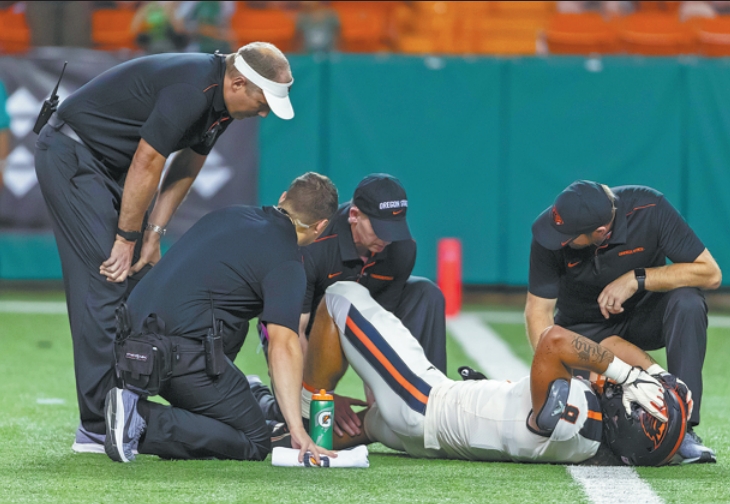
The professionalization of college sports has prompted concern among team physicians that they will be exposed to a greater risk of being sued by athletes who claim a poor outcome from treatment caused them to lose future earnings.
Before July 2021, when college athletes were cleared to be compensated by third parties for the use of their name, image and likeness, such lawsuits would have been virtually unwinnable.
Four years later, and with schools set to share millions directly with their athletes, team physicians are wary. Some of the most high-profile college athletes are already signing multimillion-dollar deals, and six-figure contracts are common.
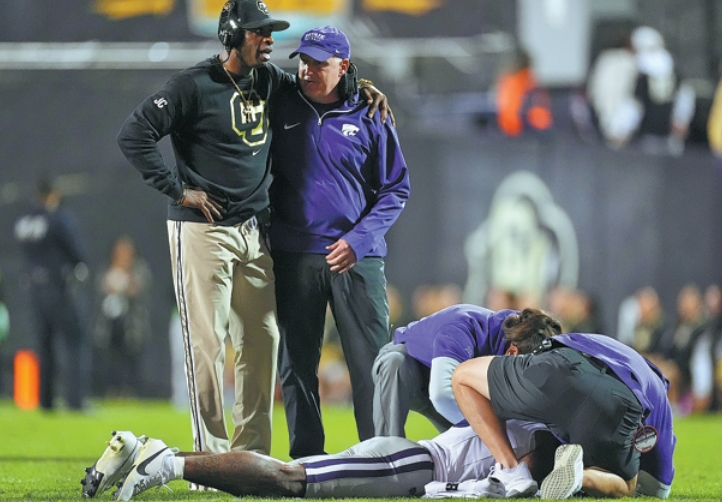
Though no malpractice lawsuits seeking lost future earnings at the college level are known to have been filed, it's only a matter of time, said Dr James Borchers, Big Ten chief medical officer and president and CEO of the US Council for Athletes' Health.
"The complexity for the clinician is going to be significant," he said. "I do think there are people who are going to evaluate this and say, 'I didn't sign up for an 18-year-old making a million dollars and then saying the decision I made affected their ability to make money.' I think you may see people say: 'This isn't for me'."
Eagles case
The case of former Philadelphia Eagles player Chris Maragos jolted the sports medicine field in 2023, when a jury ordered his surgeon and an orthopedics group affiliated with the team to pay him $43.5 million for lost future earnings and pain and suffering, after he alleged improper care of a knee injury.
The orthopedics group ended its two-decade association with the Eagles out of fear of future lawsuits.
At the college level, it still would be hard for an athlete to contend a team doctor's errant care cost them an opportunity to make money in professional sports, because there are no guarantees to play at the next level. However, a college athlete who didn't have an optimal recovery could argue that treatment reduced their ability to make NIL money, or to transfer to a higher-level school where they could make more money.
"You had an ACL tear, I did surgery and you never quite made it back — back in my day, you just had bad luck," said Borchers, who played football at Ohio State from 1989-93. "You're making a million dollars and that happens, you're probably having a different discussion."
Borchers offered a hypothetical situation to illustrate his concerns about the pressures faced by team doctors. A receiver is treated for a hamstring injury, returns to play and re-injures the hamstring. The receiver says the injury never felt fully healed and his agent takes him to another doctor who has a different opinion on how the injury should have been treated.
Borchers said the receiver would have been better off sitting out longer and missing a few more games.
"But, there wasn't money tied to that," he said. "Now you could say you hurt my ability to go out and perform, so I'm not going to get as much money, or (it) has cost me the ability to put more tape out there so I could have transferred to a better situation and made more money. Those are the types of issues we're hearing about that used to not exist in college sports."
Who is liable?
Typically in college sports, team physicians are employed by a university-affiliated medical center or local medical group. Athletic trainers are employed by the athletic department.
Team physicians must carry liability insurance, either individually or through the medical center or group. The most common limits for a malpractice insurance policy are $1 million per incident and $3 million total in a year, said Mike Matray, editor of Medical Liability Monitor.
"You can see how an athlete's economic damages, should a medical error end their career, would easily exceed those limits," Matray told reporters.
MLM has followed the medical liability insurance industry since 1975, and though the publication does not track data specific to sports medicine practitioners who perform surgeries, Matray estimated rates for that specialty to be more than $100,000 per year in some states.
Dr Jon Divine, head team physician at Cincinnati, said Big 12 team doctors are discussing among themselves and university general counsels whether they should increase their liability insurance limits, perhaps to $2 million or $6 million, or more.
Divine said he and other team doctors also are taking extra steps in evaluating injuries in the new era of college sports.
"I've probably ordered more MRIs than I ever have in 25 years in the last two years," he said. "It's to make sure we're getting it right for the (coaching) staff, for the kids, for the kids' families. There's that much more riding on it."
Changing relationships
A former Penn State football team doctor, Scott Lynch, alleged in 2019 that coach James Franklin attempted to interfere with medical decisions.
A Penn State internal review found evidence of "friction "between Lynch and Franklin, but could not determine whether Franklin violated NCAA bylaws or Big Ten standards by interfering with medical decisions. Lynch was awarded $5.25 million for wrongful termination by the hospital that had employed him.
Dr David McAllister, head team physician at UCLA who has been practicing for 27 years, said the relationship between team doctor and athlete has gone from one built on trust, to now being transactional and, at times, adversarial.
When athletes spent four or five years at the same school, as once was the norm, friendships were formed, and the team doctor continued to provide care for the same athletes long after their playing days. Now, McAllister said, many football and basketball players are taking advice from agents and business managers, whose priority is the athlete's earning power, and that puts pressure on team physicians.
"There are seasoned, experienced people that do what I do who either recently got out of it, or are really considering it, because they don't want to be exposed to the liability," McAllister said. "And they don't find it that much fun anymore."
Agencies Via Xinhua




Most Popular
- 2025 BRI International Climbing Masters concludes in Meishan
- As Liverpool's slide continues, Man United finally finds its rhythm
- Communities kick out the trauma in war-torn Sudan
- Bowled over: Canada falls back in love with cricket
- An ice warm-up, but work still to be done
- Eco-friendly Tianjin Marathon attracts over 33k runners from 39 countries