



Manila's hyping up of illegal 'arbitral award' nothing but a damp squib: China Daily editorial









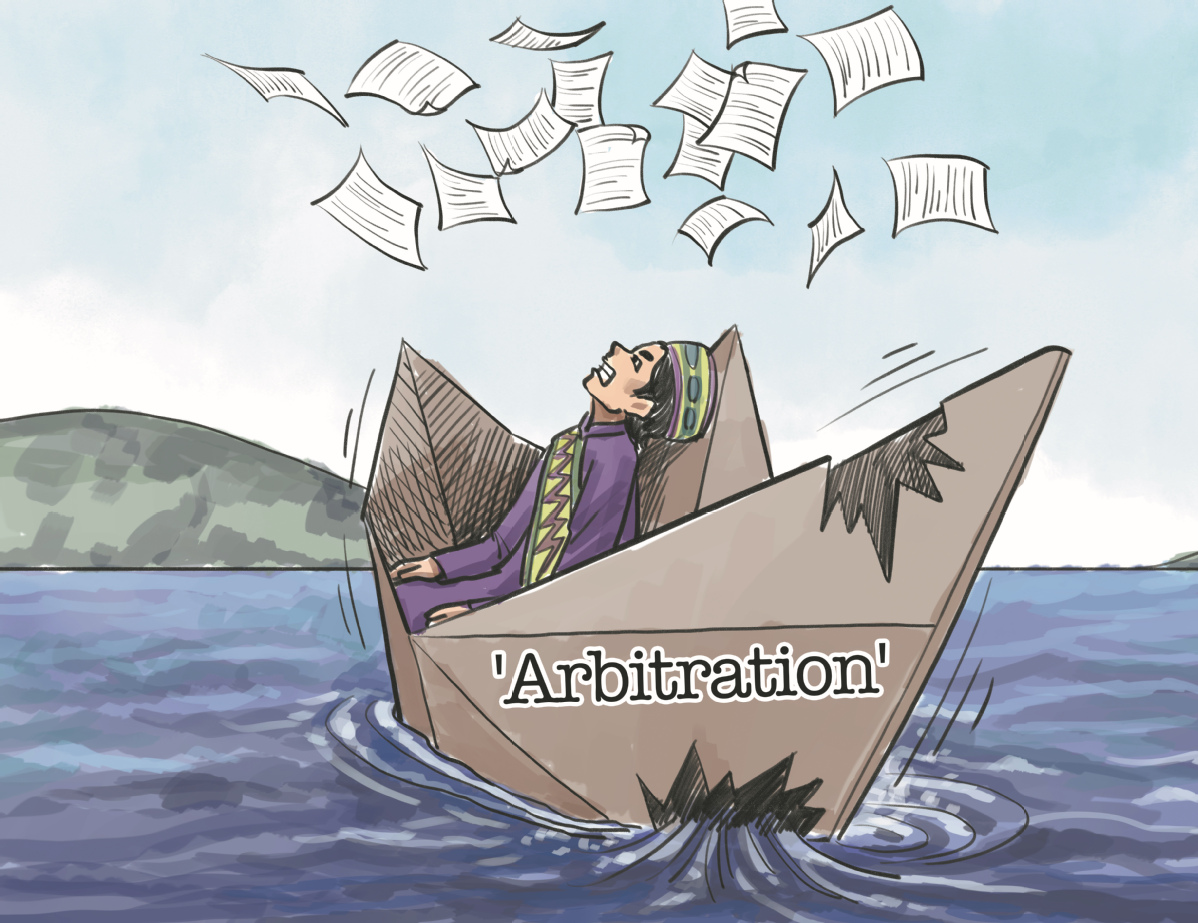
The so-called 2016 Arbitral Award on the South China Sea was a farce played by the Philippines to justify its ill-grounded claims to Chinese islands and islets in the South China Sea. It was illegal, null and void, and nonbinding from the very beginning, and will remain so despite Manila's renewed attempt to try to revive its dying embers and mislead the international community.
The Philippine Department of Foreign Affairs released a statement on the ninth anniversary of the "arbitral award", while its top diplomat delivered a speech to hype the anniversary, with the clear intention of playing up the issue again.
The Philippines unilaterally initiated the so-called arbitration case to challenge China's sovereignty over territories in the South China Sea and give itself "a legal basis" for its illegal occupation of Chinese islands and islets. However, the "arbitration case" lacked the necessary precondition of prior consultations and failed to meet the principle of state consent, which is fundamental to arbitration. Therefore, it did not possess the legal basis to proceed from the outset.
As Foreign Minister Wang Yi rightfully pointed out on Friday, although the "arbitration case" was presented in various forms, the essence of the Philippine claims concerned China's territorial sovereignty over the Nansha Islands and maritime delimitation issues. But territorial issues are beyond the scope of the United Nations Convention on the Law of the Sea, and China had explicitly excluded maritime delimitation from compulsory arbitration in a declaration made in 2006, in accordance with UNCLOS concerning the optional exceptions to the applicability of the UN Convention.
In other words, judged by either the procedure of the case or the applicability of UNCLOS to the case, the Philippines-initiated "arbitration case" was illegal through and through. Not to mention that the "arbitration" tribunal's ruling contained serious factual and legal flaws.
As such, if such a flaw-ridden, illegal ruling were to be applied globally, it would deal a heavy blow to the existing maritime order and tarnish the legitimacy of UNCLOS itself. Those who have sided with Manila in an attempt to shore up the tribunal's "ruling" should ask themselves whether they are ready to abandon their own maritime claims under the same logic of the "ruling".
The "arbitral" tribunal exceeded its mandate and abused the dispute settlement mechanism of UNCLOS, undermining the rule of law in international maritime affairs and engaging in actions contrary to the very Convention it claimed to uphold. Those attempting to play up the ruling only want to make waves over the South China Sea disputes and undermine peace and stability in the region.
The latest Philippine move violates the Declaration on the Conduct of Parties in the South China Sea, which stipulates that disputes should be resolved peacefully through friendly consultations by the parties directly concerned. It also runs counter to the commitments made by the Philippines in its bilateral consensus with China and breaches the principle of estoppel under international law.
China has repeatedly said it neither accepts nor recognizes the "arbitral award", and will never accept any claim or action arising from the "award". As a signatory country to UNCLOS, China remains committed to upholding the principle of international rule of law and the authority of the Convention.
Thanks to joint efforts by China and the Association of Southeast Asian Nations members, the situation in the South China Sea remains stable, and the freedom of navigation and overflight has been effectively protected. China and ASEAN have completed the third reading of the draft text of the Code of Conduct in the South China Sea, which aims to effectively manage differences and maintain overall maritime stability.
Hence, at this juncture, Manila should fully respect regional efforts to build lasting peace in the South China Sea and stop stirring up trouble or sowing discord in the region. It should join hands with other countries in the region to work for the establishment of a new narrative of peace, cooperation and friendship.





