


AI and algae come to the rescue of the Great Wall









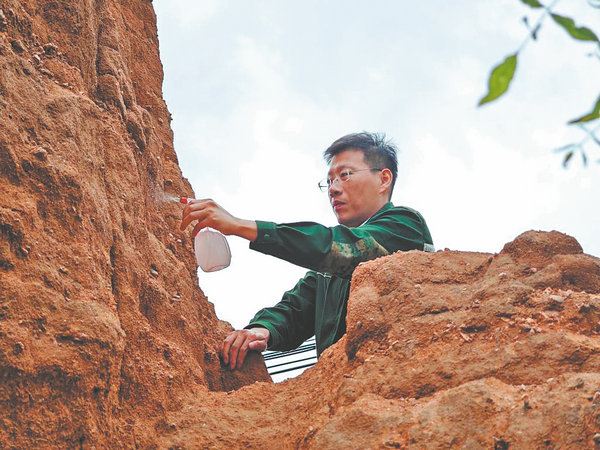
SHIJIAZHUANG — Weaving through the remains of a centuries-old watchtower, an agile four-legged robot checked the "health" of the ancient structure at Shanhaiguan Pass — a historic section of the Great Wall in Qinhuangdao city, North China's Hebei province.
Equipped with smart sensors, high-definition cameras, and lidar, the patroller can precisely identify problems such as cracks and missing bricks, and report them to relevant departments in real time.
"The robot can replace human inspectors to perform dangerous and strenuous inspections, improving both the efficiency and quality of the Great Wall protection," says Liu Liang, head of a research team affiliated with the Hebei Bureau of Geology and Mineral Resources Exploration.
The deployment of the sharp-eyed robot exemplifies China's ongoing efforts to enhance protection for the Great Wall through the use of cutting-edge technologies.
Originally built for military defense, the Great Wall is actually many interconnected walls, with some dating back more than 2,000 years. The existing sections stretch a total length of over 21,000 kilometers across the rugged landscapes of northern China.
Among 15 provincial-level regions boasting sections of the Great Wall, Hebei is home to one of the best-preserved and most iconic parts. In recent years, it has been exploring ways in which technology can help address the challenges facing the UNESCO World Heritage Site.
Monitoring is the first step in the Great Wall protection. Zhang Peng, 38, is among the pioneers who started using drones in 2017 as part of regular patrols over the walls.
"Drones can help monitor walls that are less accessible to human inspectors, such as those perched on the cliff," Zhang says, adding that the information collected by drones is put into a database to frame future protective strategies.
As tools like drones and robots empower the "physical examinations" of the Great Wall, professionals are introducing innovative "treatments" to protect the cultural heritage site.
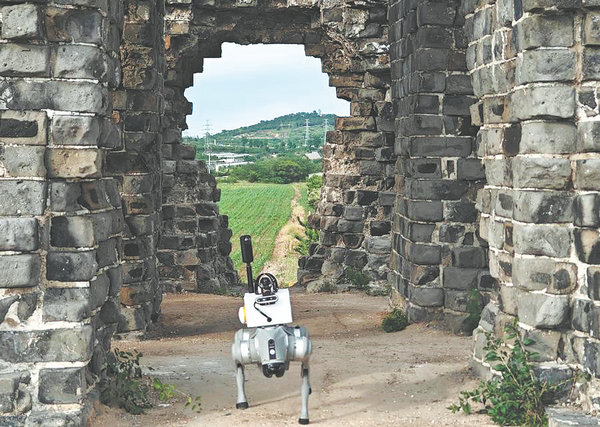
One of the most promising is a biological conservation method pioneered by Liu's team.
Rain erosion has been a persistent threat to the stability of rammed earth walls. However, after years of study, experts found that certain wall patches at their research site were remarkably resistant to water damage.
The discovery piqued the team's interest, and they conducted further analysis. Their finding was exciting: filamentous cyanobacteria, a type of algae growing on the rammed earth surface, turned out to be the real guardian against rain erosion.
"The species is capable of forming a biological soil crust on the rammed earth surface, acting as a natural 'protective suit' for the Great Wall," Liu explains.
Now, the team has cultivated the organism and applied the effective, eco-friendly method to the surface of rammed earth walls. "It's great to protect the Great Wall with tools coming from itself," he adds.
While these technologies reinforce the Great Wall's physical structures, they also serve as a bridge connecting people to the Wall's cultural legacy and boosting public awareness of its protection.
An online platform is doing just that. Aided by technologies such as virtual reality and digital modeling, netizens can enjoy a panoramic view of the Great Wall sections and related cultural artifacts in Hebei, gaining greater insight into their timeless value.
Endeavors in the education sector are also underway. For example, special courses integrating the use of AI tools, such as DeepSeek, with knowledge on the Great Wall, are being developed for children, according to Dong Yaohui, head of the research institute of the Great Wall at Hebei GEO University.
"We hope such courses can ignite the next generation's passion for the Great Wall and foster a stronger sense of responsibility for its future protection," says Dong.