China Focus: Chinese scientist details first planned Mars sample-return mission Tianwen 3









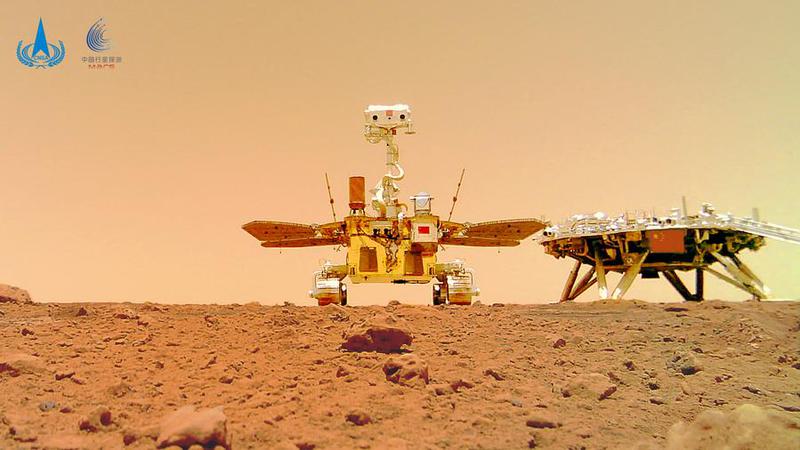
BEIJING -- China's first Mars sample-return mission, Tianwen 3, is scheduled for launch around 2028, with the goal of returning no less than 500 grams of Martian samples to Earth by around 2031, according to the mission's chief scientist.
Hou Zengqian, an academician of the Chinese Academy of Sciences and chief scientist of the Tianwen 3 mission, together with his collaborators, recently published an article in Nature Astronomy, systematically outlining the overall plan and scientific objectives of the mission for the first time.
"The mission will be a critical step in China's planetary exploration. We hope to provide the international community with an unprecedented opportunity to understand Mars," Hou said.
The Tianwen 3 mission will involve two launches, and the spacecraft will take seven to eight months to reach Mars. It will operate on Mars for about one year and then return to Earth, with the entire process spanning over three years, according to Hou.
LIFE ON THE RED PLANET?
"We aim to unravel the mystery of whether life ever existed on Mars," Hou said.
He introduced three primary scientific objectives for the Tianwen 3 mission: searching for potential signs of life on Mars, including biomarkers, fossils and archaea; studying the evolution of Mars' habitability, such as changes in water, atmosphere and oceans; and investigating the geological structure and evolutionary history of Mars, from surface features to internal dynamics.
These three objectives are interconnected. The origination of life requires a habitable environment, the proliferation of life evolves in tandem with the environment, and habitability is closely linked to geological processes, Hou explained.
To address these objectives, nine research teams have been established, covering aspects such as life-related elements, environmental conditions and geology, in order to "enhance our understanding of this Earth-like planet in our solar system," Hou said.
HOW WILL SAMPLES BE COLLECTED?
The mission's engineering team has preliminarily designed three sampling methods: surface scooping, deep drilling and drone-assisted collection to ensure sample diversity and scientific value.
Tianwen 3 will not carry a Mars rover. Instead, it will use a drone to collect samples from locations within several hundred meters of the landing site, Hou said.
He noted that Tianwen-3 will be the first mission internationally to conduct 2-meter-deep drilling for sample collection on Mars.
Previously, NASA's Perseverance rover collected shallow surface samples, and will rely on a follow-up mission to return them to Earth. In contrast, Tianwen 3 aims to accomplish both sampling and return in a single mission.
Hou emphasized that planetary protection is a major issue in deep space exploration, and that contamination control is a critical challenge that must be addressed. Strict measures are required to prevent the contamination of Mars by the spacecraft and the potential contamination of Earth's biosphere by Martian samples.
China will adhere strictly to the planetary protection policies of the Committee on Space Research to safeguard Mars from terrestrial contamination and protect Earth from potential Martian life, ensuring authentic and reliable scientific results, Hou said.
The Tianwen 3 mission will establish a complete chain in the sample preservation process, from collection and sealing on Mars to transportation and analysis on Earth. Additionally, a high-security Mars sample laboratory will be constructed, featuring ultra-clean and biosafety areas, where returned samples will undergo strict sterilization, unsealing, processing and biological risk assessment, Hou said.
WHERE WILL SAMPLES BE SOURCED?
"The selection of the landing site on Mars is crucial, as it directly impacts the achievement of the mission's scientific objectives. From an initial pool of over 80 candidate sites, we have narrowed it down to 19, and by the end of 2026, three final candidate sites will be selected," Hou said.
This selection must balance engineering constraints and scientific priorities. Due to engineering limitations, the landing site must be located between latitudes of 17 degrees and 30 degrees north on Mars. Scientifically, the site should offer the highest potential to harbor and preserve traces of life, the scientist said.
This is akin to mineral exploration on Earth — it requires the establishment of theories and models to guide predictions, and to then search for a needle in the haystack.
Similarly, identifying a suitable landing site requires a study of the conditions needed for the emergence, proliferation and preservation of life, and the development of predictive models, Hou noted.
If there is or was life on Mars, it would be or have been the result of the interplay of multiple factors, such as liquid water, atmosphere, temperature, magnetic field and internal structure. An ideal landing site should meet the requirements for habitability and life development, Hou said.
OPEN COLLABORATION
China has adopted a fully open and collaborative approach to the Tianwen 3 mission, from the formulation of scientific goals and the development of payloads to the joint research it has conducted on returned samples.
"We aim to build a global platform for scientific collaboration through planetary exploration, advancing humanity's shared scientific endeavors," Hou said.
"During the scientific goal-setting phase, we hosted an international conference, inviting global experts to participate in the discussion. For payloads, China issued an international call for proposals. After the samples are returned, China will open access to international scientists, provided safety is ensured," Hou said.
He added that some key technologies for the Tianwen 3 mission remain under development. The scientific team is leveraging Martian observational data to advance landing-site selection. Meanwhile, to achieve its primary scientific objectives, the team is intensifying full-chain research on the search for life on Mars.