Low-altitude economy ready for takeoff









Imagine stepping into an electric vertical takeoff and landing (eVTOL) cabin at dawn, a steaming cup of tea in hand. Minutes later, you're hovering above the city, with the streets and traffic jams zooming out below. No snarled bumper-to-bumper delays, no frantic main-road, side-road diversions — just a direct, scenic glide to your destination. This is not a page from a science fiction novel; it's part of China's nascent low-altitude economy, where airspace is no longer an empty expanse but the next frontier of growth.
Economists have long defined "the economy" as the art and science of marshaling scarce resources to meet our needs. Today, land has been built out, seas and oceans have become busy highways, but airspace remains largely idle.
Much like farmlands or shipping lanes, the low-altitude airspace below the clouds is a critical resource, one we have hardly begun to exploit. For China, opening up this realm to commercial, private and public use is not just an exciting technological option, but a strategic imperative.
More than a century after the Wright brothers' first tentative flights, commercial aviation has become routine, but for that you have to reach an airport. The low-altitude economy will change that dynamic altogether, bringing flights into our everyday lives. In cities, such as Shenzhen in Guangdong province; Hefei in Anhui province; and Hangzhou in Zhejiang province, drone-delivery corridors and helicopter shuttle services have graduated from pilot programs to commercial operations. Shenzhen, in fact, saw more than 770,000 drone deliveries and 28,000 manned helicopter operations last year, marking a major step toward the commercialization of low-altitude air services.
These early successes offer a glimpse into what lies ahead: eVTOL taxis skimming above congested thoroughfares, medical-evacuation drones swooping down on accident sites within minutes, light aircraft offering weekend escapes — and, perhaps most thrilling, private flights becoming as commonplace as availing a ride-hailing cab.
Yet what truly sets the low-altitude economy apart is its power to act as an aerodynamic overlay on our existing industries, transforming them from two to three dimensions. Imagine, for instance, flying in a sleek eVTOL cabin on defined aerial corridors, not only avoiding traffic jams but also turning what was once an hour-long slog into a 10-minute glide above rooftops.
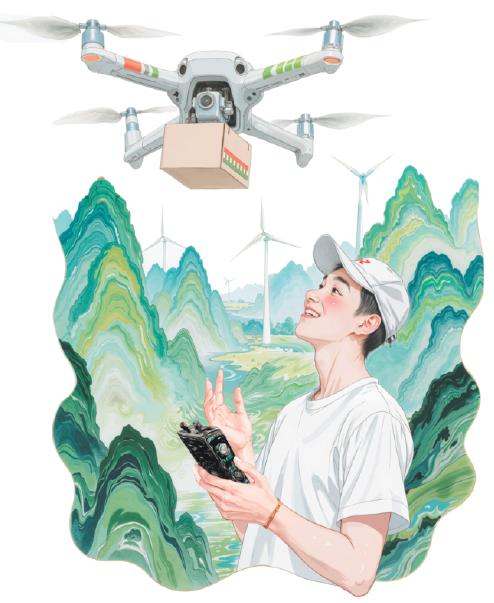
Or imagine logistics channels no longer constrained by traffic lights or security checks and, instead, choreographed drones on specified routes delivering everything from hot meals to critical medicines directly to the balcony or rooftop landing pads. Or envision tourism reinvented as panoramic flights over the Great Wall at dawn, the rising sun illuminating each turret and valley below, or imagine gliding silently in a glass-floored pod above Guilin's mist-covered karst peaks.
Each of these applications does more than spawn a new gadget; they catalyze entire ecosystems. "Vertiports" and maintenance hubs are springing up wherever demand is high, pilot training academies are enrolling aspiring aviators, and sophisticated air traffic management systems are choreographing the ballet-like movement of low-altitude vehicles.
The low-altitude economy has its genesis in the general aviation sector. While China's conventional aviation operations — chartered flights, flight schools and agricultural spraying — initially lagged behind Western countries, the country's breakneck advancement in drone technology flipped the script. Consumer and commercial drones made by Chinese companies are now global leaders, setting standards for reliability, range and cost-efficiency.
Building on that momentum, more than 30 Chinese firms are now developing full-scale eVTOL platforms. Companies such as EHang and AEROHT (an XPENG spin-off) are at the forefront of domestic eVTOL development. Their innovations span battery technology, autonomous flight control and noise-reduction mechanisms, which help overcome both technological and regulatory hurdles.
Of course, to realize this aerial vision, we need, apart from cutting-edge hardware, a robust regulatory framework to monitor low-altitude air-traffic corridors, manage stringent maintenance and pilot-licensing regimes, and engage communities to address problems such as noise pollution. For example, there is a need to implement measures like "quiet-zone" hours, set maximum decibel levels and create no-fly buffers around schools and hospitals. In such a case, as in any transformative technology, public trust hinges on transparent rule-making and safety records.
In this regard, Beijing is likely to include the low-altitude economy as an important part of the 15th Five-Year Plan (2026-30), in order to build a "network in the sky, a framework on the ground".
On the ground, a lattice of vertiports, aviation parks, drone bases and flight camps will ensure the seamless operation of the low-altitude economy, just like a modern-day grid of aerial highways and rest stations, all coordinated by next-generation air-traffic management.
Hopefully, the low-altitude economy's output will exceed 1 trillion yuan ($139.77 billion) by the end of this year, and 3 trillion yuan by 2030. Yet the true dividends may not be in these figures, but in the social development it would facilitate: de-congested cities, faster emergency response, and vitalized rural connectivity.
In the decades to come, our skylines may well be defined by not only steel and glass but also the arcs of eVTOLs, the hum of drone corridors and the beacons of vertiports. Navigating such skylines will be as routine as boarding a bus. Indeed, the low-altitude economy will signal a paradigm shift — elevating industries, transforming daily life and redrawing the map of possibility in three dimensions.
So the next time you see a swift-moving dot in the sky, don't dismiss it as a passing helicopter, because it could be a harbinger of a better future, a future when your morning commute would be in the sky.
The author is director of General Aviation Industry Research Center, Beihang University. The views don't necessarily reflect those of China Daily.
If you have a specific expertise, or would like to share your thought about our stories, then send us your writings at opinion@chinadaily.com.cn, and comment@chinadaily.com.cn.