A unified voice vital for Asia









"Across the world, tools once used to generate growth are now wielded to pressure, isolate and contain," Malaysian Prime Minister Anwar Ibrahim said last month during an opening address to the 58th Association of Southeast Asian Nations Foreign Ministers' Meeting in Kuala Lumpur, the capital of Malaysia.
"Tariffs, export restrictions and investment barriers have now become the sharpened instruments of geopolitical rivalry," he added.
At the foreign ministers' conference, Singaporean, Malaysian and Indonesian foreign ministers expressed critical viewpoints on the gathering trade frictions in the region precipitated by the United States.
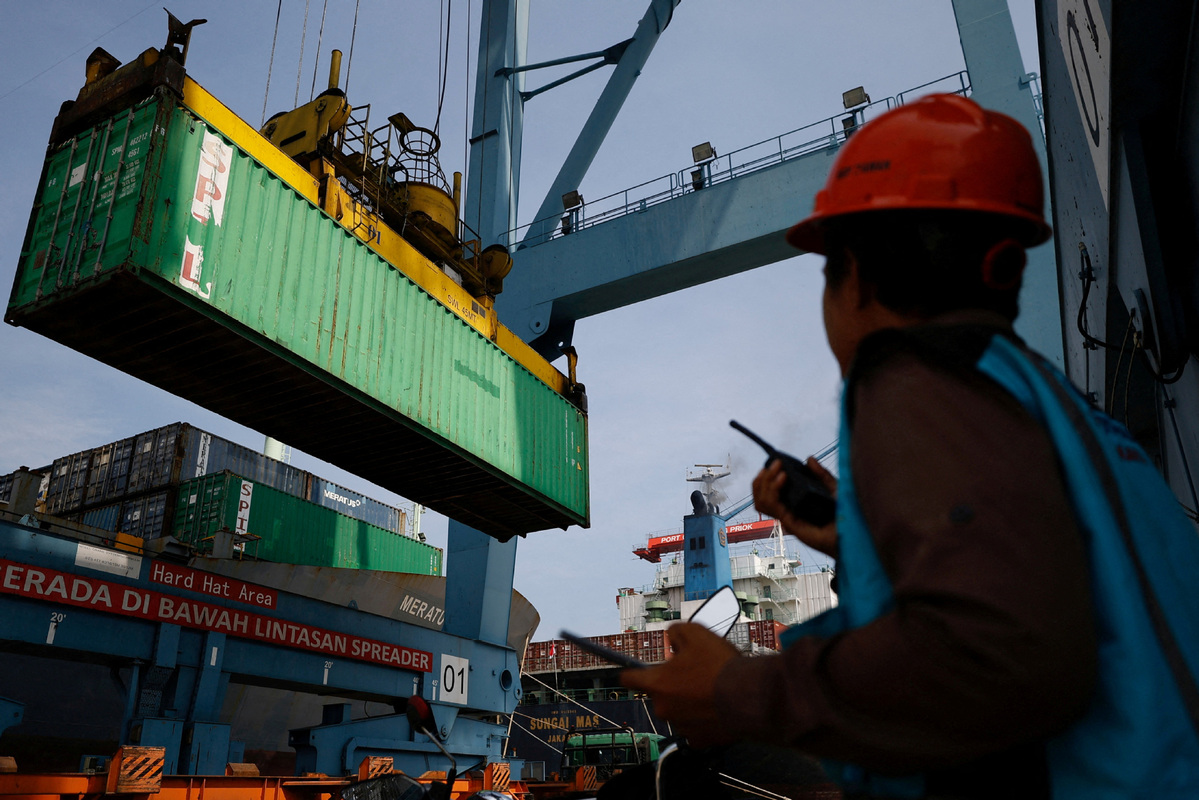
On the eve of the meeting, US President Donald Trump said he would impose heavy tariffs on key US allies — Japan, South Korea, as well as 12 others, including Southeast Asian nation Malaysia. Anwar also said during his speech that ASEAN is a group of trading nations and any increase in tariffs will have an impact on the economies of the region.
Speaking during the meeting, Singaporean Foreign Minister Vivian Balakrishnan called on the ASEAN nations to "double down "on their integration to confront Trump's tariff threat. "I would say the urgency and the salience of doing it now is so much more obvious," he added.
His Indonesian counterpart Sugiono emphasized the importance of collective and strategic efforts.
Sugiono said: "We are at a very crucial point. Geopolitical rivalries and global protectionist trends continue to increase and risk eroding regional unity and relevance."
Malaysian Foreign Minister Mohamad Hasan also warned that the "external pressures on our unity will grow. The call for us to take sides will get louder." He argued that amid the uncertainty and unprecedented strain of global challenges, ASEAN must stand firm.
With widespread sentiments in the region for unity to counter the US trade war, the US has claimed it wants to be part of Asia's rise, but on its own terms.
In Kuala Lumpur to attend the summit, US Secretary of State Marco Rubio told journalists that the "history of the 21st century will be written in Asia.... And we intend to be a full part of it."
He talked about cooperation, citing the joint US-Philippines economic corridor infrastructure project. The US has lowered tariffs on Vietnam and recently negotiated a trade deal with Hanoi.
Europe has a union that could speak with a stronger voice on the global stage. But Asia does not have such a unified voice — and it is time for the establishment of an Asian Union.
In the late 1980s, when the Asian economies were rising, there was a proliferation of regional cooperation arrangements that included major regional economies.
Then Australian prime minister Bob Hawke, during a speech in Seoul, South Korea, on Jan 31,1989, proposed an Asia Pacific Economic Cooperation grouping that included the US, New Zealand and Canada. Ten months later, 12 Asia-Pacific economies met in Canberra, Australia, to establish the APEC.
In 1990, then Malaysian prime minister Mahathir Mohamad proposed an East Asian Economic Caucus that would include the 10 members of ASEAN, as well as Japan, China and South Korea. He argued that Asian countries needed a strong voice in international affairs as their economies rose. He refused to attend the first APEC informal leadership meeting in Seattle, the US, in November 1993.
When Asian countries are faced with external pressure and tariff threats, the time is ripe to launch an "Asian Union", or whatever you prefer to call it, as the environment calls for such a grouping to be born.
Tokyo, Seoul and Beijing have recently shown positive signs of cooperation, which can become the base of grouping formation, and New Delhi could be drawn into this. It is a good sign that Indian External Affairs Minister Subrahmanyam Jaishankar visited Beijing last month — his first visit to China since 2020.
Jaishankar has stressed the importance of the "rules-based order", in which he argued that such an order cannot exist if rules are made by a few to benefit themselves.
Thus, the time is ripe for an "Asian Union" — who will make the first call?
The author is a Sri Lankan-born Australian journalist, podcaster and international communication specialist.