



Intelligent tech helps migrating antelopes cross road safely









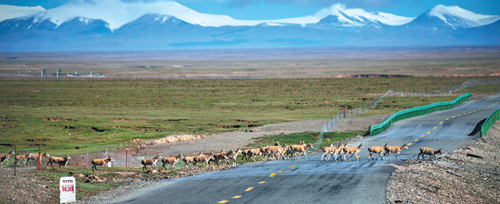
XINING — In the early summer, drivers on a stretch of National Highway 109 in the Yushu Tibetan autonomous prefecture of Northwest China's Qinghai province often encounter a unique spectacle: herds of Tibetan antelopes crossing the busy road.
In a display of harmony between nature and human activity, vehicles on the highway pull over and wait patiently, creating a temporary pause in traffic flow to allow the animals to pass safely.
More recently, a high-tech "mobile sentry" has joined this harmonious scene. Stationed by the roadside, it is remotely controlled by dedicated staff who adjust its height and angle, zoom in and out, and meticulously record the entire process of the antelopes crossing the road.
Every year from May to July, female antelopes from areas such as Sanjiangyuan in Qinghai, Changtang in Southwest China's Xizang autonomous region and the Altun Mountains in Northwest China's Xinjiang Uygur autonomous region travel hundreds of kilometers to give birth in the heart of the Hoh Xil National Nature Reserve. Many need to cross the iconic National Highway 109.
The mobile devices on duty for antelope migration are part of an intelligent management platform for human-wildlife conflict mitigation, which is the result of a key national research and development project.
The platform utilizes traffic signals that drivers can understand at a glance, effectively indicating when to proceed or stop, which can minimize the impact of antelope migration on highway traffic and efficiently avoid the risk of collision, said Lian Xinming, head of the project and a researcher at the Chinese Academy of Sciences' Northwest Institute of Plateau Biology.
"So far, our project has collected data on 28 groups of antelopes crossing the road during their migration from wintering grounds to breeding grounds," Lian said.
Using video recordings from the mobile devices, researchers analyze the scale and speed of each antelope herd to determine the correlation between the two, providing data support for rapid traffic light response.
When the platform detects antelopes approaching the road, it sends an early warning to staff at a nearby protection station, alerting them to direct traffic.
Meanwhile, electronic billboards on both sides of the passage display messages such as "Tibetan antelopes are crossing ahead, please slow down". Once the last antelope has passed, the platform prompts vehicles to proceed.
Lian noted that in situations where some antelopes do not cross the road, only cross halfway or turn back after crossing, the platform also relies on data analysis and artificial intelligence recognition to rapidly judge the animals' crossing intentions, and to prevent accidents between vehicles and herds.
The idea to develop traffic lights for antelope migration in the Hoh Xil National Nature Reserve had been brewing in the minds of scientists for two decades.
Back in June 2004, thanks to the call of the Green River nongovernmental environmental organization and support from all sectors of society, China's first traffic lights for wildlife were installed on the Qinghai-Xizang Highway.
Yang Xin, who initiated the project, remembers that whenever personnel at the observation point heard a command on their walkie-talkie, they would turn on the traffic lights on both sides of the highway where the antelopes were about to cross. The traffic police would then signal cars to pull over using standard road traffic gestures.
Today, with China's advancements in intelligent machinery and other technological fields, those manual traffic lights have been upgraded to a more intelligent system.
The management platform is expected to be put into use in 2027. By then, with the help of the smart traffic lights, this lifeline for antelopes migrating to breed and deliver their young will operate more safely and smoothly, Lian said.
Under first-class state protection in China, the once endangered Tibetan antelope is mostly found in Xizang, Qinghai and Xinjiang. The species' population has increased over the past three decades thanks to a ban on illegal hunting and measures implemented to improve habitats.
Xinhua


Today's Top News
- Deep sea needs down-to-earth scientific research
- Deeper opening-up promised for steady growth
- China to rebalance growth with domestic demand boost
- Consultative suggestions provide policymakers with essential inputs to finalize five-year plan
- Decoding China: How the people run the country
- AI helping to redefine entrepreneurship





