



Space info sector hitting new orbits
Tech aims to process massive volumes of satellite, aerial data high above Earth









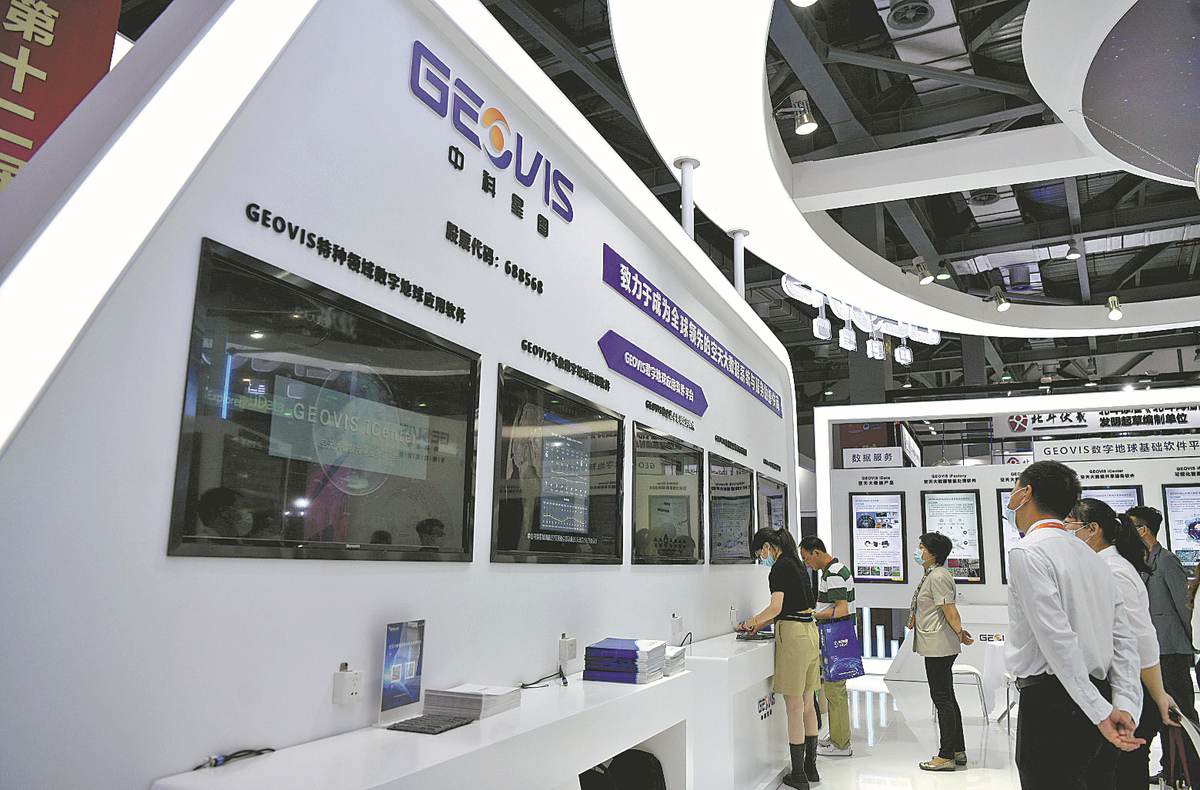
China is accelerating investment in the new and fast-growing space information — or "space computing" — sector which it sees as a future trillion-yuan driver of economic growth, with leading firms joining forces to develop the futuristic technology, which aims to process massive volumes of satellite and aerial data while in orbit.
Geovis Technology Co Ltd, a Chinese geospatial services provider, recently signed a framework agreement with supercomputer manufacturer Sugon to jointly build what they call an "open and inclusive space computing network". The planned network will connect users' devices to satellites, space-based infrastructure and ground platforms, forming a space-ground integrated intelligent computing architecture.
Shao Zongyou, president of Geovis, said in a recent interview with China Daily that computing in space could soon move from concept to reality. "Once the space computing network is completed, it will enhance global internet access capacity and stability, supporting applications such as remote work, telemedicine, online education, emergency communications and rural digital development," Shao said.
The ambition is driven in part by the rapid expansion of satellite constellations and the rising sophistication of payloads.
"With tens of thousands of satellites planned in the coming years and ever-higher payload and resolution demands, massive data — and thus computing needs — will surge," Shao said.
"Transmission methods like microwaves are slower than many home networks, while laser communication is too weather-dependent. The ideal is to compute in space, then send only the processed results back to earth," he added.
The space information sector, which spans navigation, weather forecasting, urban planning and resource exploration, has been developing rapidly under policy support, alongside China's push into the low-altitude economy and commercial spaceflight.
Over the past year, China has introduced a group of policies to stimulate low-altitude industries. These include regulations on unmanned aircraft flight management that took effect in January and a roadmap released in March for upgrading general aviation equipment through 2030.
Wu Yirong, academic dean and researcher at the Aerospace Information Research Institute of the Chinese Academy of Sciences, said: "China's aerospace information industry is integrating into all aspects of social production and everyday life at an unprecedented speed and depth. It is creating enormous economic value and social benefits."
For Geovis, the deal with Sugon marks a strategic shift from its established strengths in digital earth, AI, big data and cloud integration into the more technically demanding realm of space-based computation.
The two companies plan to develop high-performance, low-power high-reliability core components, build a space computing network, and integrate with China's national computing platforms. They will also explore industry standards and work to coordinate an ecosystem of partners.
Shao said the aim is to upgrade the current one-way satellite "data collection service" into a two-way "computing-as-a-service" model. This would allow for in-orbit intelligent processing linked to deep ground-based applications, potentially opening new commercial opportunities in areas such as real-time Earth observation, emergency disaster response and global broadband coverage.
Yet the road ahead is challenging. Shao said that deploying the same computing power in space could cost up to 1,000 times more than on the ground. Moreover, "space weather", including high-energy particles, radiation and temperature extremes, can damage electronic components and degrade performance over time.
Despite these difficulties, Geovis sees space computing as a strategic imperative with long-term returns. "Three to five years may yield no returns," Shao said. "But for national capability and the future of space industries, this must be done."
Deng Maicun, former secretary-general of the Chinese Academy of Sciences, said China's role in the field has transformed. "In recent years, China's aerospace information sector has made a remarkable leap from a follower to a front-runner, and in some areas even a leader, becoming a new engine for the development of the digital economy."
chengyu@chinadaily.com.cn



















