



Human-machine collaboration fueling high-quality growth









BEIJING — With two taps on a screen, soft music plays, and a robotic arm begins to massage. "So comfortable," a guest smiles. "I could lie here all day."
This is no ordinary machine. Developed by Chinese firm Aubo (Beijing) Robotics Technology Co Ltd, it's a collaborative robot, or cobot, capable of sensing, adapting and responding to its surroundings. It represents a new frontier in automation: embodied intelligence, involving machines that don't just think, but also feel.
"Welcome to the new face of Chinese manufacturing — not man versus machine, but man with machine," said Tian Hua, senior manager of Aubo's marketing department.
Once confined to factory floors, cobots are now spilling into healthcare and hospitality. As China transitions toward high-quality, innovation-driven growth, companies like Aubo are positioning cobots not as job-takers, but as partners — unlocking new potential for small businesses, skilled workers and daily life.
For decades, automation was equated with job loss. But the rise of cobots suggests a new narrative — collaboration over competition.
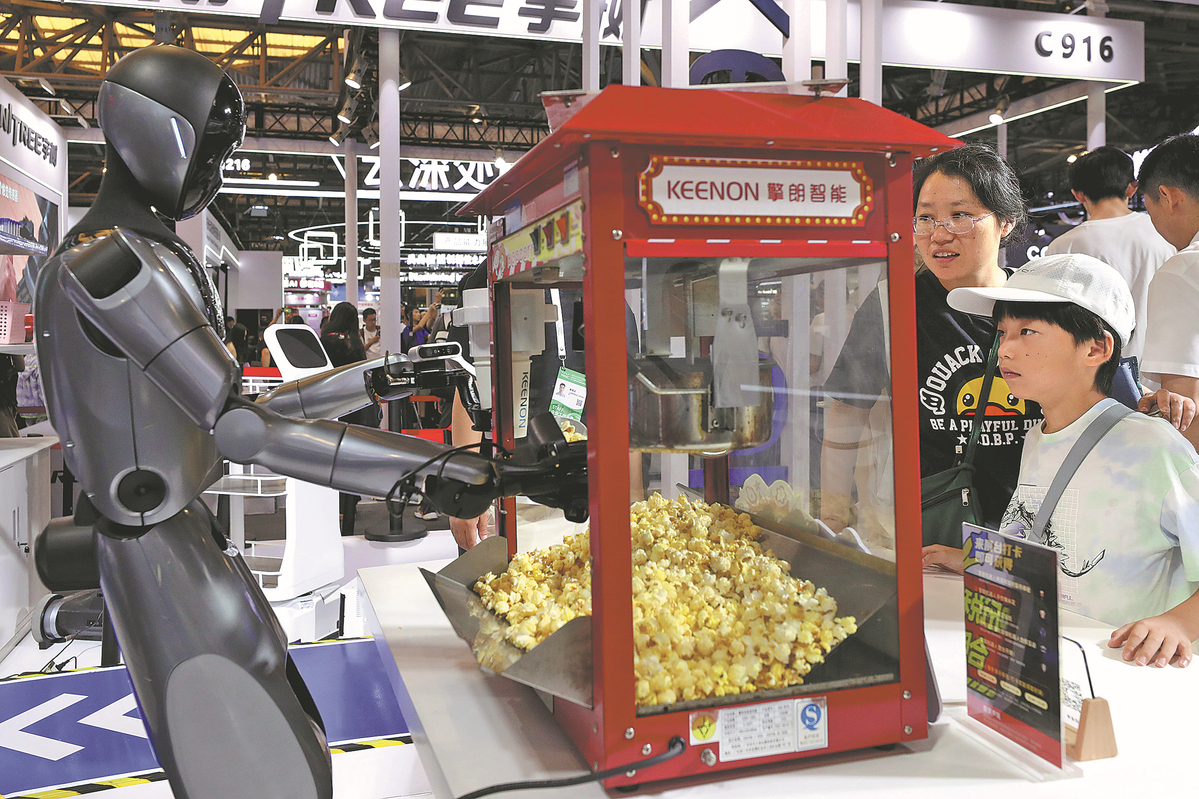
As Tian points to a robot barista, a latte is expertly topped with a flourish of foam art. "It takes 90 seconds to recreate a master's pour," said Tian. "We've deployed these in libraries and Instagrammable spots in Beijing, and they've become instant crowd favorites."
It can consistently produce 300 cups of high-quality latte art coffee a day, the equivalent of a human barista working nonstop for 15 hours and still struggling to maintain the same level of quality.
"These robots aren't here to replace people," Tian added. "They support human staff by handling repetitive, physically demanding tasks, freeing them up for more valuable, human-focused work."
For many small and medium-sized enterprises in China, the pressure is mounting. As labor shortages grow — particularly with Gen Z steering clear of repetitive factory jobs — automation has shifted from a luxury to a lifeline.
Aubo's cobots, built for easy setup and priced within reach, are helping to bridge that gap. Their best-selling palletizing model, for example, can stack up to nine boxes per minute, doing the work of three to four human laborers.
Sales to small manufacturers now make up more than 40 percent of the company's domestic orders, and the share is growing. "We've sold over 35,000 units cumulatively, making us the first in China to surpass 30,000 units, ranking first nationwide and second globally, just behind Universal Robots," Song Zhongkang, director of the Aubo Research Institute, told Xinhua News Agency in an interview. "At our peak, annual profits doubled. Growth is now holding steady at around 30-50 percent."
But it's not just about efficiency. Aubo's cobots are helping SMEs — the backbone of China's economy, responsible for over 60 percent of GDP and 80 percent of urban employment — compete on a global stage, from textile workshops in East China's Zhejiang province to electronics factories in South China's Guangdong province.
"Beyond SMEs, we also supply top-quality products to leading players in the automotive, 3C and home appliance sectors," Tian added.
In a country still reliant on a vast blue-collar workforce, Aubo is also investing in education.
"Some tasks like welding, industrial painting or marathon surgeries, are too harsh for humans," Tian said. "Cobots don't replace workers; they enhance safety and dignity."
To bridge the skills gap, Aubo has rolled out over 1,000 training programs in Chinese technical colleges. Thousands of workers, many with no prior coding or automation experience, have transformed into skilled cobot operators, steering machines with a joystick and gaining new purpose in an evolving economy.
Aubo's cobots — lightweight, human-safe and easy to master — are transforming China's workforce. "No degree needed. Some of our top operators were once packers or cleaners," Tian said.
"I thought automation would take my job," said Liu Wei, a former assembly worker and now a certified technician. "Instead, it gave me a better one with more pay and more control."
By relieving workers from repetitive, high-intensity, and hazardous tasks like welding or heavy lifting, Aubo is cultivating a more adaptable, resilient and future-ready labor force.
Aubo's cobots embody a bold vision — technological independence. Unlike many Chinese firms with foreign ties, Aubo is wholly homegrown, with 100 percent local R&D and manufacturing, driven by a team that includes 10 PhDs and 60 master's degree holders among its 500 global employees. Founder Wei Hongxing, once an aerospace researcher, started the company in a modest 10-person lab under China's "863 Program" for cutting-edge technology.
Now boasting over 270 patents, Aubo invests nearly 100 million yuan ($13.8 million) annually in research — about one-sixth of its revenue. "Not a single foreign chip powers our core systems," Wei said. "True security and scalability come from building your own tools."
Aubo Robotics' unwavering commitment to full-stack independence — from chips to algorithms — has positioned it as a formidable rival to global robotics giants like ABB, Kuka and Universal Robots. This year, Aubo has achieved a 95 percent domestic production rate, a landmark in China's quest for technological self-reliance.
Yet its ambitions extend far beyond home.
With over 2,000 partners across 50 countries, the company exports to North America, Europe, Southeast Asia, South America and advanced markets like Japan, where robotics adoption is among the highest globally. Its products, certified by CE and NRTL standards, command higher profit margins abroad.
Overseas markets are experiencing increasing demand. By 2030, the global cobot market is projected to reach $11.6 billion, with Chinese firms, led by Aubo, targeting a 30 percent share, according to a Grand View Research report.
"Overseas clients value our adaptability," Tian said. "Our cobots can switch formations and handle diverse orders, deploying in under two hours without needing a full technical crew."
Looking forward, Aubo is investing in cloud-connected cobots, AI-powered adaptive controls and remote surgical robotics. As machines grow smarter, the scope of human collaboration is expanding.
Whether on a factory floor or in a cafe, Aubo's vision endures. Humans no longer toil like machines because machines now work alongside them.




















