'Green is Gold'
China's successful experience offers the world better development pathways









Twenty years ago, Xi Jinping, then Party secretary of Zhejiang province, visited a village in Anji county in the province, where polluting quarries were being closed down. He told the locals that it made sense to do so, and that protecting the environment would provide even better economic opportunities. His quote at the time can be translated into: "Green mountains and lucid waters are in fact mountains of silver and gold."
This phrase was summarized as "Green is Gold" in a report by the United Nations Environment Programme in 2016. It provides a new way of thinking: environmental protection and economic development can go hand in hand, and are mutually reinforcing.
In the years since that visit, Xi went on to become the general secretary of the Communist Party of China Central Committee and the president of China, and he has further elaborated on his ideas around how to balance the environment and the economy. Environmental protection has become one of his signature policies, and the objective of building an ecological civilization has been incorporated into China's Constitution. Soon after he became president in 2013, the government started to release air quality data, leading to a surge in public awareness about environmental problems. A raft of environmental laws were revamped and strictly implemented, leading to visible results: air quality has greatly improved, surface water is cleaner, and many ecosystems are recovering.
China's success in green sectors is now a major driver of economic growth. Its experience is showing that there are major business opportunities in the green transition. UN Secretary-General António Guterres summarized it well: "Renewable energy is the economic opportunity of this century."
These days, Anji's economy is doing just fine. It has become a popular place to unwind for people living in big cities such as Shanghai, Nanjing and Suzhou. Fun outdoor activities are on offer in its lush environment, including river rafting, camping, hiking and more. Anji's agricultural products sell at a premium, after the farmers stopped using fertilizers and pesticides. At some of the old quarries, there are coffee shops, where digital nomads work to a view of deep blue water that has filled the pits. Anji is one of China's first examples of "reverse urbanization", where well-educated young people decide that they prefer to live in the pleasant environment of the countryside.
The concept of "Green is Gold" matters not just for China, but for the world. This is particularly evident through green cooperation in the Belt and Road Initiative. In September 2021, President Xi pledged at the UN General Assembly that China would "step up support for other developing countries in developing green and low-carbon energy, and will not build new coal-fired power projects abroad". China's halt to the building of coal-fired power plants overseas marked a turning point in global climate action. China's support in green and low carbon energy is just as important, as the world has set a target to triple the installed capacity of renewable energy by 2030.
China's green technologies are the key to the global response to climate change — they are a breakthrough the world has urgently needed. Low-cost, high-quality solar panels, wind turbines and batteries allow developing countries to leapfrog to low carbon energy systems, avoiding the "pollute first, clean up later" development model, jumping straight into the low carbon economy. They also allow advanced economies to accelerate their energy transition. And they offer an opportunity for any country to reduce dependence on imported fossil fuels.
The BRI International Green Development Coalition (BRIGC), led by former vice-minister of ecology and environment Zhao Yingmin, offers developing countries a "one-stop shop" for green cooperation under the BRI.
In Central America, Honduras is rich in hydropower and solar resources but highly vulnerable to climate change. Frequent hurricanes trigger severe floods, setting back hard-won economic development. Soon after establishing diplomatic relations with China in 2023, both sides started formulating a comprehensive energy plan for green, low-carbon and sustainable development, facilitated by the BRIGC. The cooperation will also greatly enhance water resource management in Honduras, making it much more resilient to climate change.
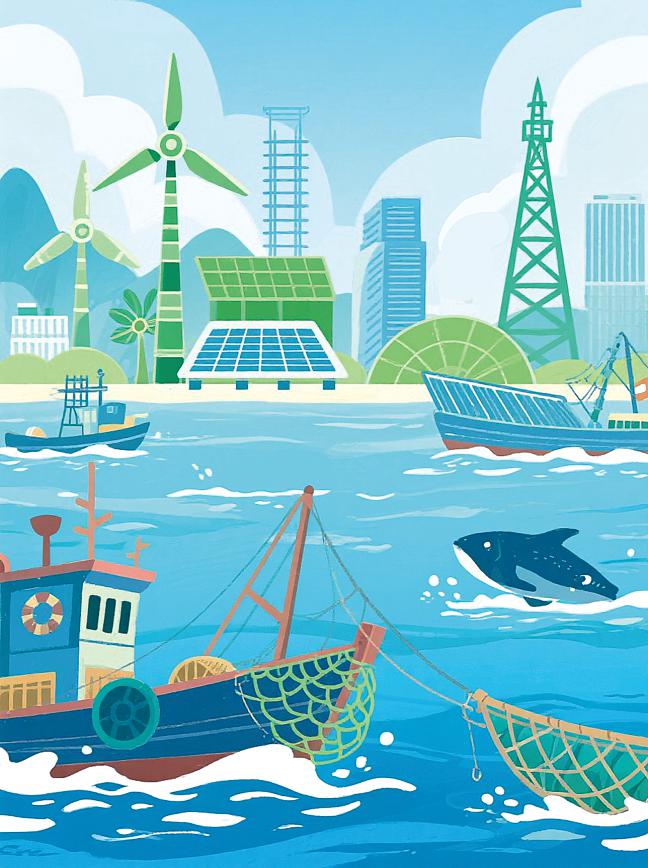
The concept "Green is Gold" highlights the intrinsic unity between the ecological and economic value of natural resources. It applies not only to ecological conservation and the energy transition, but also to the sustainable development of marine ecosystems and fisheries, which are currently of great international concern.
The ocean is a source of fisheries, and provides many other ecological services, such as maintaining biodiversity, regulating climate and purifying water. Overexploitation, destructive fishing and pollution not only deplete fisheries but also erode natural capital, ultimately undermining the foundation of human development.
Take West Africa as an example. Excessive distant-water fishing is depleting fish stocks along the West African coast, severely threatening the sustainability of local community fisheries and impacting food security and employment. Combating illegal fishing is not the responsibility of a single country. Distant-water fishing nations have a legal obligation to regulate their vessels operating in international and third-country waters.
Leaving more fish in the sea will mean that more fish will be available in the future. The "green" way — sustainable use of the ocean's resources — is in fact directly tied to the economic value — the "gold".
For many years, China has studied advanced methods and practices applied in other countries. "Green is Gold" underpins the concept of ecological civilization, which is emerging as the world's most advanced paradigm for promoting harmonious coexistence between humanity and nature. Maybe the time has come for China to share its best practices with other countries around the world.
The author is director for China at Client-Earth and special adviser of the China Council for International Cooperation on Environment and Development. The author contributed this article to China Watch, a think tank powered by China Daily. The views do not necessarily reflect those of China Daily.
Contact the editor at editor@chinawatch.cn.