



Chinese team cracks hydrates energy puzzle









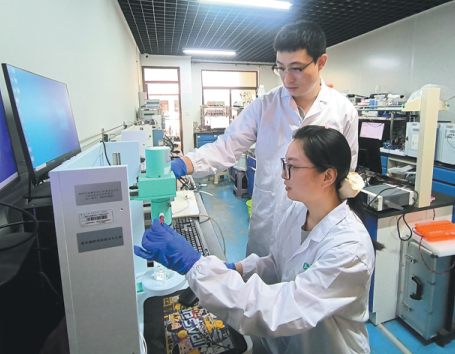
In a breakthrough that could reshape global energy markets, a Chinese research team has solved one of the most persistent challenges in catalytic chemistry: converting methane into methanol under mild conditions.
The breakthrough, published in the journal Nature Communications on Aug 19, could enable the commercial use of vast natural gas hydrate reserves — known as "flammable ice" — lying at the bottom of the South China Sea.
Developed by Hainan University's marine clean energy innovation team, the method uses a nanoscale palladium catalyst engineered to achieve 99.7 percent conversion at a temperature of 70 C.
Unlike conventional industrial processes that require temperatures above 800 C and high pressure — often burning methane into wasted carbon dioxide — the new system operates efficiently near room temperature.
"The key was precision engineering of the catalyst's surface structure," said Deng Peilin, an associate researcher at the university's School of Marine Science and Engineering. "We designed it to both activate methane and instantly release methanol before it over-oxidizes."
This "quick-release" mechanism is made possible by tailoring the electrical properties of palladium crystals at the atomic level, allowing methanol to desorb immediately after it forms.
The research, launched in 2020, addresses China's strategic priority to harness undersea energy resources while supporting its peak carbon and carbon neutrality goals.
"Our aim was to provide a core technology for use with South China Sea hydrates," Deng said.
The team's goal was to develop a system that aligned with China's carbon goals and offered a low-emission, high-efficiency alternative to traditional energy-intensive processes.
The result, said team leader Tian Xinlong, "possesses extremely high commercial application potential and economic value".
Financial analysts quickly recognized the significance. Everbright Securities, a financial services institution, called the breakthrough a "milestone". In a note, it said the new technique removes a critical barrier to using South China Sea gas hydrates and predicted commercial extraction of flammable ice could begin around 2030.
Everbright also said it expects growth opportunities for companies in deep-sea drilling equipment, methanol production and specialized catalyst manufacturing.
However, several hurdles remain before the technology can progress from the laboratory to offshore production. Deng said the primary challenges were scaling up the reactor design, creating equipment that can withstand a corrosive oceanic environment and wave action, and ensuring the process is cost-competitive.
The team's road map calls for constructing a medium-scale demonstration unit within two years, achieving a commercial-scale demonstration within five years and seeing the technology widely adopted across the South China Sea within a decade.
Methanol's potential downstream uses are extensive. It is a foundational chemical feedstock used to make plastics, paints and synthetic fibers. It can also serve as a clean-burning fuel for ships and vehicles.
Deng said the team is in talks with State-owned oil and gas giant China National Offshore Oil Corporation to adopt the technology for pilot applications and is researching ways to create high-value products from methanol.
Looking ahead, the researchers envision Hainan province becoming a global hub for deep-sea energy technology and manufacturing. By leveraging the island's status as a free trade port, they aim to build a complete industrial chain, from extraction and conversion to manufacturing.
The team also has global ambitions. The plan is to promote the technology through partnerships with international energy agencies, set up licensing agreements with foreign companies and make contributions to international standards — positioning the "Hainan solution" as a Chinese response to global energy and environmental challenges.


Today's Top News
- Stability, vitality and creativity appeal to all: China Daily editorial
- Xi attends Chinese New Year gathering with non-CPC personages
- Xi extends Spring Festival greetings to service personnel
- Nigeria and China at 55: a partnership for a new era
- 'Shopping in China' a broader economic repositioning
- China successfully conducts key flight test for manned lunar mission







