What is artificial intelligence's greatest risk?









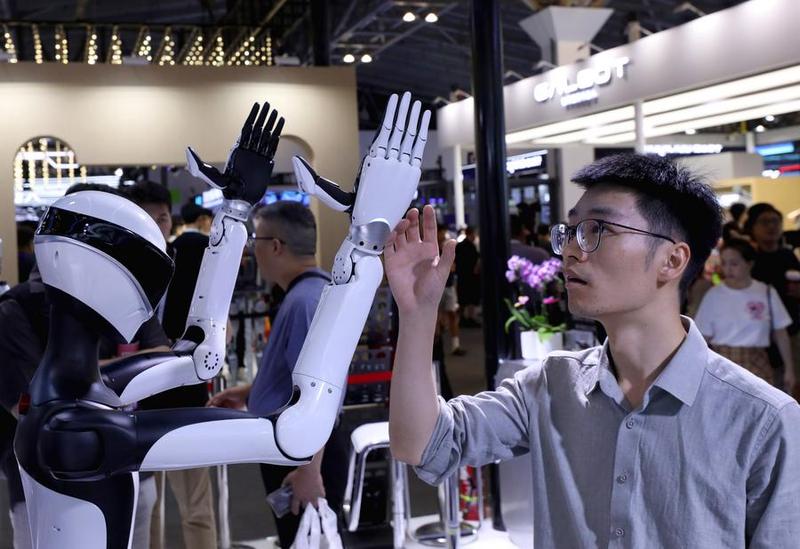
Risk dominates current discussions on AI governance. This July, Geoffrey Hinton, a Nobel and Turing laureate, addressed the World Artificial Intelligence Conference in Shanghai. His speech bore the title he has used almost exclusively since leaving Google in 2023: "Will Digital Intelligence Replace Biological Intelligence?" He stressed, once again, that AI might soon surpass humanity and threaten our survival.
Scientists and policymakers from China, the United States, European countries and elsewhere, nodded gravely in response. Yet this apparent consensus masks a profound paradox in AI governance. Conference after conference, the world's brightest minds have identified shared risks. They call for cooperation, sign declarations, then watch the world return to fierce competition the moment the panels end.
This paradox troubled me for years. I trust science, but if the threat is truly existential, why can't even survival unite humanity? Only recently did I grasp a disturbing possibility: these risk warnings fail to foster international cooperation because defining AI risk has itself become a new arena for international competition.
Traditionally, technology governance follows a clear causal chain: identify specific risks, then develop governance solutions. Nuclear weapons pose stark, objective dangers: blast yield, radiation, fallout. Climate change offers measurable indicators and an increasingly solid scientific consensus. AI, by contrast, is a blank canvas. No one can definitively convince everyone whether the greatest risk is mass unemployment, algorithmic discrimination, superintelligent takeover, or something entirely different that we have not even heard of.
This uncertainty transforms AI risk assessment from scientific inquiry into strategic gamesmanship. The US emphasizes "existential risks" from "frontier models", terminology that spotlights Silicon Valley's advanced systems.
This framework positions American tech giants as both sources of danger and essential partners in control. Europe focuses on "ethics" and "trustworthy AI", extending its regulatory expertise from data protection into artificial intelligence. China advocates that "AI safety is a global public good", arguing that risk governance should not be monopolized by a few nations but serve humanity's common interests, a narrative that challenges Western dominance while calling for multipolar governance.
Corporate actors prove equally adept at shaping risk narratives. OpenAI's emphasis on "alignment with human goals" highlights both genuine technical challenges and the company's particular research strengths. Anthropic promotes "constitutional AI" in domains where it claims special expertise. Other firms excel at selecting safety benchmarks that favor their approaches, while suggesting the real risks lie with competitors who fail to meet these standards. Computer scientists, philosophers, economists, each professional community shapes its own value through narrative, warning of technical catastrophe, revealing moral hazards, or predicting labor market upheaval.
The causal chain of AI safety has thus been inverted: we construct risk narratives first, then deduce technical threats; we design governance frameworks first, then define the problems requiring governance. Defining the problem creates causality. This is not epistemological failure but a new form of power, namely making your risk definition the unquestioned "scientific consensus". For how we define "artificial general intelligence", which applications constitute "unacceptable risk", what counts as "responsible AI", answers to all these questions will directly shape future technological trajectories, industrial competitive advantages, international market structures, and even the world order itself.
Does this mean AI safety cooperation is doomed to empty talk? Quite the opposite. Understanding the rules of the game enables better participation.
AI risk is constructed. For policymakers, this means advancing your agenda in international negotiations while understanding the genuine concerns and legitimate interests behind others'.
Acknowledging construction doesn't mean denying reality, regardless of how risks are defined, solid technical research, robust contingency mechanisms, and practical safeguards remain essential. For businesses, this means considering multiple stakeholders when shaping technical standards and avoiding winner-takes-all thinking.
True competitive advantage stems from unique strengths rooted in local innovation ecosystems, not opportunistic positioning. For the public, this means developing "risk immunity", learning to discern the interest structures and power relations behind different AI risk narratives, neither paralyzed by doomsday prophecies nor seduced by technological utopias.
International cooperation remains indispensable, but we must rethink its nature and possibilities. Rather than pursuing a unified AI risk governance framework, a consensus that is neither achievable nor necessary, we should acknowledge and manage the plurality of risk perceptions. The international community needs not one comprehensive global agreement superseding all others, but "competitive governance laboratories" where different governance models prove their worth in practice. This polycentric governance may appear loose but can achieve higher-order coordination through mutual learning and checks and balances.
We habitually view AI as another technology requiring governance, without realizing it is changing the meaning of "governance" itself. The competition to define AI risk isn't global governance's failure but its necessary evolution: a collective learning process for confronting the uncertainties of transformative technology.
The author is an associate professor at the Center for International Security and Strategy, Tsinghua University.
The views don't necessarily represent those of China Daily.
If you have a specific expertise, or would like to share your thought about our stories, then send us your writings at opinion@chinadaily.com.cn, and comment@chinadaily.com.cn.