



Remembering the cultural front line against Japanese aggression









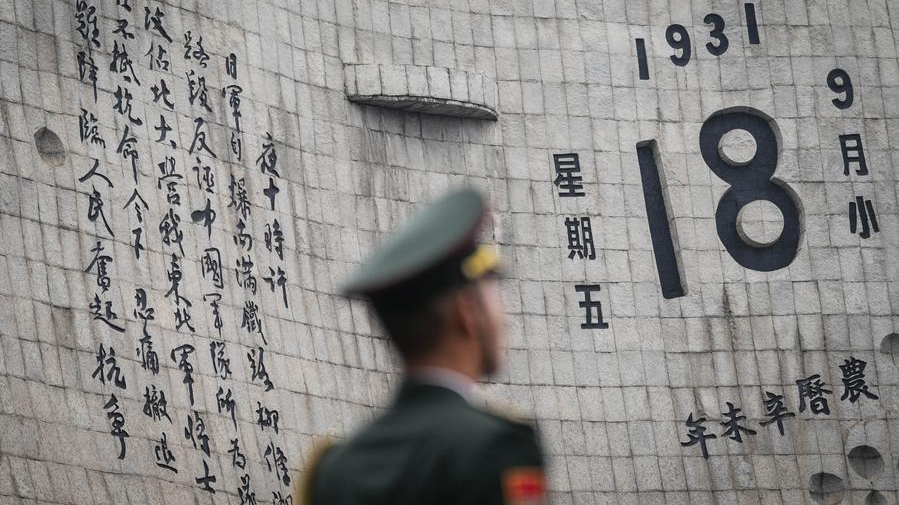
As Thursday marks the 94th anniversary of the September 18 Incident that marked the start of Japan's 14-year invasion of China, let us recall how a city in Southwest China countered the invaders using an unassuming weapon — culture.
On Sept 18, 1931, Japanese troops blew up a section of railway under their control near Shenyang, Liaoning province, and accused Chinese troops of sabotage as a pretext for the attack. Later that night, they bombed the barracks near Shenyang.
During the Chinese People's War of Resistance Against Japanese Aggression (1931-45), particularly between 1938 and 1944, Guilin, a regional hub in Southwest China, held its ground, not only by virtue of being a military stronghold but also as a beacon of cultural resistance. Millions of soldiers, civilians and cultural figures converged in Guilin, forging a unique cultural front and mobilizing national strength for survival and eventual victory.
Before the war, Guilin was a small city of about 70,000 people. Yet, as Guangzhou and Wuhan fell to Japanese forces, Guilin's population surged to half a million in a short time, becoming a magnet for more than 1,000 prominent cultural figures, including Liu Yazi, Xia Yan, Mao Dun, Tian Han and Ouyang Yuqian, along with over 100 progressive cultural groups.
In the face of the Japanese incursion, the cultural figures in Guilin resisted through their writing and cultural performances. At its peak, Guilin boasted more than 200 bookstores and publishing houses, producing over 200 magazines and an average of 20 new books and periodicals each day. These works reached readers across China, Hong Kong, Macao and Southeast Asia, ensuring that Chinese culture not only endured the war but also laid the foundation for postwar rejuvenation.
In the autumn of 1938, as the war situation grew dire, the Communist Party of China Central Committee designated Guilin as a strategic fulcrum connecting Yan'an with overseas. Through cultural dissemination, the Party transformed intellectual activity into a source of strength for the resistance.
Intellectuals, artists and workers from different regions and backgrounds rallied to the call of resistance, forging solidarity across divides. The 1944 Southwest Drama Exhibition epitomized this unity: 33 troupes from across southern China staged over 170 plays, turning the stage into a fortress and the theater into a battlefield.
Importantly, Guilin's cultural role extended beyond China's borders. Despite relentless Japanese air raids, schools relocated to mountain caves, showcasing the people's indomitable spirit. The establishment of the Guilin branch of the Anti-Fascist League in 1939 attracted journalists and writers from France, the United Kingdom, the United States and the Soviet Union. Through their reports and works, they exposed Japanese atrocities and conveyed the heroism of the Chinese people to the world.
Figures such as American writer Agnes Smedley, who delivered a speech broadcast globally from Guilin Radio Station in 1940, embodied this international solidarity.
What made Guilin's cultural resistance remarkable was mass participation. Cultural workers never stopped inspiring ordinary people to resist Japanese aggression through street performances, songs and accessible literature. These efforts made culture a living, breathing force that strengthened national consciousness and mobilized collective will.
The story of Guilin during those turbulent years is a vivid reminder that culture is not a luxury in times of crisis, but a weapon of resilience and unity. Under the leadership of the CPC, Guilin safeguarded the lifeblood of Chinese civilization, inspired faith in victory, and contributed to both national rejuvenation and international solidarity. Today, as China continues to draw strength from its cultural heritage, the experience of Guilin stands as a powerful testament to the enduring role of culture in the destiny of the nation.





