Draft standards for driver assistance tech a milestone
Clearer requirements for L2 systems focus on categories related to safety









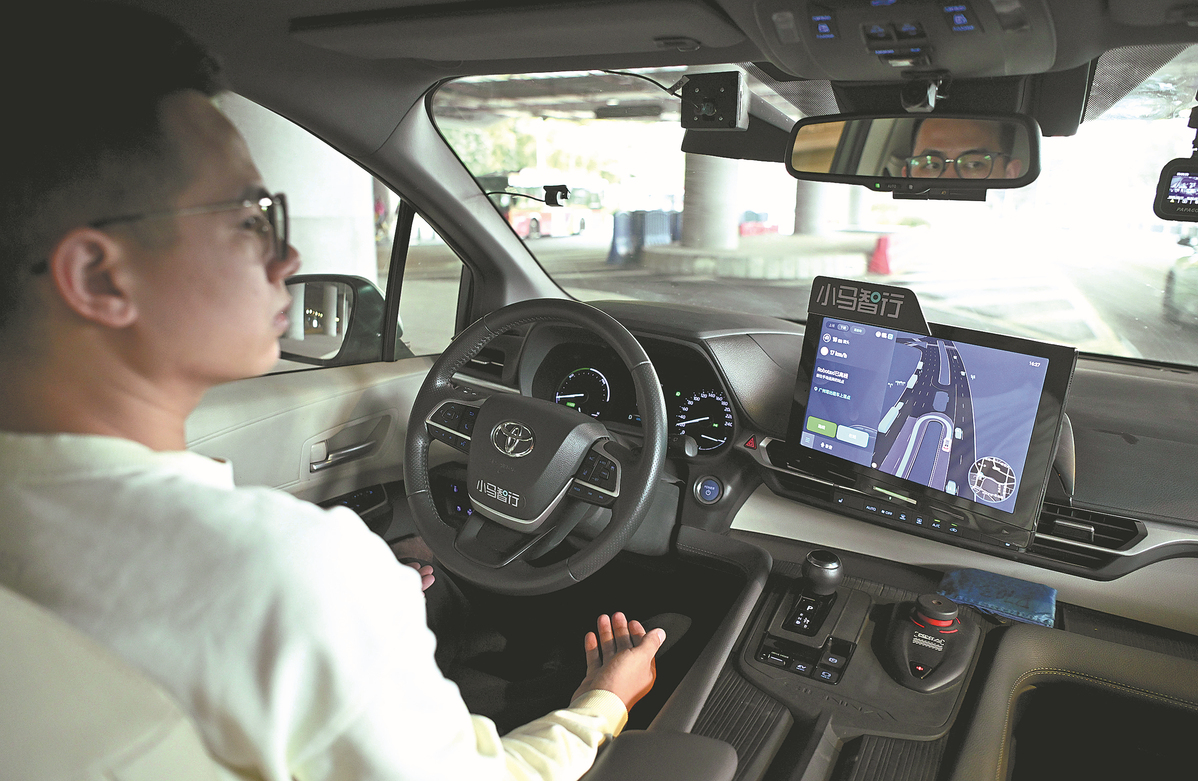
China is stepping up efforts to ensure the safe and steady rollout of driver assistance technologies by introducing new national standards, in a bid to guide innovation with regulation and ensure the steady, secure growth of its automobile industry, said industry experts.
The Ministry of Industry and Information Technology (MIIT) on Wednesday released a draft of the mandatory national standard on safety requirements for combined driver assistance systems, or Level 2 systems, aiming to fill key regulatory gaps for product safety in the field.
The highlight of the new standard is its clear requirements on operational conditions and driver monitoring, while further strengthening safety obligations for both automakers and their products, said an MIIT official.
According to the draft, L2 systems are not autonomous driving systems, as drivers must remain continuously engaged in dynamic driving tasks.
Automakers must specify the conditions under which such systems can be used — such as applicable speeds and road types — and are prohibited from activating the function outside these parameters.
The measure is intended to prevent misuse or abuse of the technology, the official said.
Standardized use is also highlighted as a key priority. The draft requires L2 systems to include both hands-off and gaze-off detection.
To further ensure proper use, the draft stipulates that when the system triggers risk mitigation due to driver disengagement, or if hands-off or gaze-off occurs repeatedly, the system must be disabled for at least 30 minutes before being reactivated, the draft said.
While remaining aligned with international standards, the new rules also take into account China's unique traffic environment and industry development needs, making adaptive adjustments to key technical requirements with a strong focus on safety performance and risk control, said Gong Jinfeng, deputy general manager of the China Automotive Technology and Research Center.
For example, compared with the UN Regulation No 171 adopted by the United Nations Economic Commission for Europe in 2024, the draft provides more detailed road test requirements and introduces locally relevant scenarios. It also adds in-vehicle data recording requirements to ensure accurate documentation of critical operating information and support accident investigation.
"This provides comprehensive safeguards for road safety as well as the life and property safety of the people," Gong said.
"It will also guide enterprises to increase investment in safety-related research and development and shift from pursuing diversified functions to prioritizing safety and reliability," Gong added.
Li Chuanhai, vice-president of Geely Auto Group and president of Geely's research institute, put forth a similar viewpoint.
Li noted that in the short term, automakers and suppliers must accelerate compliance upgrades to ensure that system naming, performance indicators and safety mechanisms meet national standards.
"In the longer term, the rules will help unify technical approaches, boost public trust and pave the way for L3 and higher-level driving automation systems," Li said.
The senior executive emphasized that the draft comes at a critical moment, as driver assistance technologies are gaining rapid traction in the country.
According to MIIT data, from January to July, China sold 7.76 million new passenger vehicles equipped with combined driver assistance systems, up 21.3 percent year-on-year, with a penetration rate of 62.6 percent.
"Given the fast pace of technological iteration and the complexity of application scenarios, a mechanism of continuous updates and phased tightening should be established under the current framework," Li added.
"Establishing baseline standards first, followed by phased tightening, will allow enterprises to transition smoothly while driving steady progress toward higher safety levels," he added.
Taking into account different product forms and technical routes, the draft categorizes L2 systems into three types and provides relevant standards: basic single-lane combined assistance, basic multilane combined assistance, and navigation-based combined assistance.
As the draft standard is currently open for public comment, its technical provisions will be further refined based on feedback from industry players, technical institutions, and experts, the MIIT said.
lijiaying@chinadaily.com.cn