


Burial bricks show evidence of barbecue parties










In the heart of the Gobi Desert, where the sands whisper tales of ancient times, lies an unexpected culinary delight immortalized in stone — perhaps indicative of the world's oldest barbecue party.
On the vast desert near Jiayuguan in Gansu province, the Wei and Jin Tombs, often hailed as an "underground art gallery", offer a tantalizing peek into the past with their vibrant brick murals dating back to the Wei (220-265) and Jin (265-420) dynasties.
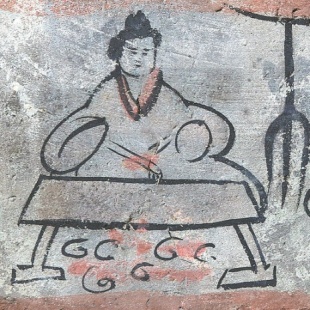
On the mural bricks found within the tombs, the barbecue culture emerges as a common and intriguing theme.
Scenes repeatedly depict a barbecue, frequently featuring roasted mutton as an integral part of banquets, which were important occasions for celebrations and social gatherings at the time.
"Each brick tells its own little story, showing scenes like slaughtering cattle and sheep or making meat skewers, like a lively comic book," says Lu Xiaoling, a researcher at the Wei and Jin Tombs Research Institute.
For decades, Lu has worked and conducted research at the tombs in Xincheng town, located at the junction of Jiuquan and Jiayuguan. More than 3,000 tombs have been discovered here, ranging from the Han (206 BC-AD 220) and Tang (618-907) dynasties, with most dating back to the Wei and Jin periods.
For preservation purposes, only Tomb No 6, excavated in 1972, is open to visitors.
"It's the one tomb among the other excavated ones that has the most richly detailed and best-preserved mural bricks. It also contains the most complete depiction of a barbecue scene," says Lu, 47.
The entire barbecue scene is depicted on the mural bricks in comic strip format. It illustrates chefs using knives to carve freshly slaughtered cattle and sheep into strips of meat, threading the cut pieces onto large three-pronged skewers, and then carefully roasting them over a fire. Finally, the cooked meat is presented by servants to the banquet guests, where sizzling meat, music and dance come together in a celebration of life and leisure.
"This indicates that, at the time, especially in the Hexi Corridor (a vital passageway on the ancient Silk Road), roasted meat was already very popular. It was a delicacy used to entertain guests and was highly favored," she says.
The tomb occupant used mural bricks to document his life, hoping to continue enjoying these experiences after death. This reflects the perspective on life and death at the time, where people viewed death as a continuation of life, explains Lu.
This particular tomb was built for a married couple. Based on the unearthed artifacts, the tomb occupant was a civil official in the government during his lifetime. In contrast, tombs of military officials often depict hunting scenes.
In the limited number of excavated tombs, more than 700 mural bricks have been unearthed, depicting a variety of scenes, including agricultural activities, such as mulberry picking and animal husbandry, farming, banquets, hunting, cooking activities, and various other aspects of social life.
The scenes depicted on the mural bricks also reveal that what is now a vast desert was once a fertile land rich in water and grass. It was also a region where multiple ethnic groups coexisted. The mural bricks illustrate foreign merchants with pointed noses leading camels. Based on their attire, they appear to be from present-day Uzbekistan.
Since the initial excavations in the 1970s, fewer than 10 tombs have been uncovered because the excavation has been conducted primarily for rescue and preservation purposes. Currently, there are no plans to excavate the remaining burial sites.
Tomb No 6, the only tomb open to the public, allows a maximum of 225 visitors per day. To visit the tomb, one must pass through a narrow, downward-sloping passage.
Upon entering the brick tomb, each doorway requires visitors to bend down to pass through. Due to the tomb's limited space, only a maximum of 12 people can be inside at a time.