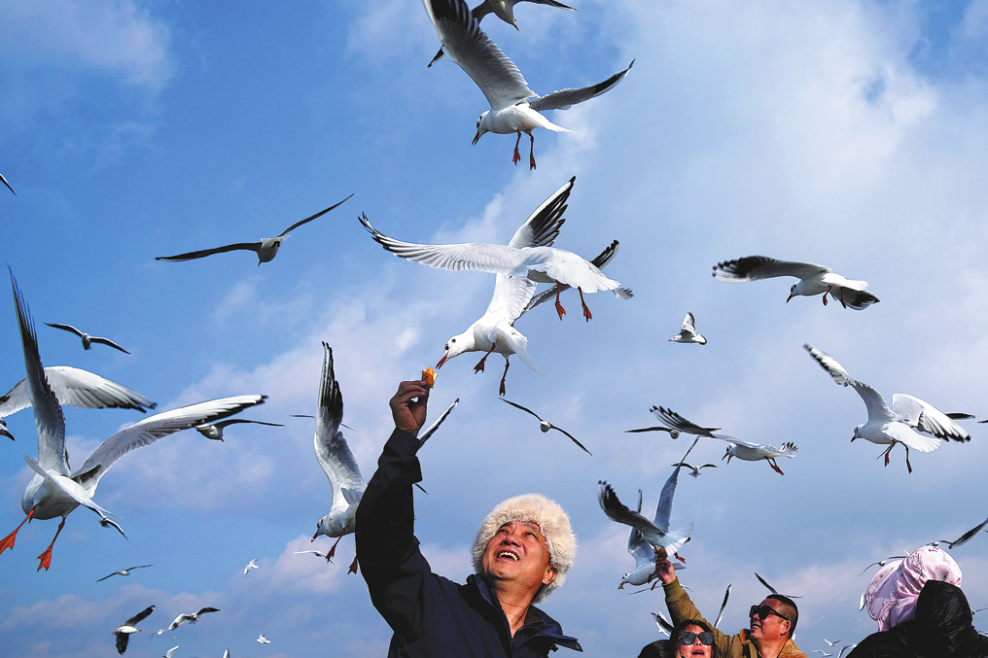
North China's barren salt flats turn into rice fields, tourist attractions










HOHHOT -- October on the Ordos Plateau brings blue skies and a cool breeze that carries the scent of ripening rice in North China's Inner Mongolia autonomous region. Little more than five years ago the same wind only lifted white dust from a stretch of alkaline land so sterile that locals nicknamed it "earth's cancer."
Today, standing atop a 26.5-meter-tall viewing tower in Xiaotanzi village, Dalu township of Zhungeer Banner, the township's Party Secretary Gao Xiangdong pointed to a golden carpet of paddies rippling beneath him. "Who could imagine we would have rice paintings, viewing towers and a glass walkway, attracting a constant stream of tourists and bringing prosperity to the villagers?" he said.
The turn-around began in 2021, when modern agricultural technology was introduced to use rice paddies to flush out salt hidden in the soil. This innovative approach gradually reduced salinity and revived the once-infertile land.
The local Yellow River rice and fish eco-tourism park also embraced a rice-crab polyculture: crabs feed on pests and weeds, their droppings fertilize the rice, and the rice canopy shades the crabs.
The park covers an area of about 3,000 mu (200 hectares), with over 1,800 mu dedicated to rice-crab coexistence farming and an annual rice yield of over 500,000 kilograms, according to Gao.
Giant rice-paddy paintings, like the image of the iconic character Nezha, a rebellious boy-god from Chinese mythology, adorn the landscape. These stunning artworks are enhanced by a 700-meter-long glass walkway, tree-house homestays and a VR experience hall inside the park. Together, these attractions draw a significant number of tourists eager to enjoy their rural getaway.
The benefits of local development are now reaching more and more villagers, with the majority of the park's workforce comprised of local residents.
Local villagers receive a direct annual income of 1.4 million yuan (about $200,000) from the land rent and operation, benefiting 258 households with a total of 774 people. It has also provided employment for more than 20 villagers, with an average annual income of 42,000 yuan per person.
More than 70 fish restaurants have sprung up around the park, all doing a roaring trade. "Each family has its own agricultural products and skills. Although they all serve fish, each has its own unique features," Gao added. "On weekends, many people from surrounding cities come here specially to taste the farmhouse delicacies."
In Dagou Village of Dalu Township, another scene stops busloads of travelers: a 30-mu lotus pond inside the Kubuqi Desert, where pink and white blooms still flower in early autumn. "It was an abandoned fish pit. As ground-water seeped in, the sand filtered it and the lotus roots love the clean water," explained Hao Weiquan, who manages the lotus attraction.
Since the pond appeared and local environment improved, herons, egrets and wild ducks have followed the water, contributing over 20 new bird species to the local lists in Dalu Township.
As a frontline in China's Three-North Shelterbelt Forest Program (TSFP), the world's largest afforestation initiative launched in 1978 to combat desertification across the country's northwestern, northern and northeastern regions, Zhungeer Banner has completed in recent years four 1-million-mu projects: sea-buckthorn planting, apricot planting, comprehensive management of loess sandstone and harnessing of mining areas.
Gao did a rough calculation: During this year's peak tourist season, the eco-tourism park has already generated tourism revenue of more than half a million yuan and the lotus pond alone has also driven the development of surrounding farm-stay businesses, which are still growing rapidly.
"We tied ecological repair to real income," said Gao. "One patch of wasteland has delivered environmental, economic and social gains all at once."

- Shanghai braces for record passenger numbers during Spring Festival
- China’s disciplinary bodies penalize over 3,700 staff in 2025
- Radiopharmaceutical development alliance launched in Shanghai
- Kelsang Pedron: A Tibetan female pilot in the Chinese PLA Air Force
- China expands rural land contract extension pilot program
- Fiber chip thinner than a hair