



China economy to stay growing, IMF forecasts
Tariffs, possibility of technology sector downturn cloud global picture: Experts









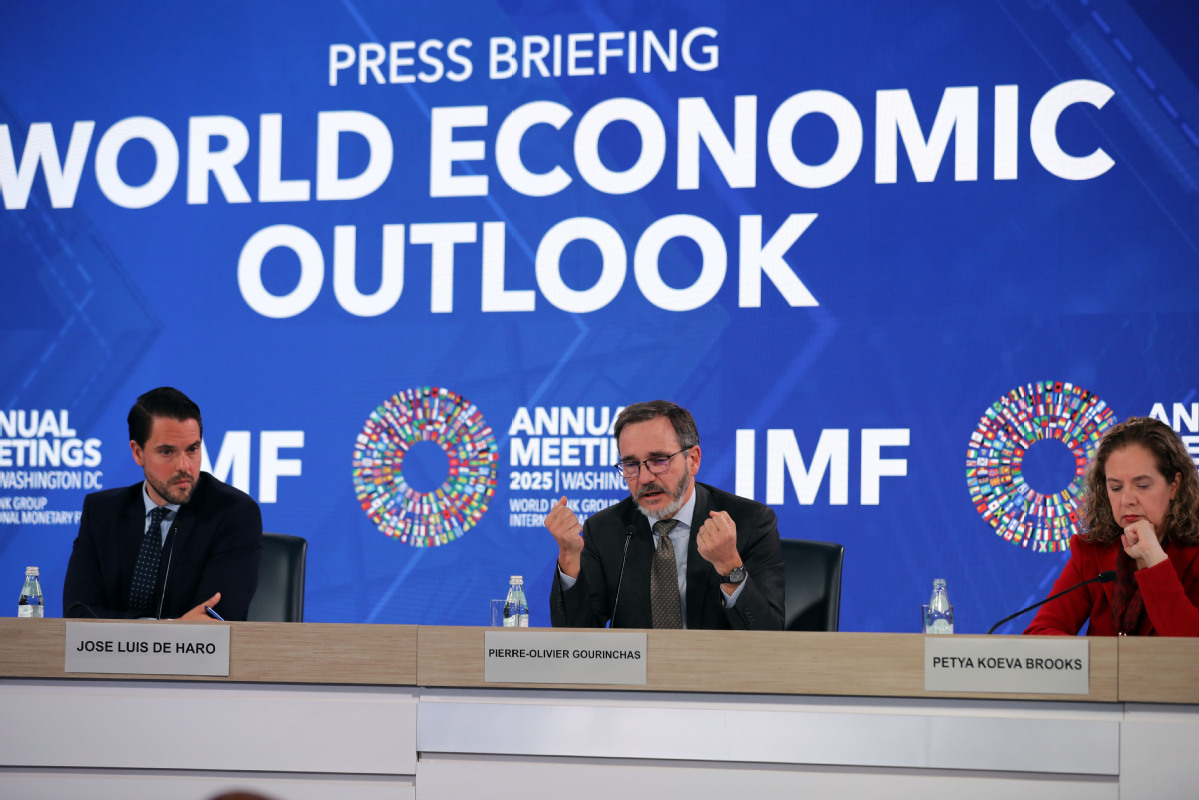
The International Monetary Fund has predicted that China's economy will grow 4.8 percent this year, up 0.3 percentage point on what was forecast a year ago, saying it expects the world economy to slow further in the coming years.
Global growth was projected at 3.2 percent this year and 3.1 percent next year, a cumulative 0.2 percentage point downgrade since forecasts a year earlier, the IMF said in its October World Economy Outlook, published on Tuesday at the start of the annual IMF/World Bank autumn meetings.
The IMF's projection for China, close to China's goal of about 5 percent growth for the year, has reflected the shifting effects of trade policy and domestic efforts.
"A stronger-than-expected outturn in recent quarters — reflecting front-loading in international trade and relatively robust domestic consumption supported by fiscal expansion in 2025 — more than offset the headwinds from higher uncertainty and tariffs," the IMF said of China's growth prospect.
China's Premier Li Qiang, presiding over a symposium on Tuesday on China's current economic situation and the next steps for economic work, emphasized the need to understand the current economic situation with a broader perspective.
It is essential to view the long-term trends in economic development from the implementation of the Five-Year Plan for National Economic and Social Development, assess the vitality of business entities through human resources, material, information and capital flows, and understand the resilience of China's economy in light of changes in the international landscape, he said.
Li stressed the importance of enhancing the effectiveness of counter-cyclical adjustments, making the most of policy support, and using reform measures to clear obstacles hindering economic growth.
He also called for sustained efforts to expand domestic demand, as well as measures to foster a world-class industrial ecosystem and address disorderly and irrational competition in some sectors.
In April, when US President Donald Trump shook global trade norms by announcing sweeping tariffs, the IMF trimmed its forecast for China's growth by 0.6 percentage point in response to escalating US-China trade frictions.
By July, following a pause on higher rates in May, it revised the figure upward by 0.8 percentage point.
Now, half a year after the tariff war began, the IMF projects China's economy to maintain the growth rate it predicted in July, 4.8 percent, and that it will slow modestly next year.
A week earlier the World Bank projected China's economy would grow 4.8 percent; in April it had forecast growth of 4 percent.
China's gross domestic product grew 5.3 percent in the first half of this year, up 0.3 percentage point from the same period last year, according to official figures.
"China is weathering higher tariffs with a weaker real exchange rate, redirected exports to Asia and Europe, and fiscal support," Pierre-Olivier Gourinchas, the IMF's economic counselor and director of the research department, wrote in a blog on Tuesday.
The US economy is expected to slow more sharply this year than was projected a year ago.
Its growth, forecast at 2 percent this year, compares with the 2.2 percent projected in the October 2024 World Economic Outlook, mainly as a result of greater policy uncertainty, higher trade barriers, and lower growth in both the labor force and employment.
Though the increase in tariffs and its effect has been smaller than expected so far, Gourinchas cautioned that it would be both premature and incorrect to conclude that the recent tariff surge has had no impact on global growth.
While the immediate data show limited visible fallout, the full economic effects are likely to unfold over time, he said.
On the one hand, US tariffs remain elevated and trade tensions continue to flare, with no lasting agreements in sight and experience showing that trade shocks can take years to play out.
Most of the burden seems to have fallen on US importers, because import prices excluding tariffs have stayed flat and retail prices have risen only modestly. However, consumers could still face higher costs, and trade rerouting could lead to lasting efficiency losses worldwide, Gourinchas said.
On the other hand, other forces are simultaneously shaping the outlook. For example, tighter US immigration policies have reduced the supply of foreign-born workers, compounding the supply shock from tariffs.
At the same time, loose financial conditions, a softer dollar and booming AI-driven investment are propping up demand and activity, though they may also be adding to inflationary pressures, Gourinchas said.
"Overall, despite a steady first half, the outlook remains fragile, and risks remain tilted to the downside. The main risk is that tariffs may increase further from renewed and unresolved trade tensions, which, coupled with supply chain disruptions, could lower global output by 0.3 percent next year."
Among the "simmering" downside risks, Gourinchas highlighted the risk posed by surging investment in artificial intelligence in the US, reminiscent of the dot.com boom of the late 1990s.
In explaining the flip side, Gourinchas said that markets could reprice sharply, especially if AI fails to justify lofty profit expectations. That would dent wealth and curb consumption, with adverse effects potentially reverberating through the financial system.
In an analysis published a week ago, Oxford Economics predicted that a technology downturn would inflict a sharp global slowdown.
"We constructed two scenarios for a tech sector downturn using Oxford Economics' Global Model," the researchers at the Oxford-based economic advisory firm said in a report on Oct 3.
"In a US-centered downturn with modest international spillovers, US GDP growth falls to just 0.8 percent in 2026, flirting with recession."
Despite the downside risks, Gourinchas said, resolving policy uncertainty would provide a significant lift to the global economy, with clearer and more stable bilateral and multilateral trade agreements being able to raise global output by 0.4 percent in the very near term.
Cao Desheng in Beijing contributed to this story.










