Digital technology reveals ancient caisson artistry









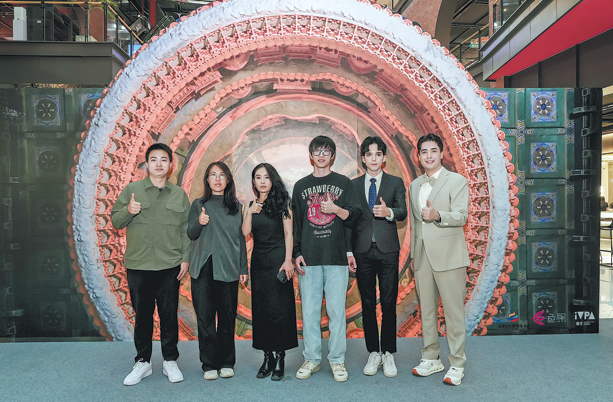
"You can try lying down," said Wang Zhigang, chief curator of Houses of Heaven: Immersive Chinese Caisson Digital Art Exhibition, to a mother and daughter visiting the show in Beijing.
The girl lay on the floor as a six-sided LED ceiling lit up above her, projecting vivid images of Qing Dynasty (1644-1911) caissons, or zaojing — ornate wooden dome structures commonly found in imperial palaces and grand temples, renowned for their intricate painting and geometric design.
"In real historic buildings, I always had to lift her onto my shoulders, and even then, she still couldn't see the caisson clearly," her mother said. "Here, she feels as if the whole ceiling is within her reach."
According to Wang, a professor at Tsinghua University's Academy of Arts and Design, the towering height of caissons and the dim lighting in traditional halls often make the details difficult to see, leaving much of their artistry overlooked.
To change that, he led a team of young cultural heritage specialists and turned to digital technology to bring these ancient designs closer to the public.
Held at Beijing's Huiduo Mall from Sept 18 to 24, the exhibition recreated these architectural marvels using a cave automatic virtual environment (CAVE) — a room-sized immersive virtual reality system — allowing visitors to experience the caissons up close in striking detail.
"Shifting from traditional exhibitions to immersive ones is a major trend today," said Zhang Yuan, 31, a doctoral student and the exhibition designer. She oversaw the entire process, from research to digital reconstruction.
According to her, the three-minute immersive display took one year and nine months to complete, with the main challenges being limited access and difficult data collection.
"Some archives are restricted by copyright, while on-site documentation often faces practical obstacles," Zhang said.
She recalled the team's fieldwork last summer in Shanxi province. "We brought professional laser scanners, but many sites banned large equipment for safety reasons," she said. In those cases, Zhang and her teammates had to photograph the sites as ordinary visitors and later used photogrammetry to build 3D models.
Collecting the data was just the first step. Zhang noted that raw scans often contained local inaccuracies, requiring meticulous manual correction — a process she likened to "micro-sculpting".
"People used to understand through books that caissons connect heaven and earth, reflecting cosmic order and social hierarchy," she said. "In our CAVE space, visitors naturally look upward — and that very act conveys a sense of hierarchical authority."
For 28-year-old Iranian doctoral student Pouya Amani, who grew up and studied in China, the project drew on his interdisciplinary background in design and cultural heritage.
"Iran and the Middle East also have striking caisson-like structures, such as muqarnas. But the Chinese caissons we worked on stood out for their narrative depth," he said.
The exhibition took inspiration from caissons found in landmark sites across China, including the Longfu Temple in Beijing and Yongle Palace in Ruicheng county, Shanxi. Amani helped animate the dragon motif from the Longfu Temple's caisson, allowing the imperial symbol to interact dynamically with visitors.
"Each caisson tells its own story," Amani said. "Designers from different dynasties and regions expressed different ideas through them."
A digital vista
After the exhibition, Zhang, a member of the Miao ethnic group, set her next goal: turning Miao folk songs into a visual soundscape map.
"These songs are like the Miao 'Bible'. They preserve our history, although their melodies and styles vary from region to region," she explained.
In her vision, audiences can locate specific villages on the map, listen to their unique chants, and even interact with and learn from them.
Amani also looks forward to taking the exhibition abroad. With its digitized VR version, he believes the show has a great opportunity to tour internationally.
"Technology can quickly bring cultures closer. A short film with the right visuals can help international audiences grasp the essence of caissons," he said.
"China is full of culture. The key is finding subjects that translate well into digital form," he added.