Authentic credentials









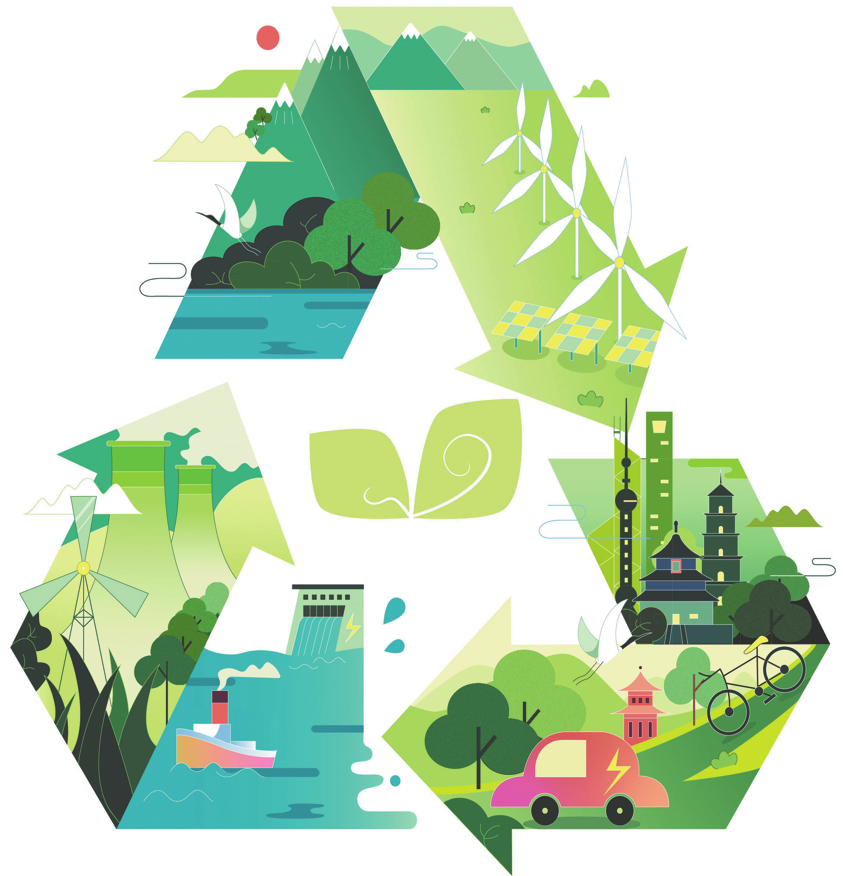
China's economic and industrial policies are increasingly green and it now leads the world's response to climate change
The centrality of ecological thinking to China's development path requires emphasizing. It is often neglected for several reasons. First, attention has long focused on China's stupendous economic growth, which was unavoidably fueled initially by traditional sources of carbon-rich energy. Less often recognized is that it has been 20 years since China was one of the few developing countries to pass a national Renewable Energy Law.
Second, countries playing catch-up on China's lead in green technology find it politically convenient to downplay China's achievements. But China has the world's largest capacity and has installed more wind and solar energy in 2024 than the United States has installed in total.
Third, the depth and breadth of China's ecological policies are so extensive that they are difficult to convey succinctly in words. The often-used translations are "lucid waters and lush mountains are invaluable assets" or "clear waters and green mountains are just as valuable as mountains of gold and silver".
The original Chinese concept refers to multiple aspects of related policies. It is often used as an umbrella term for environmental policies or as a concept encouraging public engagement in green issues. Sometimes it illustrates the stages of development since China's reform and opening-up. Equally, it refers to the motivation and policies that underpin China's world-leading investment in green industries, from the refining of essential rare earth minerals to the production of electric vehicles.
Employed alongside the concept of building an ecological civilization, it presents a bold vision for China's future cultural development. The ambition of building an ecological civilization was proposed at the 18th National Congress of the Communist Party of China in 2012, along with goals of economic, political, cultural and social progress. So central is the concept to China's future, that it has been added to the Chinese Constitution.
Priority given to the environment is not new. The traditional Chinese idea of the unity of heaven and humanity even predates Confucianism but was later absorbed into Confucian teaching. Translated into modern language, the universe was viewed as a dynamic interdependent system to which every person and object in nature contributed. In addition, notions of moderation and restraint predominated, alongside ethical principles of virtuous governance based on benevolence, ensuring that rulers implemented policies beneficial to society and the environment.
Similar ideas are discernible from Chinese painting. Humans are typically embedded as small figures in majestic landscapes that, read from bottom to top, dominate the image. In contrast, linear perspective in Western art often relegates the environment to a distant backcloth with people placed centerstage in front.
The concept of an ecological civilization translates into practical policy. China announced its dual-carbon goals at the general debate of the 75th session of the United Nations General Assembly in 2020, pledging that China would strive to peak carbon dioxide emissions before 2030 and achieve carbon neutrality before 2060. Given China's recent industrialization, the goals are massively ambitious. Yet, the United Kingdom-based Carbon Brief reports that China's CO2 emissions may have already peaked in 2024, six years earlier due to investment in green energy.
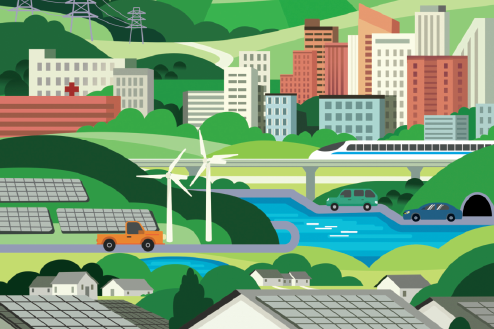
The scale of investment — 2.16 billion kilowatts of China's total installed renewable energy capacity by June 2025 — defies words. Imagine a 220-meter-tall lighthouse built in a desert; 14,500 heliostats turn — as sunflowers do — with the movement of the sun, reflecting sunlight to the top of the "lighthouse" tower that appears incandescent. There, in Hami, Northwest China's Xinjiang Uygur autonomous region, the sun's warmth turns water into steam and steam into 50 megawatts of electricity.
Efficient use of energy is as important as clean production. China has designated 66 national-level strategic emerging industry clusters to develop green, low-carbon and circular economies with maximum energy efficiency, refurbishment and recycling, creating minimum waste. In addition, there are more than 6,400 national-level green factories, and over 490 green industrial parks. According to the University of Chicago's Air Quality Life Index, particulate pollution has fallen faster since 2014 than in any other country, attention now being focused on late-developing cities in China's western region.
Some areas in China are exceptionally vulnerable to climate change, with summer 2025 being the hottest on record and 329 rivers flooding above warning levels before July. Under the National Climate Change Adaptation Strategy 2035, provinces are implementing action plans with resiliency initiatives for vulnerable regions and populations. Thirty designated "sponge cities" are being re-engineered to minimize flooding. About 1,780 kilometers of coastline have been rehabilitated, and the total mangrove area has increased to 30,300 hectares.
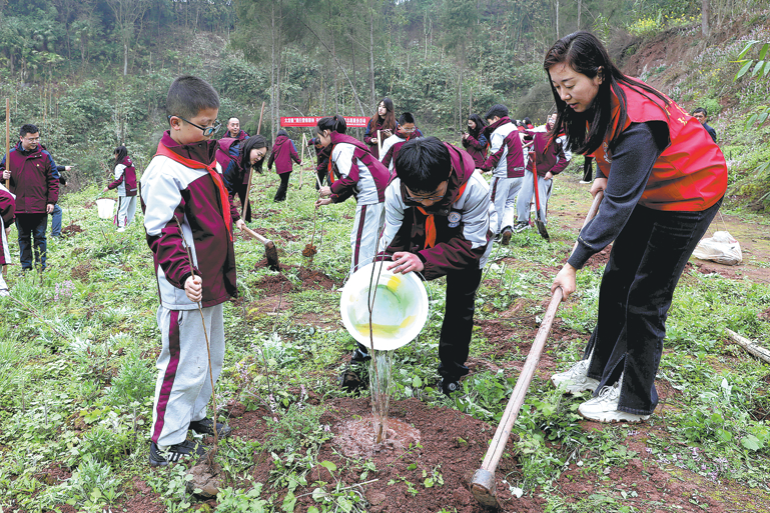
In 1978, China took some afforestation programs to scale, embarking on the Three-North Shelterbelt Forest Program, the world's largest afforestation program, covering over 40 percent of China's land area. By addressing desertification, dust storms and soil erosion, 30.14 million hectares have been reforested, carbon sequestration enhanced, crop yields increased and economic development fostered. Apples, peaches, red dates, chestnuts, jujubes and apricots are harvested to be marketed from where nothing once grew. While scale is important, detail matters too. The flower beds between the crash barriers on Beijing's ring roads symbolize respect for nature and people.
China's green policies demonstrate sustained long-term investment and commitment spanning generations. And they need to be complemented by the actions of other countries. With the US addicted to hydrocarbon energy and pursuing an "only American matters" policy under the guise of "America First", Europe would be the best to collaborate with China to ensure that future generations inherit a green and prosperous world.
The author is a professor at the Jingshi Academy at Beijing Normal University and an emeritus fellow at Green Templeton College at Oxford University. The author contributed this article to China Watch, a think tank powered by China Daily.
The views do not necessarily reflect those of China Daily.
Contact the editor at editor@chinawatch.cn.