



Significant shift









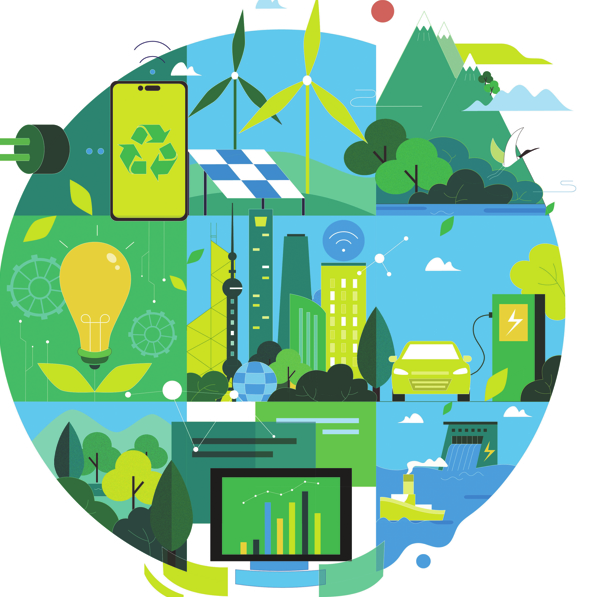
China has progressed from being a participant in the global energy transition to a provider of solutions
Over the 14th Five-Year Plan (2021-25) period, China has delivered tangible results in its green transition. The country has strengthened its energy supply capacity, improved efficiency and accelerated technological innovation, laying a solid foundation for the next stage of modernization.
In 2024, China's total electricity generation exceeded 10 trillion kilowatt-hours — around one-third of the global total — driven largely by the rapid rollout of renewable energy and smart grid dispatch. Provincial and regional electricity spot markets have been launched, while major transmission corridors such as the west-to-east power and gas pipelines continue to expand, enabling more efficient cross-regional allocation of resources.
At the same time, the structure of energy consumption is beginning to shift. In 2024, non-fossil energy accounted for 19.8 percent of primary energy use, and renewables represented roughly 56 percent of installed power capacity. The clean energy transition is also reshaping the transport sector: New energy vehicles make up 40.9 percent of new car sales, supported by the world's largest charging network.
Institutional reforms have kept pace with technological advances. China has launched a national carbon emissions trading system, expanded its sectoral coverage and fostered a fast-maturing green finance market that channels capital toward low-carbon industries. Breakthroughs in ultra-high-voltage transmission, advanced batteries and other next-generation energy technologies have further cemented China's position as a global front-runner in clean energy innovation.
With the conclusion of the fourth plenary session of the 20th Central Committee of the Communist Party of China in October, the country's green transition is shifting from laying the groundwork to accelerating comprehensive implementation. The plenary session's communiqué sets out a clear policy sequence for this new stage of modernization: pressing ahead with the critical battle against pollution and advancing the drive to upgrade ecosystems, moving faster to develop a new energy system, working actively and prudently toward peaking carbon emissions, and accelerating the shift to eco-friendly production practices and lifestyles.
What makes this moment particularly significant is a subtle but important change in policy language — from "plan and develop a new energy system" in the report to the 20th CPC National Congress in 2022 to simply "develop a new energy system". This shift indicates that China's energy transition is no longer confined to strategic design or pilot programs, but is entering a phase where institutional frameworks must deliver concrete results on the ground.
Against this backdrop, the 15th Five-Year Plan period (2026-30) will become a pivotal window for transformation. It will test China's ability to translate policies into system-wide change, align economic growth with energy security and advance carbon reduction without compromising industrial resilience. In short, success in this period will determine whether China can move from ambition to execution in building a modern, low-carbon energy system.
As China moves from planning to implementation, the task ahead becomes significantly more complex. The goals are no longer policy concepts. They now face the test of real-world constraints. At this stage, ambition must be matched with system-level solutions.
On the supply side, long-standing structural challenges remain. Renewable energy resources are unevenly distributed across regions, transmission bottlenecks persist, and the mismatch between power generation in the western regions and strong demand in the east continues to constrain efficiency. China needs to further enhance its resources storage capacity and flexible generation resources to make better use of its wind and solar power.
At the same time, external uncertainties are rising. Geopolitical tensions, such as the Ukraine crisis and the conflict in the Middle East, as well as the growing risk of supply chain fragmentation, are reshaping the landscape of global energy security. Green trade barriers such as the European Union's Carbon Border Adjustment Mechanism are adding pressure to China's export-oriented industries and manufacturing supply chains.
On the demand side, the challenge is no less daunting. Rapid electrification in transportation, buildings and manufacturing is causing demand to concentrate in certain hours and regions, increasing pressure on grid flexibility. Extreme weather events are making electricity loads more volatile and harder to predict. Most notably, the rapid expansion of artificial intelligence, data centers and cloud computing is driving a new surge in electricity demand. These computing hubs run almost non-stop, consuming vast amounts of power and creating a new dilemma for China: how to support digital growth without causing an uncontrolled increase in energy use and carbon emissions.
As China enters the 15th Five-Year Plan period, the focus of its energy transition is shifting from expanding capacity to improving efficiency, flexibility and resilience across the system.
First, China should build a more flexible and resilient energy infrastructure. The focus must shift from adding wind turbines and solar panels to strengthening the systems that make renewable energy reliable at scale. This means accelerating the rollout of large-scale energy storage, upgrading transmission and distribution networks, and retrofitting coal and gas units to make them cleaner and more flexible for peak-shaving operations. At the same time, digital and intelligent technologies such as AI-assisted dispatch, real-time forecasting and virtual power plants should be widely adopted to enhance real-time coordination between variable generation and dynamic demand.
Second, market mechanisms and price signals must evolve in tandem. A unified national electricity market should be established more rapidly by integrating regional spot, capacity and ancillary service markets. When electricity prices reflect real-time supply and demand more accurately, they create powerful incentives for investment in storage, demand response and flexible generation. Expanding the use of real-time pricing and refining transmission and distribution tariffs will also provide local governments and enterprises with clearer signals to optimize electricity use and avoid waste.
Third, energy planning must be better coordinated with industrial and digital development. The rapid growth of data centers, electric vehicles, hydrogen production and advanced manufacturing must be matched with clean power access and efficient spatial planning. New infrastructure such as computing hubs, charging networks and hydrogen corridors should be concentrated in renewable-rich regions, supported by long-term green power contracts. Energy, storage, hydrogen and computing should no longer be planned in isolation but developed as part of an integrated system.
Finally, international cooperation in technology, standards and finance must deepen and diversify. As global energy geopolitics becomes more fragmented, China can play a stabilizing role by working with partners including those in Europe, Southeast Asia, the Middle East and Africa. Collaboration in advanced nuclear power, battery recycling, hydrogen standards and green finance will strengthen global supply chains while supporting shared climate objectives.
Looking ahead, China's new energy system will not only determine whether the country can meet its carbon peaking and neutrality goals, but also shape the future of its industrial competitiveness and modernization. By 2030, non-fossil energy is expected to supply around one-fourth of total energy consumption, and renewables will dominate new power generation.
If reforms stay on track, China could build an energy system that is cleaner, smarter and more secure by 2035 — supported by a nationwide electricity market, high-efficiency storage and a more connected system linking electricity, hydrogen and computing, with greater resilience to global shocks. Beyond that, China's role will evolve from a participant in the global energy transition to a solutions provider, offering technologies, standards and governance concepts to help other countries achieve green and inclusive growth.


Guo Bowei is an associate professor at the School of Applied Economics and the Center for Research on Global Energy Strategy at Renmin University of China. Wu Tielong is a PhD candidate at the School of Applied Economics at Renmin University of China. The authors contributed this article to China Watch, a think tank powered by China Daily.
The views do not necessarily reflect those of China Daily.
Contact the editor at editor@chinawatch.cn.





