


Gold, bronze and mystery
New studies reveal an astonishing blend of artistry, technology and spiritual belief, Peng Chao reports in Chengdu.









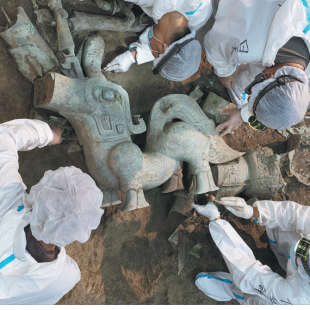
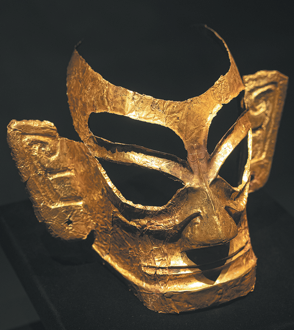
Researchers say the gold artifacts from Sanxingdui, all gold-silver alloys, were likely sourced from relatively stable placer gold deposits and refined through cupellation, an ancient method used to purify silver and gold.
The technique involves heating a lead alloy that contains gold or silver in a specially designed porous vessel made of bone ash or similar materials under a stream of air. The lead oxidizes into litharge, carrying away other impurities, and is absorbed by the vessel, leaving behind purified gold and silver. The total amount of gold discovered at Sanxingdui exceeds 2 kilograms — unmatched in China during the same period.
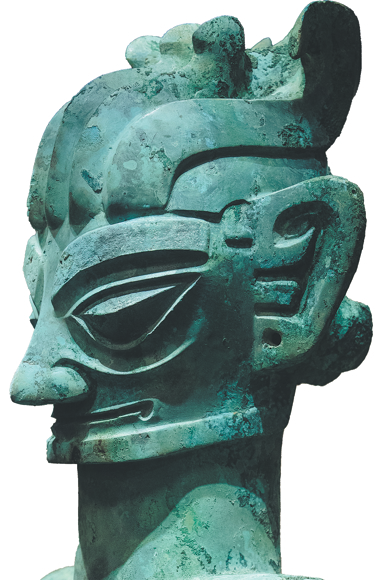
Gold masks were used not only on statues of humans but also as independent masks, the institute says.
In addition, the painted bronze artifacts from Sanxingdui, decorated with cinnabar and lacquer, are the earliest bronze-body lacquerware in China, it says.
Ivory objects have also been excavated from the site, and on the basis of understanding the preservation status, deterioration patterns and degradation mechanisms of the ivory unearthed from Sanxingdui, the institute developed on-site preservation and dehydration reinforcement technologies, enabling the ivory to be preserved and exhibited in a normal environment.
In the late Shang Dynasty, significant changes occurred in both the quantity and particle size of the tempering materials in the small flat-bottomed pottery jars in Sanxingdui. Additionally, the body proportions and rim shapes of the pottery began to show a high degree of standardization.
Evidence also demonstrates that early Sanxingdui inhabitants practiced intensive wetland rice farming. This agricultural base supported a dense population and fueled the rapid rise of Sanxingdui, the institute says.
Covering 12 square kilometers, the Sanxingdui site includes the remains of an ancient city, sacrificial pits, residential quarters and tombs.
Scholars believe the site was established 2,800 to 4,800 years ago, and archaeological discoveries confirm that it was a highly developed and prosperous political, economic and cultural center of the Shu Kingdom, as recorded in many ancient Chinese documents. In ancient times, Sichuan was known as Shu.
It had long been thought that Sanxingdui wasn't discovered until 1929, but this has since been proven to be incorrect, says Sun Hua, a professor at Peking University's School of Archaeology and Museology.
He explains that in 2023, Huo Wei, a distinguished professor and academic dean at the school of history and culture at Sichuan University, used university archives to write a paper proving that Sanxingdui was actually discovered in 1927, not in 1929 as previously believed.
In 1933, an archaeological team headed by David Crockett Graham, who came from the United States and then taught at West China Union University in Chengdu, Sichuan — now West China Medical Center of Sichuan University — carried out the first formal excavation work at the site after Yan Daocheng, a local villager, accidentally discovered Sanxingdui.
Yan, who lived in Guanghan, unearthed a pit full of jade and stone artifacts while repairing a sewage ditch on the side of his house.
Then, in 1984, archaeologists had a major breakthrough when the remains of large palaces and parts of the eastern, western and southern city walls were found. Two years later, two large pits full of bronze artifacts, including masks and figurines, were unearthed. More than 600 were found in pit No 1 and more than 4,000 in pit No 2. Since the end of 2019, six additional pits have been discovered and excavated in the same area.