



Lantern of legend takes flight
A mythical dragon-fish reborn as a glowing airborne masterpiece is a dazzling highlight of China's National Games, report Xing Wen in Zhuhai and Li Wenfang in Guangzhou.










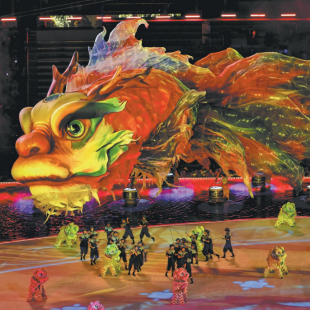
A colossal, multicolored lantern floated effortlessly into the Guangdong Olympic Sports Center, its dragon head fierce and eyes bold, fins flowing like waves. It was Aoyu — a legendary mythical creature with the head of a dragon and the body of a fish — brought vividly to life.
Against the dynamic backdrop of the stadium, with its sweeping lights and digital screens, the lantern created an immersive, dreamy spectacle, as if a giant Aoyu were gliding through the air.
Many viewers dubbed the moment "cyberpunk", and it quickly became a highlight of the opening ceremony for the ongoing 15th National Games of China, jointly hosted by Guangdong province, Hong Kong, and Macao.
"The sight of the Aoyu lantern floating across the stadium, while the audience lit their phone flashlights in response, left a lasting impression," recalled Angus Ng Hok-ming, chairman of the Guangdong-Hong Kong-Macao Greater Bay Area Youth Association, who was at the ceremony last Saturday.
The lantern's movement relied on an airbag system filled with a precisely calibrated mixture of helium and air.
Through repeated experimentation, technicians determined the optimal gas ratio to ensure the Aoyu could remain suspended midair for extended periods, allowing it to float and flip through the stadium, explained Wang Ruixiang, chief producer of the opening ceremony.
Its body consists of 128 independently controlled scales, each equipped with LED beads and sensors that enable them to change color and angle in response to musical rhythms and the live atmosphere. All these components are made from recyclable, eco-friendly materials.

Aoyu is a mythical creature from ancient Chinese legend. According to folklore, in ancient times, carp sought to leap over the Dragon Gate to transform into dragons. However, after swallowing a dragon pearl from the sea, they could only become creatures with a dragon's head and a fish's body — known as Aoyu.
In Lingnan (South China) traditions, Aoyu is an auspicious symbol, symbolizing both academic excellence and prosperity. Lingnan refers to the region encompassing Guangdong and Hainan provinces, the Guangxi Zhuang autonomous region, and parts of Yunnan and Fujian provinces.
Its image frequently adorns traditional architecture in the area.
"In Lingnan, especially on the roof ridges of ancestral halls, temples and traditional residences, it's common to see a pair of vividly crafted Aoyu ornaments — known as 'Aoyu Kiss' — placed at both ends of the ridge," says Ruan Chengyu, deputy head of the intangible culture protection department at the Guangzhou Cultural Center.
"They symbolize warding off evil, attracting good fortune, and preventing fires and disasters."
Zhong Dong, associate professor at the institute of ancient Chinese literature at Sun Yat-sen University, notes that the use and symbolism of Aoyu vary slightly across different regions in Lingnan.
In the Pearl River Delta, Aoyu is often used as decoration in academies and ancestral halls. In Chaoshan region, it is more like a guardian deity, frequently appearing in architectural porcelain inlays and gold-varnished wood carvings to symbolize protecting the home, preventing fires, and bringing good fortune and prosperity. Among the Hakka people, Aoyu motifs on building bases and beam brackets represent stability, growth and progress, he says.
In Panyu and Nansha districts in Guangzhou, an intangible cultural heritage known as the Aoyu dance is actively practiced. With a history spanning over 600 years, this tradition features performers wearing bamboo-and-paper props shaped as male and female Aoyu.




















