


The cultural master of Tinglin town
Scholar and historian is hailed for his original works that have been lost over time, but researchers are dedicated to breathing new life into his legacy, Wang Xin reports.










While most people are familiar with Confucius, few are aware of the existence of "Jiangdong Confucius" in the Yangtze River Delta region, a notable forefather of the Gu family that is spread across the area.
Gu Yewang (519-581), originally known as Gu Tilun, was a senior official, and a renowned geographer, philologist and historian who lived during the Liang (502-557) and Chen (557-589) dynasties.
Dubbed "the Confucius" of the eastern region of the lower reaches of the Yangtze River in a Song Dynasty (960-1279) poem, Gu is seen as an encyclopedic master of culture, who has cultivated and influenced a large number of renowned scholars, poets, artists, and others in ancient China.

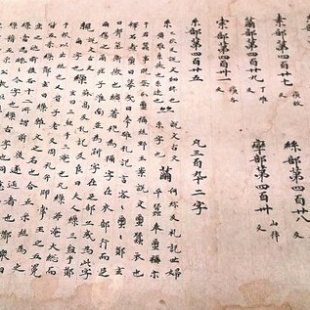
Among his dazzling achievements are the remarkable Yu Pian, or Jade Chapters, China's first regular-script dictionary, and Yudi Zhi, or A Gazetteer of Ancient China, a rare national geographical gazetteer from the 3rd to 6th centuries.
Although most of Gu's original works have been lost over time, citations and other later records solidly prove their existence and profound influence, continuously drawing crowds to Tinglin town in Shanghai's Jinshan district, where Gu once lived.

Jiang Zhiming, 63, head of Shanghai's Gu Yewang Research Institute since 2016, was born in Tinglin and has been engaged in the education sector for several decades. He has chosen to fully dedicate himself to researching Gu.
Jiang shares that Tinglin town boasts a long history, and the story between the town and Gu's distinguished family dates back even earlier to his ancestors. Gu traced his own ancestry to Gu Yong (168-243), the grand chancellor to Sun Quan, the king of the Wu State, during the Three Kingdoms (220-280) era. Tinglin is the hometown of Gu Yong, and is also where Gu Yewang lived for many years, completing many works.
"Born in a distinguished and growing family, Gu Yewang was talented and studious since his childhood, and started writing essays at age 9. He changed his name to Yewang after Feng Yewang, an accomplished mandarin scholar who lived during the Han Dynasty (206 BC-AD 220)," says Jiang.
Gu Yewang lived up to his name. During the Northern and Southern Dynasties (420-589), the coexistence and integration of various ethnic groups led to confusion in the use of written characters. Buddhism also introduced numerous new characters and terms. The translation of these various script styles, from seal script and clerical script to regular script, created gaps in daily reading and writing.
In such a context, the very young Gu Yewang was assigned the imperative task of standardizing character forms and unifying standards. He spent five years completing it, finishing the masterpiece Yu Pian at the age of 24.
It is particularly worth noting that the ancient dictionary does not only have profound influence passed down through generations and eras in China, but has also greatly influenced the languages and cultures of some other nations, such as South Korea and Vietnam, according to He Huazhen, professor and deputy director of the Research Center for the Civilization of Chinese Characters at Zhengzhou University.
"Yu Pian is a bridge connecting China and other nations that used Chinese characters. As a carrier of Chinese classics, it can be seen as a cultural heritage shared by all of Asia, providing the footprints for spreading and localizing Chinese characters," says He.
He adds that Chinese characters serve as the basis of the languages, and then books, cultures, philosophies, and social and political systems. In East Asia, there is a unique cultural phenomenon known as "writing conversations", which allows people who speak different languages to communicate through writing.