Stepping up to the plate
China's role and responsibility amid unprecedented global changes









The Recommendations of the 20th Central Committee of the Communist Party of China for Formulating the 15th Five-Year Plan (2026-30) for National Economic and Social Development point out that "China is in a period of development where strategic opportunities coexist with risks, challenges, uncertainties and unforeseen factors, all of which are on the rise."
Faced with the question of "what is happening to the world, and what should we do", China is taking proactive actions to inject stability and certainty into the turbulent world.
China's international role has always been closely linked to its own development stage. Since the launch of reform and opening-up in 1978, China has leveraged the stable environment provided by the existing international system to achieve rapid development, thus emerging as a beneficiary of this order. With the sustained growth of its comprehensive national strength, China's role has undergone a subtle qualitative shift: from a passive adapter to the system to an active shaper, and from a beneficiary of global stability to a contributor to upholding the international order. By providing the world with stable policy orientations, and an inclusive approach to cooperation, China has contributed to infusing vitality into the world through the certainty of its own development.
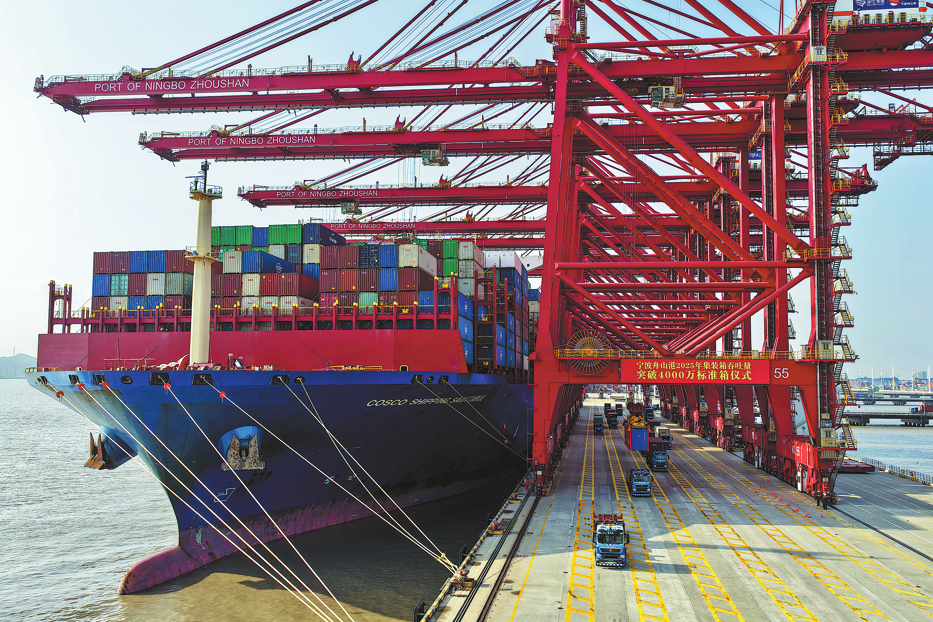
During the 14th Five-Year Plan period (2021-25), China has delivered remarkable results in various aspects. In the economic field, relying on its super-sized market and complete industrial system, China accounted for roughly 30 percent of global economic growth. China has deepened its opening-up and shared market opportunities with the world by hosting events such as the China International Import Expo and the China International Fair for Trade in Services. Accounting for approximately 13.3 percent of global imports, China provides a valuable source of demand for countries around the world.
In the security field, as a permanent member of the UN Security Council, China has deployed the largest number of UN peacekeepers, and it is also the second-largest contributor to UN peacekeeping funds. China has demonstrated its wisdom in resolving hotspot issues, such as successfully mediating the resumption of diplomatic relations between Saudi Arabia and Iran, calling for the peaceful resolution of the Israel-Palestine conflict, and advocating for peace talks to solve the Ukraine crisis.
In the governance field, the concept of a community with a shared future for humanity and the four global initiatives — Global Development Initiative, Global Security Initiative, Global Civilization Initiative and Global Governance Initiative — have won broad international recognition. Those initiatives provide a systematic solution to enhance global governance. Emerging multilateral financial institutions, such as the Asian Infrastructure Investment Bank, have injected new vitality into global governance. In the development field, Chinese modernization has broken the myth that "modernization equals Westernization". The Belt and Road Initiative has provided development opportunities for other countries in the Global South since 2013, having created more than 420,000 jobs collectively for participating countries. These practices break away from the Western mindset of a zero-sum game and forge a new paradigm of international relations characterized by win-win cooperation.
In its journey to infuse vitality into the world, China faces certain challenges coming from external strategic pressure. China's efforts are often misinterpreted by established major powers as a challenge to the United States' hegemony. Some Western countries have erected barriers through measures such as "decoupling policies" and "small yard, high fences", attempting to maintain the dominance of the US through technological blockades, trade restrictions and alliance expansion. Such asymmetrical confrontation not only raises China's costs of participating in global governance but also threatens to destabilize the international system in the future.
In response to this, China can take pragmatic and targeted actions in the next five years.
First, deepen opening-up through rule integration to break down collaboration barriers. One-way rule alignment can be gradually replaced by two-way rule integration that facilitates the mutual adaptation of domestic regulations and international trade rules. China can offer more Chinese solutions to advance the development of the international rule-based system.
Second, the supply model of public goods should be innovated to focus on actual needs. A research mechanism can be established targeting the demand side of other developing countries, transforming services in areas such as infrastructure, green energy, and public health into standardized project modules that can serve as replicable case studies for other Global South countries. Additionally, the AIIB can be encouraged to set up a "small-sum fast-approval channel", attracting small — and medium-sized economies to participate in the Belt and Road construction, and fostering a sound ecosystem of demand and supply.
Third, a cooperation network oriented toward specific topics can be established. This network should focus on pragmatic areas in specific fields such as climate change, public health and the digital economy, through which China can carry out in-depth collaboration with other countries. Furthermore, consensus can be built through the achievements of this network, and it could form a cohesive force around these topics.
Fourth, a multi-stakeholder collaborative evaluation system can be established. This evaluation mechanism should encourage the joint participation of various stakeholders, including governments, enterprises, and think tanks to establish risk mitigating measures and prevent the reverse transmission of external risks.
Zhai Kun is a professor at the School of International Studies and the deputy dean of the Institute of Area Studies at Peking University. Hu Xin is an assistant research fellow at the National Institute for South China Sea Studies. The authors contributed this article to China Watch, a think tank powered by China Daily.
The views do not necessarily reflect those of China Daily.
Contact the editor at editor@chinawatch.cn.