Reference model for practical approach to climate action










The United States has announced its withdrawal from 66 international organizations, with the White House declaring that 31 United Nations and 35 non-UN entities "no longer serve American interests".
Many of these bodies, however, are vital to humanity's shared future, particularly those confronting the interconnected crises of climate change, biodiversity loss and pollution. This includes the UN Framework Convention on Climate Change, a treaty that underpins international efforts to combat global warming.
The US, which is the largest historical emitter of greenhouse gases, has also withdrawn from the landmark 2015 Paris Agreement for the second time. As the world's second-largest annual carbon emitter, the US' exit from global efforts to limit greenhouse gas emissions and curb dangerously rising temperatures represents more than a diplomatic departure; it shatters trust and constitutes a default on its responsibility to help less developed countries mitigate the effects of climate change.
The Paris treaty explicitly reaffirmed the commitment of developed nations — initially made in 2009 and extended through 2025 — to mobilize $100 billion annually by 2020 to help developing countries better manage the impacts of climate change. Yet this pledge has seldom been honored in practice.
Against this backdrop of broken promises, developed countries pledged $300 billion annually by 2035 at the 2023 UN climate change conference in Dubai. The figure still falls drastically short of the over $1 trillion in assistance called for by developing nations. The US' withdrawal from the Paris pact has made the inadequate pledge of $100 billion more elusive, while the prospect of mobilizing the $1 trillion truly needed has become more remote.
The US decision to abandon the UNFCCC strikes another blow to climate efforts, further trapping developing nations in the worsening crisis.
This moment of fracture reveals a deeper truth: the path forward must transcend reliance on uncertain aid and instead embrace a dual imperative. While developed economies must be held accountable for their commitments, developing nations must also accelerate the creation of sustainable, self-reinforcing economic models to finance climate resilience.
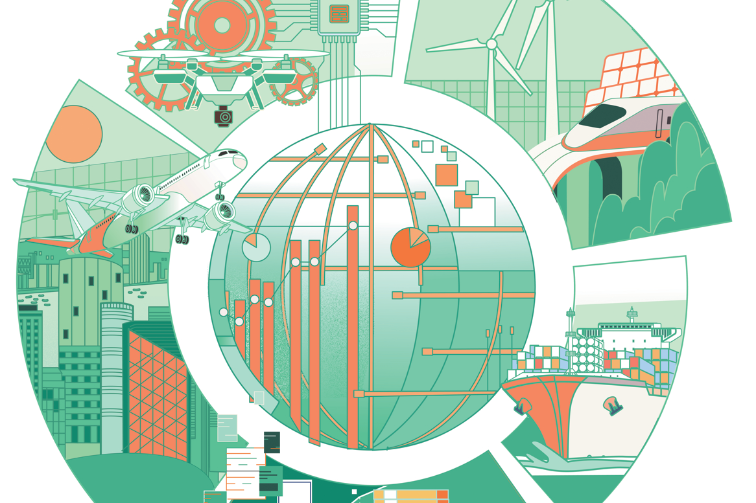
What is urgently needed is a shift toward investment-driven green transition frameworks. China's experience provides a reference here. The country has developed a practical nexus of policy, finance, market instruments and industrial scaling from which other countries can draw inspiration.
China's unparalleled success in scaling renewable energy, for instance, offers a critical lesson in how targeted policy can act as a catalyst for industrial transformation, even in capital-constrained environments.
More than four decades ago, lacking the necessary technology and research and development capabilities, China was only able to manufacture microturbines for off-grid power generation. But now, the country supplies roughly 70 percent of the world's wind power equipment.
This achievement is due to the consistent, systematic and stage-specific policies that have built a resilient renewable ecosystem from the ground up. A cornerstone of this approach was the feed-in tariff — a guaranteed above-market price for solar and wind power, funded through a small surcharge on electricity bills.
Over the past decade, China's efforts have lowered the global costs for wind-generated electricity by approximately 60 percent and for solar-generated electricity by 80 percent.
China's model affirms a crucial insight: well-designed public policy can drive radical cost reduction. This policy-first approach offers developing countries a tangible blueprint for building climate-resilient economies from within. The goal is not to replace global cooperation, but rather to redefine it, shifting to a paradigm of engineering shared and sustainable prosperity.