KUNMING - For Sun Yunhua, the country roads of Yunnan not only take him home, but also reveal a thoroughfare toward prosperity.
After running a furniture business in Laos for many years, the Yunnan-born businessman has decided to enter the floral and tourism industries back in Yunnan, as he senses a business boom taking off in his home province in Southwest China.
"China has launched a strategy to build Yunnan into a gateway for South and Southeast Asia, which will bring more favorable and open policies to the province," Sun says.
Sun's optimism is shared by 35,000 businesspeople from 31 Asian countries and regions attending the ongoing China Kunming Import & Export Fair (Kunming Fair), where they have clinched $179.1 billion in contracts on investing in Yunnan's mining, energy, tourism and infrastructure sectors.
Despite the economic slowdown China is currently experiencing, Chinese and foreign entrepreneurs are eyeing new opportunities as the country has pledged to expand the opening-up of its southwestern border regions.
Although it is an area long marked by poverty, Southwest China is nevertheless believed to have huge yet untapped potential. It is also geologically close to South Asia and Southeast Asia -- regions China is looking to boost trade with in order to buffer the effects of waning Western demand.
Massive infrastructure projects are currently in full swing to complete the transport and logistic networks in Yunnan, which positions itself as the "bridgehead" on the opening up of Southwest China.
Construction has begun on 12 railroads connecting Yunnan with other parts of China as well as Myanmar, Laos and Vietnam, and these projects are "making progress," said Li Jiming, vice head of the Commercial Department of Yunnan.
Yunnan is also building a financial center to facilitate trade between China and South and Southeast Asia. Last year, 85 percent of local companies in the import and export sector got approvals to settle their foreign trade using renminbi, or yuan, China's currency.
Favorable winds are also blowing throughout other southwestern provinces and autonomous regions, including Guangxi and Guizhou, where officials have promised favorable investment conditions.
"Guizhou has rolled out new measures on land supply, tax reduction and support services, which are all to better serve our investors," Meng Qiliang, vice governor of Guizhou, said at the fair.
From backwater to bonanza
In addition to the need to boost the local economy, experts say the goal of sustaining rapid growth nationally is also prompting China to develop its southwest regions at a faster pace.
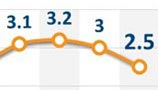
China's GDP growth eased to 8.1 percent year-on-year in the first quarter of 2012, down from 8.9 percent in the fourth quarter of last year and marking the weakest pace in nearly three years.
With the country's urban real estate sector in the doldrums and manufacturers in eastern China distressed by surging costs and an energy crunch, analysts say the government has to look beyond the wealthy coastlines for new power engines.
Central China, with its mature infrastructure, low labor costs and a rising market, has already been designated as a hot spot for foreign investment and industrial transfers from the coastal areas.
However, in mountainous Southwest China, where natural and human resources are abundant, poor infrastructure and a lack of modernization have long curbed efforts to buoy the local economy, says Wu Conghu, a researcher with the Yunnan government.
About 100 years after the first railway was built in Yunnan to link it with Vietnam, the province has rail lines in only 7 of its 16 cities and prefectures, making it the second-least-developed Chinese province in terms of railway connectivity, Wu says.
Its utilization of water resources and the urbanization level are also far below the national level, he adds.
But such backwardness has left huge space for development, and heavy investment in the region can benefit the economy of the entire country, says Xiao Xian, vice president of Yunnan University.
"The development of the southwest will bring access to its enormous natural resources, boost infrastructure construction and bolster a range of industries," says Wang Chongli, a researcher at the Yunnan Academy of Social Sciences.
Wang said the "advantage of backwardness" also means that the southwest will rise more quickly than many have imagined.
"China has gone through 30 years of opening up and industrialization, amassing enormous experience and capital that the southwest can draw from to ensure a smoother and healthier path of development," Wang says.
Regional cooperation
At the Kunming Fair, officials and entrepreneurs from other Asian countries are also showing support for the opening up of China's southwest, through which their goods can more easily enter the Chinese market.
Myanmar Ambassador to China U Tin Oo said at a Thursday conference that infrastructure projects in the Greater Mekong Sub-region (GMS), including the Kunming-Singapore railway, would "definitely enhance cooperation among GMS countries."
"I believe that connecting Yunnan with GMS countries by strengthening and facilitating trade and investment connections will generate endless opportunities among GMS countries," says Admiral Thomrat Hatayodom, vice chairman of GMS Business Council.
Last year, China's bilateral trade with the Association of Southeast Asian Nations (ASEAN) topped $362.9 billion, marking a 23.9-percent rise year on year, while its trade with South Asia also increased by 20 percent year on year in 2011.
The bustling trade and complicated political situations in Asian regions have prompted China to strengthen economic ties with these countries by developing the country's southwest.
In 2010, China launched the Bridgehead Strategy to build Yunnan, which borders Myanmar, Laos and Vietnam, into a social and economic corridor toward South Asia and Southeast Asia.
But unlike eastern China, where the economy relies on investment and demand from the Western world, experts say China's southwest must "go out" and lift its neighbors to affluence before its own economy can take off.
To this end, China must encourage its companies to invest in these Asian countries, increase imports from them and take the lead in building shared infrastructure, such as cross-border railways, experts say.
"What the southwest mainly opens up to are the less-developed countries in South Asia and Southeast Asia, and China can not perfect itself while leaving its trade partners behind," Wang Chongli says.

Copyright 1995 - . All rights reserved. The content (including but not limited to text, photo, multimedia information, etc) published in this site belongs to China Daily Information Co (CDIC). Without written authorization from CDIC, such content shall not be republished or used in any form. Note: Browsers with 1024*768 or higher resolution are suggested for this site.
License for publishing multimedia online 0108263 Registration Number: 130349