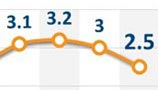
To arrest the economy's slowdown, Beijing has, in the last couple of weeks, cut interest rates, approved more investment projects and drawn up new incentives for consumer spending.
|
|||
One thing that they are particularly concerned about is another bubble in the urban real estate market.
In a commentary in the People's Daily, Xu Hongcai, an economist with the China Center for International Economic Exchanges, said a bubble-prone industry like real estate development is an unfit engine for the economy. For if a nationwide bubble bursts, it will hurt the economy so deeply that it would probably take one to two whole decades to recover fully.
Meanwhile, in the China Economic Times, an editorial warned that if China moves to ease property curbs, it will be "like trying to quench one's thirst by drinking poison".
The government should stick to all its existing measures to keep down the general price level of the urban housing market, said the newspaper, which is owned by the State Council Development Research Center. It said it was erroneous that real estate development was once called a pillar of the national economy.
That error, as amply proved, caused the inflating of the housing bubble, and many local governments' excessive dependence on land auctions for revenue. The editorial called it "a vicious cycle".
A correct method of development would be to link to the real economy, rather than the virtual economy, which includes speculative investment in property. Until new channels of investment become available, China would remain vulnerable to such speculative money, the editorial said.
Making change first
Is China's economy heading for a hard landing? Will there be a further slowdown now that Europe is poised on the brink of a bigger crisis that may hurt China's exports in a bigger way?
Such questions are being asked by many people. But there are worse problems, said He Jun, an economist with Anbound, an independent consulting service in Beijing.
China's priority has been to shift from its past growth model, which put excessive emphasis on exports, to a new growth model led primarily by domestic consumption, the economist said.
No scenario can be worse than a failure to change the growth model during a slowdown, the economist was quoted as saying by the financial information website Caijing.com.cn.
He said there should be "no mercy" for the smokestack industries such as electrolytic aluminum, calcium carbide, coking and iron-based alloys. They should be phased out by administrative force.
A differentiated approach should be taken regarding industries with excess capacity. The government should support the overseas relocation of part of China's manufacturing capacity for vehicles, garments and home appliances.
Industries more closely tied to fixed-asset investment - such as steel, cement and non-ferrous metals - should remain under more rigorous control, with no new investment permitted.
Caijing.com.cn also quoted Zhong Wei, economist and director of the Beijing Normal University's center of finance and economics, as saying China should have regret for the hasty stimulus program (as much as 4 trillion yuan, or $623 billion, from the central government) it came up with following the outbreak of the global crisis in 2008
Large incentives and heavy investments were made, only to duplicate the old growth model.
The current slowdown is in part a result of the kind of stimulus pursued three years ago, or a consequence of "treating the head for a headache and treating the foot for a foot pain" - a method China's traditional doctors always criticize for a lack of systematic understanding of a problem, Zhong said.
In comparison with the past three years, the situation now is more worrisome only on the microeconomic level, seen primarily in the difficulties many companies have run into."The government should focus on reform," Zhong said, so it can show how progress can actually be achieved.
Expensive lesson
Although the economy is in a slowdown, another 4-trillion-yuan stimulus package is definitely not what it needs, according to a column in China Business News.
Now the National Development and Reform Commission is approving new fixed-asset investment. But it should be pointed out that, when local government debt has piled up and companies are less interested in borrowing than banks are in lending, government-backed investment projects have a limited role in driving economic growth.
The real powerhouse of China's economic growth is domestic consumption. But to tap its potential fully, the government must provide better and more comprehensive social security policies for low-income families, so that they will have more to spend.
A temporary stimulus doesn't provide any help in this direction. So, there is no need for investors to wait. The 4 trillion-yuan stimulus package isn't going to make a comeback.
For more subscription details of China Banking, please visit our E-Shop.

Copyright 1995 - . All rights reserved. The content (including but not limited to text, photo, multimedia information, etc) published in this site belongs to China Daily Information Co (CDIC). Without written authorization from CDIC, such content shall not be republished or used in any form. Note: Browsers with 1024*768 or higher resolution are suggested for this site.
License for publishing multimedia online 0108263 Registration Number: 130349