The dispute between China and Japan over the Diaoyu Islands has triggered large demonstrations in several Chinese cities, with many protestors calling for a boycott of Japanese products in response to Japan's illegal occupation of the islands.
This calls for some serious thought. A country's import capacity is one of its sources of power. The higher its imports, the greater its potential influence will be on the exporting country. To secure its overseas market, an exporting country's government and enterprises have no option but to accept the rules and laws - some times even at odds with their own - set by the importer. The Toyota quality crisis in the United States two years ago is a case in point.
In this regard, boycotting Japanese products would be a practical approach to punish Japanese right wing activists for trying to arouse ultra-nationalist sentiments in Japan. China, strong as it is today, is indeed in a position to use its "importer's power". It is, after all, the world's second largest importer and its annual import growth rate is more than twice of that of the world average in the past decade.
Also, China's current account surplus and foreign exchange reserves (largest in the world) will ensure that it retains its huge import capacity. This is especially true when it comes to Japan, because China is one of the largest markets for Japanese products.
But importer's power will be effective only if goods can be easily accessed in other markets or if the importing country's industries can produce substitutes. That's why the US uses the extraterritorial application of Anti-Trust Law to impose sanctions on other countries' companies and make them pay up to hundreds of millions of dollars as fine. But the US dare not use it against organizations such as OPEC, which dominate or control the market of an irreplaceable resource.
The importer's power that China has in its economic exchange and trade with Japan is limited because it does not have the capacity to produce substitutes for a majority of the Japanese goods it imports.
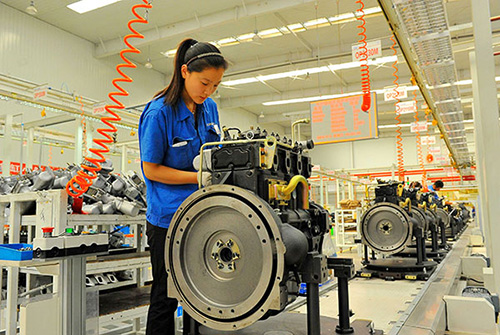
Many of Japan's exports to China are intermediate inputs and manufacturing equipment. Consumer goods make up only a small part of Japanese exports to China. Moreover, in the field of advanced manufacturing, Japan is in a commanding position as the major provider of intermediate inputs and manufacturing equipment, especially for industries like automobiles and electronics. That's also why last year's earthquake in Japan triggered price fluctuations in the global electronics market.
Last year, China imported $194.6 billion worth of Japanese products, of which electro-mechanic and audio and video equipment accounted for 48 percent; base metal materials and products, 11 percent; vehicles, aircrafts, ships and transportation equipment, 9 percent; and optic, medical apparatus, watches, clocks and musical instruments, 8.6 percent.
Besides, Japan controls more than 70 percent of the global electronic materials' market. For example, two Japanese companies supply more than half of the world's semiconductor silicon wafer, a crucial parent material for integrated circuit chips.
It is difficult for China to find substitutes for most of the products it imports from Japan. Under such circumstances, blindly boycotting Japanese goods by giving way to sentiments could harm our own industries and exports, and reduce employment. Before boycotting Japanese goods we have to accelerate the development of China's advanced manufacturing sector.
Generally, a large part of the success of China's production industries and exports can be attributed to "Japanese core components". The international industrial division chain of Japanese core components - Chinese processing - and global sales decide China's trade deficit with Japan and dependency on Japanese materials.
In the wave of global industrial transfer and domestic industrial upgrade, China has emerged as a hot spot for investment in new industries, thanks to positive factors such as good human resources, sound industrial system, excellent infrastructure, and a stable political and macroeconomic environment. At such a time, boycotting products from Japan or any other country blindly will harm the normal operation of the transnational industrial chain and create impediments for the production and management of advanced manufacturing.
Without clearly understanding China's weak points and the global situation, boycotting Japanese goods will only result in a Pyrrhic victory. Instead, Chinese consumers can help their country exercise its importer's power by selectively replacing some consumer goods from Japan, especially those made by right-wing companies, with national brands.
We know we are right, but we should not hurt ourselves in the process of punishing the Japanese wrongdoers. And the few compatriots who have vented their anger by smashing Japanese brand cars on streets should be condemned for breaking the law.
We should probe deeper to understand the complexity of global competition, especially in the Northeast Asian region that revolves around four global powers - the US, China, Russia and Japan. Intensifying a dispute between any two of them will only benefit the others, especially the one with hegemonic ambitions.
Also, we should not do anything that would fan Japanese right wing activists' passions, because it could widen the divide between Japan's faction-ridden government and make it more difficult for it to resolve conflicts such as the one with China over the Diaoyu Islands. Japanese Prime Minister Yoshihiko Noda and his cabinet have been passive despite the hue and cry raised by right-wingers, led by Tokyo Governor Shintaro Ishihara who initiated a plan in April to "purchase" the islands.
So we should believe in ourselves and, given our political stability and greater development potential, take measures to better protect our national interests.
The author is a researcher with the Chinese Academy of International Trade and Economic Cooperation under the Ministry of Commerce.
(China Daily 08/24/2012 page9)

Copyright 1995 - . All rights reserved. The content (including but not limited to text, photo, multimedia information, etc) published in this site belongs to China Daily Information Co (CDIC). Without written authorization from CDIC, such content shall not be republished or used in any form. Note: Browsers with 1024*768 or higher resolution are suggested for this site.
License for publishing multimedia online 0108263 Registration Number: 130349