Enforcement planned to ensure workers get what they are due
 |
|
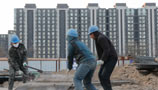
A worker at a railway construction site in Ningbo drinks water to protect himself against the high temperature and scorching sun on July 29. Hu Xuejun / for China Daily |
Wang Jianzhong said he can't work anymore if high temperatures hit again.
The 32-year-old deliveryman at a logistics company in Chongqing rides his motorbike at least seven hours a day.
In July, Chongqing saw 25 days in which the temperature surpassed 35 C, according to the city's meteorological bureau. The temperature hit 40 C in some places in the city in August.
"The weather is so hot that I sweat almost every minute during work," Wang said. "I feel thirsty no matter how much water I drink."
Although he works outdoors for a long time every day, Wang said he had never received a high-temperature subsidy from an employer.
The subsidy is mandatory, according to a revised government regulation that took effect in June.
"I've never heard of anyone in my company ever getting such a subsidy. My salary is decided only by the quantity of goods I deliver," he said. "But the boss sometimes give us mineral water and anti-sunstroke medicine on hot days."
The regulation stipulates that employers should grant subsidies to workers who work outdoors where the temperature is above 35 C, and those at workplaces where the temperature is above 33 C. Each place's labor authority is responsible for setting local subsidy standards, the regulation says.
In East China's Jiangxi province, the subsidy has recently been increased from 120 yuan ($18.90) to 240 yuan a month. Also, workers can get the subsidy for four months, instead of three, starting this year.
Holding back the subsidy will be considered defaulting on wages, according to local labor authorities.
In July, Southwest China's Sichuan province adjusted its local subsidy standard from 6 to 10 yuan a day to 8 to 12 yuan. Companies that do not pay the high-temperature subsidy will be severely punished, according to the regulation made by local labor authorities.
In fact, Wang is by no means the only one who has been deprived of his subsidy.
According to a survey conducted by China Youth Daily this month, of the nearly 2,800 people surveyed, 82 percent have not received a high-temperature subsidy this year.
Only 5 percent of people polled have turned to employers to ask for the subsidy, and less than 3 percent have appealed to local labor authorities, the survey found.
Another survey recently taken by Daguu, a website mainly offering grassroots positions for laborers, showed that among the 1,570 workers polled in Guangzhou, 60 percent did not even know the subsidy exists.
Workers in food and catering and logistics sectors are those most likely to be deprived of the high-temperature subsidy, the survey found.
The survey also found that many employers give workers anti-sunstroke medicine and beverages instead of the subsidy.
Zhang Quan, a 25-year-old security guard at a residential community in Beijing's Fangzhuang area, said he could not bear the hot summer, even sitting in the duty room where there is only an electric fan.
"I could earn only 1,500 yuan a month," he said. "It's a risk to ask my boss for the high-temperature subsidy. What if he fires me because of my complaint?"
An official with Beijing Administration of Work Safety, who gave her surname as Duan, said that her organization opened a hotline to receive work-safety related complaints and consultations in 2009, but it has not received any complaints related to the high-temperature subsidy.
"We only received a couple of calls from enterprises to ask about the subsidy standard and the way to grant the subsidy when the new heat regulation took effect," she said.
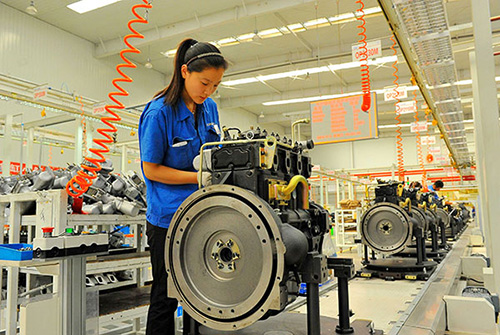
Zhao Wei, a labor expert at Beijing Normal University, said her study showed that big companies in the manufacturing sector will generally hand out high-temperature subsidies, but most construction workers do not get the money.
"Construction workers, most of whom come from rural places to make a living in the city, are happy to get their wages on time," she said.
"They would not think about receiving a high-temperature subsidy, and they do not even know about it."
Zhao said some workers do not even sign an employment contract with contractors, so a high-temperature subsidy exists only in name for them.
"The cost of breaking the rules is low for employers," she said.
In Chongqing, employers who do not provide high-temperature subsidies face a fine of 1,000 to 30,000 yuan. In Guangdong, violators can be fined 2,000 to 10,000 yuan.
"Such a fine is sometimes less than the high-temperature subsidies they have to pay, so they would rather be fined than give workers the money," said Zhao. "In many cases, they would not receive punishment at all because of inefficient supervision."
The expert called for more severe punishment for violators and more efficient supervision by work safety and labor authorities to boost enforcement of the law.
Trade unions should play a bigger role in this regard and should inform workers to ask bosses to include the high-temperature subsidy in collective contracts, she said.
chenxin1@chinadaily.com.cn

Copyright 1995 - . All rights reserved. The content (including but not limited to text, photo, multimedia information, etc) published in this site belongs to China Daily Information Co (CDIC). Without written authorization from CDIC, such content shall not be republished or used in any form. Note: Browsers with 1024*768 or higher resolution are suggested for this site.
License for publishing multimedia online 0108263 Registration Number: 130349