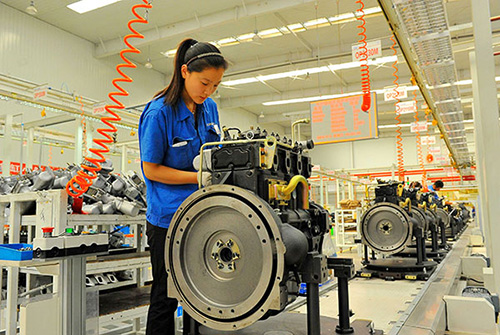
Workers at a fan and ventilation machine plant, a China-Germany joint venture, in Nantong, Jiangsu province. China remains a strong and attractive market for foreign investors, despite reports that growing numbers of international companies, particularly manufacturers, have been considering pulling out of the market. [Photo/China Daily]

Trend of foreign?firms returning is temporary, economist says
Officials at the Ministry of Commerce have insisted that China remains a strong and attractive market for foreign investors, despite reports that growing numbers of international companies, particularly manufacturers, have been considering pulling out of the market, as their own nations' economies suffer.
Shen Danyang, the ministry spokesman, told a news conference before the start of the four-day 16th China International Fair for Investment and Trade, to begin on Saturday in Xiamen, Fujian province, that some developed countries have already been encouraging their own organizations to consider reinvesting, or "reshoring", back in their own markets, as a boost to their own struggling sectors.
The United States launched its own official "Reshoring Initiative" in 2010, and according to one recent survey, as many as 39 percent of companies operating abroad were reported to be considering moving some manufacturing back to the US.
While this kind of policy could have an effect on China, Shen said that the ministry considers it to be "limited", and that the country still remains attractive to foreign direct investment in the medium and long term.
"Growing efforts by the United States and the European Union to boost their own domestic manufacturing sectors will surely have some impact on Chinese attractiveness of FDI.
"But that will be limited, owing to the differences in industrial structures between China and the US and countries in the EU, and the manufactured products in question," he said.
Sang Baichuan, director of the Institute of International Business at the University of International Business and Economics in Beijing, disagreed.
Sang said that this "reindustrialization" of some developed economies will more likely lure back companies involved, for instance, in IT or innovation, best-suited to creating jobs at home, with businesses involved in more labor-intensive industries still happy to keep their investments in China.
"This will affect China's industrial upgrading and ongoing economic restructuring in addition to reducing FDI flowing into China.
"The reshoring of manufacturing has started to take effect, so the government must take immediate measures to optimize the business environment and reduce investment costs," Sang added.
In Asia, South Korea announced policies in April aimed at enticing more of its companies to come home and invest.
A group of 14 South Korean jewelry and accessory companies pulled out of Qingdao in East China in late August, for instance, the first time any companies from the country had jointly pulled out of investments in China.
The companies concerned blamed the worsening business environment in China, including rising costs and the appreciation of the yuan, as well as the favorable incentives being offered in South Korea, helped by free trade agreements which came into force with the US and EU in 2011, according to a report in Korea JoongAng Daily.
Wang Haifeng, director of international economics at the Institute for International Economic Research, which is affiliated with the National Development and Reform Commission, agreed with Shen, and said that he too considers any trend by foreign firms to return home as temporary.
Foreign direct investment into China declined 8.7 percent in July from a year earlier to $7.58 billion, the eighth drop in nine months and the smallest inflow since July 2010, according to the ministry.
But Shen emphasized that Chinese manufacturing attracted 45.2 percent of FDI in China from January to July, which is almost the same as previous years, showing that there has been no significant capital withdrawal from Chinese manufacturing at the time being.
"In the medium and long term, China still retains competitiveness in attracting FDI," Shen said.
"Despite rising operating costs, which are actually relatively low compared with other developed economies, China has a huge domestic market and a well-developed industrial structure as well as a labor supply which is rising in quality."
Contact the writer at lijiabao@chinadaily.com.cn

Copyright 1995 - . All rights reserved. The content (including but not limited to text, photo, multimedia information, etc) published in this site belongs to China Daily Information Co (CDIC). Without written authorization from CDIC, such content shall not be republished or used in any form. Note: Browsers with 1024*768 or higher resolution are suggested for this site.
License for publishing multimedia online 0108263 Registration Number: 130349